

TL;DR
- You have the right to choose your own towing company after an accident in Milwaukee, exercise it
- Average towing costs in Milwaukee range from $75 to $350+ depending on distance, time of day, and vehicle condition
- Insurance coverage for towing depends on your policy type collision coverage and roadside assistance add-ons are the most applicable
- Wisconsin towing laws protect you from predatory billing, unauthorized vehicle holds, and improper lien practices
- Damaged vehicle towing requires specialized equipment always insist on a flatbed truck for seriously damaged vehicles
- Acting quickly, contacting your insurer within 24 hours is the single most important step to controlling storage costs
Being involved in a vehicle accident is one of the most stressful experiences any driver can face. In those chaotic first moments after a crash, you may be dealing with physical shock, property damage, and a flood of urgent decisions all at once. One of the most immediate concerns is getting your damaged vehicle safely off the road and into professional hands.
Whether you’re a Milwaukee resident, a commuter passing through the metro area, or a visitor traveling on Wisconsin highways, understanding how accident towing services work and what your rights are can save you hundreds of dollars and prevent you from being taken advantage of during a vulnerable moment.
This comprehensive guide covers everything you need to know about towing after an accident in Milwaukee: from what happens in the first minutes after a crash, to average towing costs, what your insurance will and won’t cover, Wisconsin state towing laws, and exactly what legal rights you have as a vehicle owner. We’ve also included a detailed breakdown of how to choose a trustworthy towing company and what red flags to watch out for.
By the end of this guide, you’ll be fully equipped to handle post-accident towing confidently protecting your finances, your vehicle, and your legal standing.
Related Articles:
Ultimate Milwaukee Driver’s Guide: Road Safety, Winter Driving & Local Towing Information
What Happens After a Car Accident in Milwaukee? The First Steps
Immediate Safety First
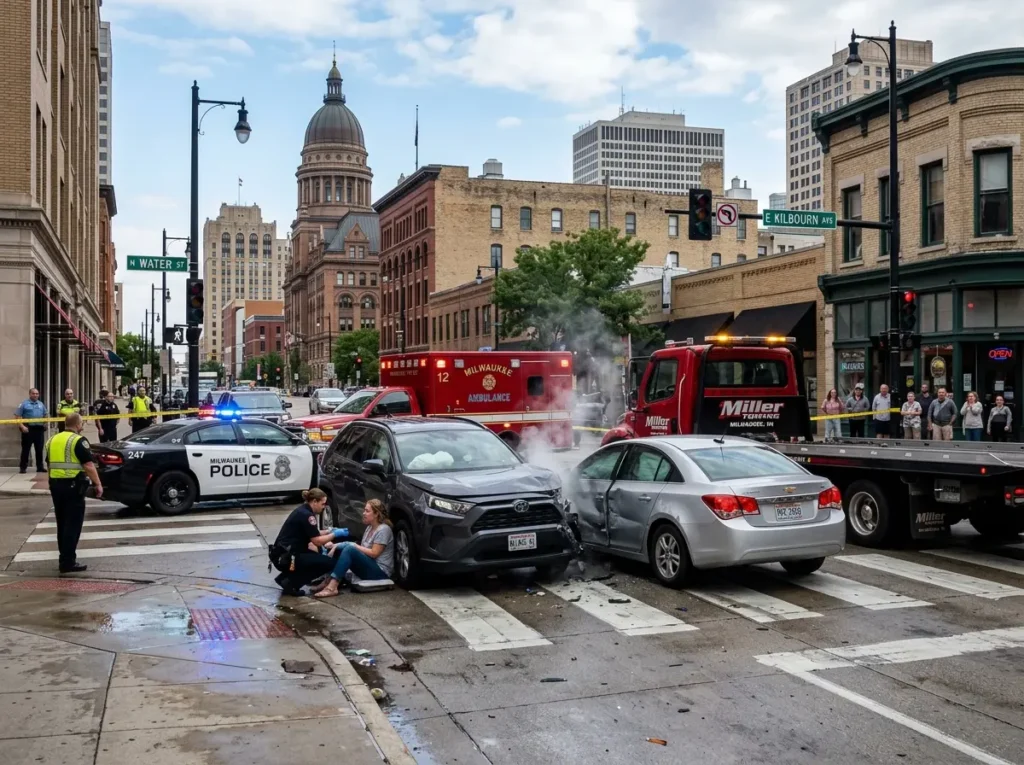
Before anything else, your first priority after an accident is safety. If you are able to move, get yourself and any passengers to a safe location away from traffic. Turn on your hazard lights and, if available, place road flares or warning triangles to alert other drivers.
Call 911 immediately if there are injuries, if the road is blocked, or if any vehicle is leaking fuel or fluids. Even for minor accidents, it is strongly recommended to file a police report in Milwaukee, as this documentation becomes critical for insurance claims and any future legal proceedings.
When Does Towing Become Necessary?
Not every accident requires emergency accident towing, but many do. Your vehicle will likely need to be towed if:
- The vehicle is undriveable due to structural or mechanical damage
- Airbags have deployed (indicating significant impact)
- Fluids are leaking and the car cannot be safely operated
- A wheel, axle, or suspension component is visibly damaged
- Law enforcement deems the vehicle unsafe for road travel
- The vehicle is blocking traffic and must be moved immediately
- Your vehicle sustained frame or body damage that affects steering
In many accident scenarios in Milwaukee, local police will dispatch a tow truck through their rotational dispatch system, meaning you may not always get to choose which towing company arrives. Understanding this process is critical to protecting your interests.
The Police Dispatch Towing System in Milwaukee
The Milwaukee Police Department maintains a list of approved towing companies that are dispatched on a rotational basis when an officer at the scene requests a tow. These companies are licensed by the City of Milwaukee and are required to adhere to regulated rate schedules.
However, just because a tow truck is police-dispatched does not mean the company has your best financial interests in mind. Always ask for documentation and a written estimate before allowing your vehicle to be towed to a specific storage facility.
| Pro Tip from MG Towing & Recovery: You always have the right to request a specific towing company before your vehicle is moved, as long as the vehicle does not pose an immediate safety hazard to the public. Exercise this right early once a competing tow truck has your car on the hook, it becomes more complicated. |
Understanding Accident Towing Services in Milwaukee
1. What Are Accident Towing Services?
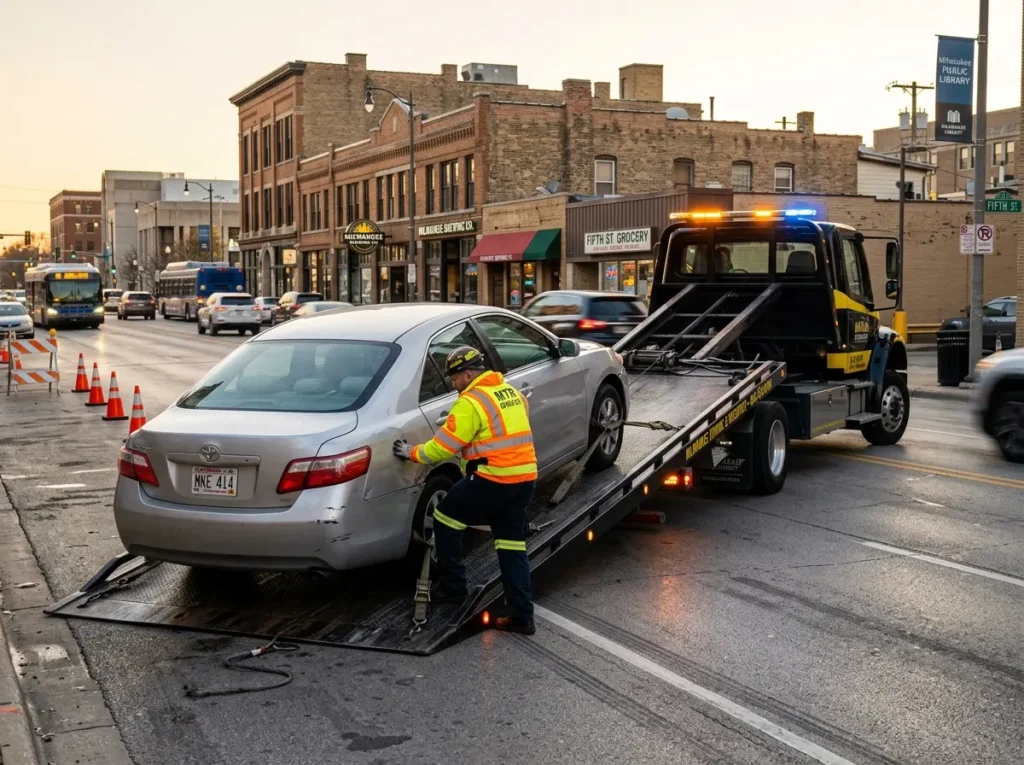
Accident towing services refer to specialized towing operations designed specifically to handle vehicles involved in collisions. Unlike standard towing for breakdowns or parking violations, accident towing in Milwaukee often involves:
- Extracting vehicles from ditches, medians, or tight spaces
- Handling vehicles with significant structural damage
- Coordinating with police and emergency responders on scene
- Managing fluid spills and debris cleanup
- Safely loading and transporting damaged vehicles without causing additional damage
- Storing vehicles in a secure, insured facility pending insurance assessment
A qualified accident towing service has trained operators, specialized equipment like flatbed trucks and wheel-lift systems, and the experience to handle complex post-collision scenarios without further damaging your vehicle.
3. Types of Tow Trucks Used in Accident Situations
| Tow Truck Type | Best For | Notes |
| Flatbed / Rollback | All-wheel drive, AWD, luxury, heavily damaged vehicles | Safest option; entire vehicle rides on the bed |
| Wheel-Lift | Shorter tows, vehicles with accessible front or rear axle | Less expensive but less ideal for severe damage |
| Integrated / Heavy-Duty | Large trucks, SUVs, multi-vehicle extractions | Used in serious commercial vehicle accidents |
| Rotator Crane Truck | Vehicles in ditches, rollovers, off-road accidents | Specialized; higher cost but essential for complex recovery |
4. Emergency Accident Towing vs. Standard Towing
Emergency accident towing is a higher-stakes service than standard towing. It is available 24 hours a day, 7 days a week including holidays and prioritizes rapid response. In Milwaukee, reputable providers like MG Towing & Recovery offer emergency accident towing with trained operators who understand both the technical demands of post-crash vehicle recovery and the legal sensitivities involved in an insurance claim scenario.
The key differences between emergency accident towing and standard towing include response time, equipment capability, operator experience, and coordination with law enforcement. Emergency towing also typically involves more detailed documentation photos, condition reports, and chain-of-custody records all of which are important for your insurance claim.
Average Towing Costs in Milwaukee: What You Should Expect to Pay
Breaking Down Towing Cost Structure
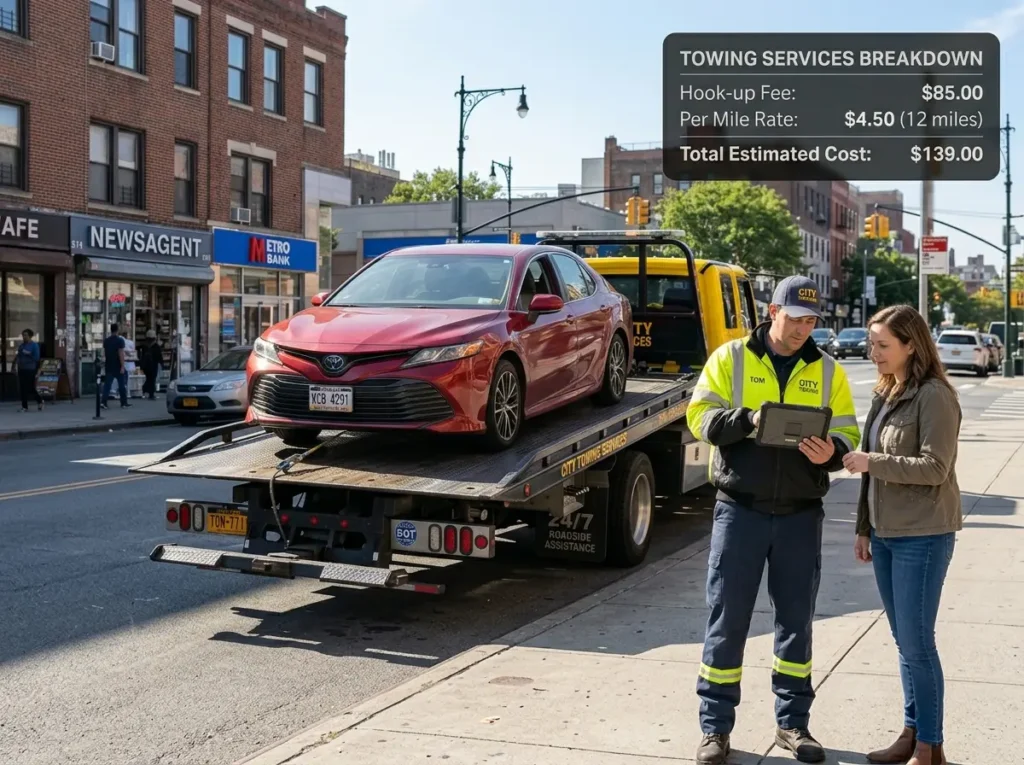
One of the most common questions drivers have after an accident is: “How much is this going to cost me?” Understanding average towing costs in Milwaukee helps you avoid being overcharged and helps you know when to dispute a bill.
Towing companies in Milwaukee typically charge using a combination of the following fee types:
- Hook-up / Base Fee: A flat fee charged just for connecting to and loading your vehicle
- Per-Mile Rate: A per-mile charge for the distance the vehicle is transported
- After-Hours / Emergency Fee: A surcharge for towing outside of standard business hours
- Storage Fee: A daily rate charged once your vehicle is at the tow yard
- Special Equipment Fee: Additional charges for winching, crane use, or flatbed service
- Administrative / Release Fee: Charged when you pick up your vehicle from storage
Typical Cost Ranges for Accident Towing in Milwaukee
| Service | Typical Cost Range | Notes |
| Base Hook-Up Fee | $50 – $100 | Standard for most light-duty tows |
| Per-Mile Rate | $3 – $7 per mile | Varies by company and vehicle type |
| Local Tow (Under 5 Miles) | $75 – $175 | Typical for moving vehicle from scene |
| Long-Distance Tow (10–30 Miles) | $150 – $350 | Common for cross-city transport to shop |
| After-Hours / Emergency Surcharge | $25 – $75 extra | Nights, weekends, holidays |
| Daily Storage Fee | $35 – $75 per day | Accrues quickly — act fast |
| Winching / Off-Road Recovery | $50 – $250+ | Ditch extractions, rollover recoveries |
| Heavy-Duty Towing | $250 – $600+ | Trucks, large SUVs, commercial vehicles |
How to Avoid Overcharges and Predatory Billing?
Unfortunately, predatory towing practices do exist, and accident scenes are a known target for opportunistic companies. Here’s how to protect yourself:
- Always ask for a written estimate before your vehicle is loaded onto the tow truck
- Request an itemized invoice that lists every fee separately
- Ask the driver which storage facility your vehicle will be taken to and look up their daily storage rates before agreeing
- If the fees seem unreasonably high, ask the officer on scene to intervene or contact the City of Milwaukee’s Consumer Protection division
- Never sign a document giving the towing company permission to release your vehicle to a third party without your explicit instruction
- Compare the quoted rates against the Milwaukee towing rate schedule (available through the city’s licensing department)
| Important: Storage fees can accumulate rapidly. If your vehicle is being held at a towing yard, contact your insurance company within 24 hours of the accident. Many insurers will cover or reimburse storage fees for a limited number of days, but delays can result in you owing fees that insurance won’t cover. |
Insurance Coverage for Towing After an Accident in Milwaukee
Does Car Insurance Cover Towing?
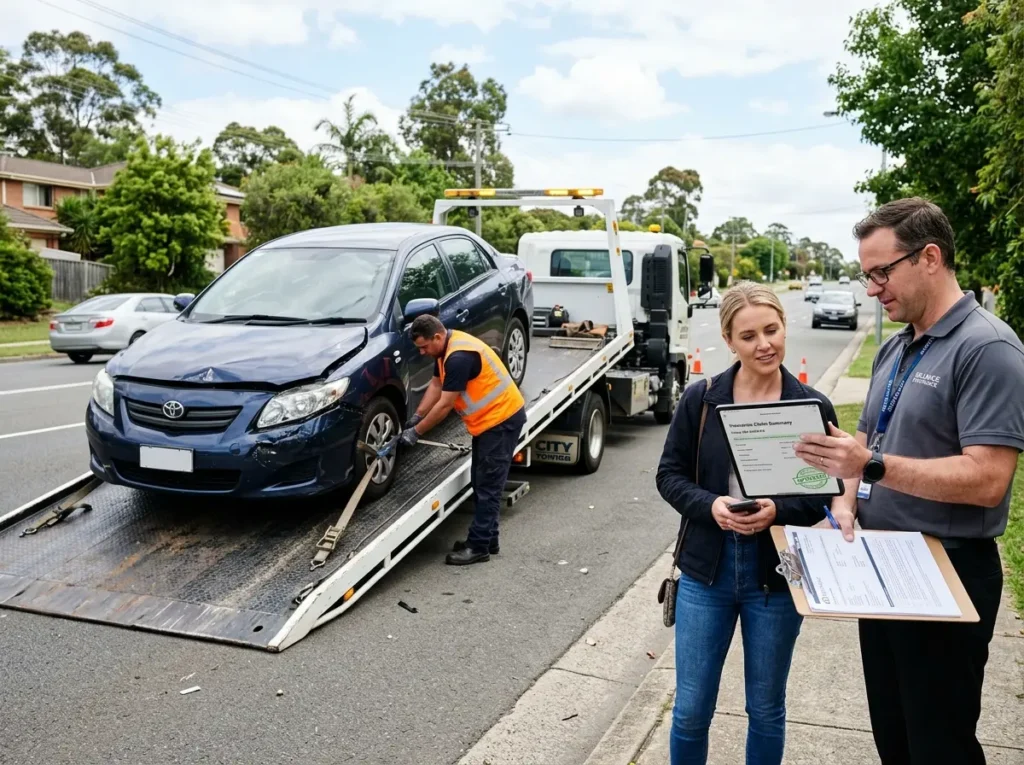
Whether your insurance covers accident towing depends on the type of coverage you carry. In Wisconsin, auto insurance coverage for towing varies significantly based on your policy type. Here’s a breakdown of the most common coverage types and what they mean for your situation:
1. Liability Coverage Only
If you carry only the state-minimum liability insurance in Wisconsin, towing is almost certainly not covered for your own vehicle. Liability insurance pays for damage you cause to other people’s vehicles and property not your own. If your vehicle needs to be towed after an accident that was your fault, you would be responsible for the full cost out of pocket.
2. Collision Coverage
Collision coverage is one of the most relevant coverage types for accident towing in Milwaukee. If your policy includes collision coverage, it will typically pay for towing your damaged vehicle to a repair facility after a covered accident, subject to your deductible. This is the coverage most drivers rely on for post-accident towing reimbursement.
3. Comprehensive Coverage
Comprehensive coverage handles non-collision incidents such as theft, flooding, falling objects, or hitting a deer. If you need damaged vehicle towing after one of these incidents, comprehensive coverage typically applies. Like collision coverage, it is subject to your deductible.
4. Roadside Assistance / Towing Add-On
Many insurers offer a separate roadside assistance or towing endorsement that can be added to your policy for a modest monthly premium. This coverage typically covers towing costs more broadly sometimes with no deductible and may also include services like flat tire changes, battery jump-starts, and lockout assistance.
Popular providers in Wisconsin offering this add-on include AAA, State Farm, Progressive, American Family Insurance, Erie Insurance, and USAA. If you don’t currently have this coverage, it is worth adding before you ever need it.
5. Gap Insurance and Towing
Gap insurance covers the difference between your vehicle’s actual cash value and what you still owe on a loan or lease. It does not cover towing costs, but it is worth mentioning because totaled vehicles often the result of serious accidents require towing to a salvage yard, a process that gap insurance does not cover.
How to File an Insurance Claim for Towing Costs?
Filing an insurance claim for towing after an accident in Milwaukee involves several steps:
- Contact your insurer as soon as possible after the accident ideally from the scene or within a few hours.
- Provide your policy number, a description of the accident, and the location where your vehicle was towed.
- Ask your insurer if there are preferred towing providers or approved storage facilities in their network.
- Keep all receipts, invoices, and documentation related to towing and storage costs.
- Submit documentation to your insurer for reimbursement or direct payment to the towing company.
- Follow up within 48–72 hours if you do not hear back delays can result in escalating storage fees.
What If the Other Driver Was at Fault?
If the other driver caused the accident, their liability insurance should cover your towing and storage costs. You would file a third-party claim with their insurance company. However, this process can take time, and in the meantime you may be responsible for accruing storage fees.
You have the option to file with your own collision coverage first (paying your deductible) and then have your insurer recover the costs from the at-fault driver’s insurer through a process called subrogation in which case your deductible should eventually be refunded.
Towing Laws in Wisconsin: What Every Driver Must Know
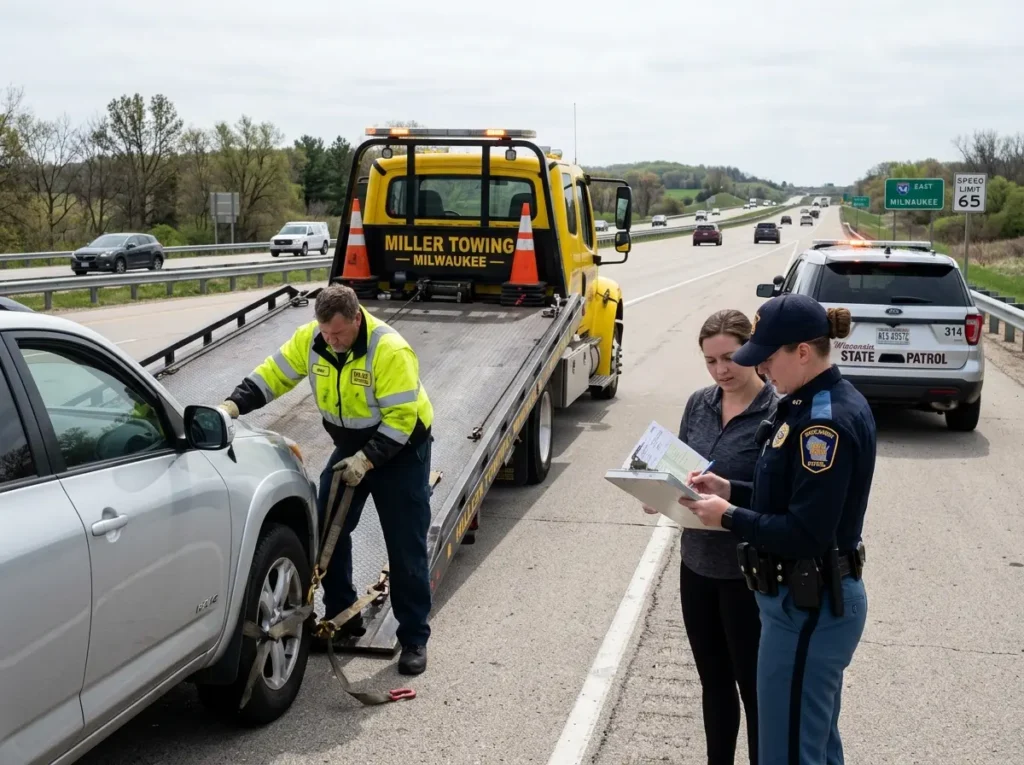
Wisconsin has a set of specific towing laws that govern how towing companies operate, what they can charge, and what rights vehicle owners retain. Understanding these towing laws in Wisconsin is essential to protecting yourself, especially in the stressful aftermath of an accident.
1. Wisconsin Statute 349.13 – Abandoned Vehicles and Towing
Under Wisconsin Statute 349.13, local authorities have the right to have vehicles removed from public roads when they are involved in accidents, blocking traffic, or otherwise creating a safety hazard. This statute gives law enforcement the authority to order a tow but it does not eliminate your rights as the vehicle owner.
Key provisions include:
- The vehicle owner must be notified of the towing and the storage location within a reasonable timeframe
- The towing company must provide a written invoice for all charges
- Vehicle owners have the right to retrieve personal property from their vehicle at any time during business hours, free of charge
- Towing companies cannot charge fees beyond what is listed in their rate schedule filed with the local licensing authority
2. Wisconsin Statute 779.415 – Towing Company Liens
Wisconsin Statute 779.415 governs towing company liens the legal mechanism by which a towing company can place a claim on your vehicle to recover unpaid towing and storage fees. Key points:
- A towing company acquires a lien on your vehicle the moment towing services are rendered
- If fees are not paid within a prescribed period, the company can proceed with a lien foreclosure and potentially sell the vehicle
- You have the right to dispute excessive fees or improper towing through the circuit court
- The lien does not apply to any personal belongings inside the vehicle those must be returned to you
3. Milwaukee Municipal Towing Regulations
In addition to state law, the City of Milwaukee has its own towing ordinances that apply to licensed towing companies operating within city limits. These regulations include:
- Towing companies must be licensed and bonded by the City of Milwaukee
- Maximum rates for police-dispatched tows are set by the city and reviewed periodically
- Companies must maintain a secure, accessible storage facility within reasonable proximity to the tow location
- Operators must provide written receipts for all charges
- Complaints about unlicensed or unethical towing companies can be filed with the Milwaukee Department of Neighborhood Services
4. Non-Consensual Towing Rules in Wisconsin
Non-consensual towing occurs when your vehicle is towed without your direct permission which includes police-dispatched tows after accidents. In these situations, Wisconsin law provides additional protections:
- You must receive written notice of the tow location and charges within 24 hours
- You cannot be denied access to retrieve personal belongings from your vehicle
- The towing company must accept at least one form of payment (cash, credit card, or debit card)
- Fees cannot be retroactively increased after you’ve been quoted a price
- You have the right to request a hearing to dispute any towing or storage fees you believe are unreasonable
| Know Your Rights: If a towing company in Milwaukee refuses to let you retrieve your personal belongings, demands payment in cash only, adds unexpected fees after the fact, or cannot provide a written invoice these are violations of Wisconsin towing law. Document everything and contact Milwaukee’s Department of Neighborhood Services or consult an attorney. |
Driver Rights After Accident Towing: Your Complete Checklist
1. You Have the Right to Choose Your Towing Company
One of the most important and least known driver rights after accident towing is the right to choose your own tow truck company. While police may dispatch a company from a rotational list, you can request a specific company, provided it does not create a significant delay that endangers public safety.
To exercise this right:
- Immediately inform the responding officer that you want to call your own towing company
- Have the name and number of a trusted Milwaukee towing provider saved in your phone in advance
- If an officer insists on using the rotational dispatch, document this in writing and follow up with your insurance company
2. Right to Retrieve Personal Property
Under Wisconsin law, you have the unconditional right to retrieve personal belongings including documents, medications, child safety seats, electronics, and valuables from your towed vehicle at any time during normal business hours, at no additional charge. This right exists even if you have not yet paid the towing or storage fees.
If a towing company attempts to hold your personal property as leverage for payment, this is unlawful and should be reported immediately.
3. Right to an Itemized Invoice
Every licensed towing company in Milwaukee is required to provide you with an itemized invoice that lists every charge separately. This includes the hook-up fee, mileage charges, storage fees, and any special service fees. Never accept a lump-sum invoice without a detailed breakdown.
4. Right to Dispute Excessive Charges
If you believe you have been overcharged for accident towing in Milwaukee, you have several avenues for dispute:
- Contact the Milwaukee Department of Neighborhood Services to file a formal complaint
- Dispute the charge through your insurance company they often have leverage with towing companies
- File a complaint with the Wisconsin Department of Agriculture, Trade and Consumer Protection (DATCP)
- Consult a consumer protection attorney if the overcharge is significant
- Leave a documented review on Google, Yelp, or the Better Business Bureau but focus on factual accounts, not emotional commentary
5. Right to Know Where Your Vehicle Is Being Taken
Before your vehicle is towed, you have the right to be told exactly where it is being transported. Ask for the name, address, and phone number of the storage facility. Write this information down or take a photo of the tow truck operator’s license plate and company identification.
This is especially important because some impound lots charge different daily storage rates, and knowing the location in advance allows you or your insurance adjuster to arrange a prompt inspection, which can limit storage fee accumulation.
6. Right to a Timely Vehicle Release
Once you or your insurance company pays the required fees (or makes arrangements to do so), the towing company is required to release your vehicle in a timely manner. Unreasonable delays in releasing a vehicle after payment has been tendered can constitute a violation of your rights under Wisconsin towing law.
Damaged Vehicle Towing: Special Considerations
Towing a Severely Damaged Vehicle
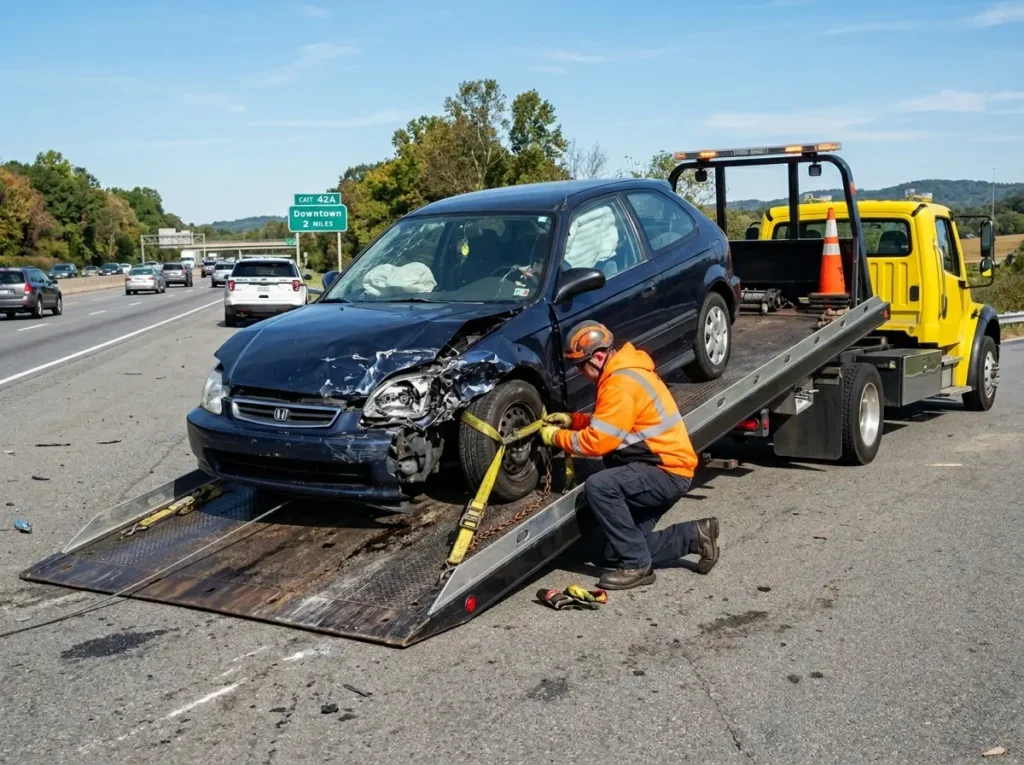
Damaged vehicle towing after a serious accident requires specialized equipment and expertise. Vehicles with compromised frames, missing wheels, deployed airbags, or significant undercarriage damage cannot simply be hooked up and dragged doing so can cause additional damage that may complicate your insurance claim and increase repair costs.
When dealing with a severely damaged vehicle, always insist on a flatbed tow truck, which supports the vehicle’s entire weight on a flat platform and eliminates risk of further axle, drivetrain, or suspension damage during transport.
Total Loss Vehicles
If your vehicle is declared a total loss by your insurance company, it still needs to be towed typically to a salvage yard or the insurer’s designated inspection facility. In these cases:
- Your insurer may arrange and cover towing directly as part of the total loss process
- Storage fees continue to accrue until the vehicle is moved, even if it’s been declared a total loss so prompt communication with your insurer is critical
- You retain the right to remove all personal belongings from the vehicle before it is transported to the salvage yard
- Do not sign a title transfer or salvage agreement until you have confirmed your insurance settlement amount
Electric Vehicle (EV) Towing
Electric vehicles present unique towing challenges that not every company in Milwaukee is equipped to handle. EVs should never be towed with drive wheels on the ground, as this can damage the electric motor and drivetrain. Always use a flatbed truck for EV towing, and notify the towing company that your vehicle is electric before they arrive on scene.
Additionally, if your EV has been in a serious accident, the battery may pose a fire risk a consideration that qualified accident towing services are trained to manage.
Classic, Luxury, and High-Value Vehicles
If your accident involves a classic, luxury, or high-value vehicle, the stakes for proper towing are even higher. Improper attachment points, dragging wheels, or rough handling can cause thousands of dollars in additional damage to high-end vehicles.
For these vehicles, request:
- An enclosed flatbed truck if available
- An operator with experience in handling luxury or classic vehicles
- Documentation of the vehicle’s pre-tow condition with photos
- A chain of custody record for all components, especially any detached parts
Choosing the Right Accident Towing Company in Milwaukee
What to Look for in a Milwaukee Towing Provider
Not all towing companies are equal, and after an accident is not the time to gamble on an unknown provider. When choosing an accident towing service in Milwaukee, look for:
- City of Milwaukee towing license and current bond
- 24/7 emergency accident towing availability
- A modern fleet that includes flatbed trucks suitable for damaged vehicle towing
- Trained, professional operators with accident recovery experience
- Transparent, posted rate schedules with no hidden fees
- A secure, insured storage facility
- Positive reviews from Milwaukee-area customers on Google and the BBB
- Direct billing capability with major insurance companies
- Clear, written documentation of all charges before towing begins
Red Flags to Avoid
Unfortunately, predatory towing practices are real in any major metro market. Watch out for:
- Companies that arrive uninvited to accident scenes without police dispatch (known as “bandit towing”)
- Operators who pressure you to sign documents quickly or without reading them
- Refusal to provide a written estimate or itemized invoice
- Storage facilities that claim to be “closed” when you try to retrieve your vehicle or belongings
- Demands for cash-only payment with no receipt
- Rates that far exceed Milwaukee’s posted towing rate schedule
- Tow trucks with no visible company name, license plate, or operator identification
Why MG Towing & Recovery Is Milwaukee’s Trusted Choice?
MG Towing & Recovery is a fully licensed, insured, and locally operated towing company serving the Milwaukee metro area with professional accident towing services. We built our reputation on transparency, speed, and treating every customer with the respect they deserve especially in the most stressful moments after a crash.
Here’s what sets MG Towing & Recovery apart from other accident towing providers in Milwaukee:
- 24/7 emergency accident towing response, 365 days a year
- Modern flatbed and wheel-lift fleet capable of handling all vehicle types, including EVs, luxury vehicles, and heavy-duty trucks
- Trained, licensed operators with extensive accident recovery experience
- Transparent pricing, you know exactly what you’ll be charged before we load your vehicle
- Direct insurance billing to streamline your claim process
- Secure, covered storage facility in Milwaukee with competitive daily rates
- A customer-first approach backed by hundreds of 5-star reviews from Milwaukee drivers
When you’re stranded after an accident in Milwaukee, call MG Towing & Recovery. We’ll be there fast, handle your vehicle with care, and walk you through every step of the process so you can focus on what matters most.
Step-by-Step: What to Do After an Accident in Milwaukee
Your Complete Post-Accident Action Plan
- Ensure Safety: Move to a safe area, turn on hazard lights, call 911 if needed.
- Document the Scene: Take photos of all vehicles, damage, road conditions, and any injuries before anything is moved.
- Exchange Information: Get the other driver’s name, insurance info, license plate, and contact details.
- File a Police Report: Request a report number from the responding officer — this is critical for your insurance claim.
- Choose Your Towing Company: Assert your right to select your own towing provider. Call Towing & Recovery for trusted Milwaukee accident towing.
- Get a Written Towing Estimate: Before your vehicle is loaded, get itemized charges in writing.
- Retrieve Your Belongings: Remove all valuables, documents, medications, and personal items from the vehicle.
- Notify Your Insurance Company: Call within 24 hours. Provide the tow location, police report number, and all documentation.
- Monitor Storage Fees: Follow up with your insurer daily until the vehicle is assessed or released to minimize accruing storage charges.
- Know Your Rights: If at any point you feel your rights are being violated, contact Milwaukee’s Department of Neighborhood Services or consult a consumer protection attorney.
Frequently Asked Questions
Q: Can I refuse a tow after an accident in Milwaukee?
A: If your vehicle is blocking traffic or poses a safety hazard, law enforcement has the authority to order it towed regardless of your preference. However, if your vehicle is safely off the road and not blocking traffic, you generally have more flexibility. You can also accept a tow while requesting your preferred company just communicate this clearly to the responding officer.
Q: How long can a towing company hold my vehicle in Milwaukee?
A: There is no strict maximum storage period under Wisconsin law, but towing companies must follow proper notification procedures before pursuing a lien sale. Storage fees accumulate daily, so it’s in your best interest to arrange pickup, transfer, or insurance assessment as quickly as possible — typically within a few days of the accident.
Q: What is the average towing cost in Milwaukee for accident towing?
A: The average towing cost in Milwaukee for a standard post-accident tow (local, under 5 miles) typically ranges from $75 to $175 for the tow itself, plus potential storage fees of $35 to $75 per day. Emergency surcharges and special equipment fees can increase the total. Always request an itemized estimate.
Q: Will my insurance cover all towing costs?
A: It depends on your policy. Collision coverage typically covers towing after an at-fault accident; roadside assistance add-ons often cover towing broadly. Liability-only policies generally do not cover your own towing costs. Always verify your specific coverage by calling your insurer directly.
Q: Can a towing company sell my car without my permission in Wisconsin?
A: Under Wisconsin Statute 779.415, a towing company can initiate a lien foreclosure process if towing and storage fees go unpaid for a prescribed period. This process requires legal notifications and filings. If you receive a lien notice, respond promptly and contact your insurer or an attorney.
Q: What if the tow truck damages my vehicle further during transport?
A: Document the pre-tow condition of your vehicle thoroughly with photos before it is loaded. If your vehicle sustains additional damage during towing, the towing company may be liable for those damages. File a complaint with their insurer and contact the City of Milwaukee’s licensing department.
Q: Do I need to be present for the tow?
A: You do not need to be physically present for your vehicle to be towed, but being present allows you to assert your rights, choose your company, retrieve belongings, and document the condition of the vehicle. If you cannot be present, make sure someone you trust is, or at minimum ensure you receive written documentation of the tow.
Conclusion: Be Prepared Before You Ever Need Accident Towing
No one ever plans to be in a car accident but being prepared can make an enormous difference in the outcome. Knowing your rights under Wisconsin towing laws, understanding what accident towing services in Milwaukee cost and what your insurance covers, and having a trusted towing provider’s number saved in your phone are all steps you can take today.
When you need emergency accident towing in Milwaukee, MG Towing & Recovery is available 24/7 to provide fast, professional, and fully transparent service. We know what you’re going through, and we’re here to help.