



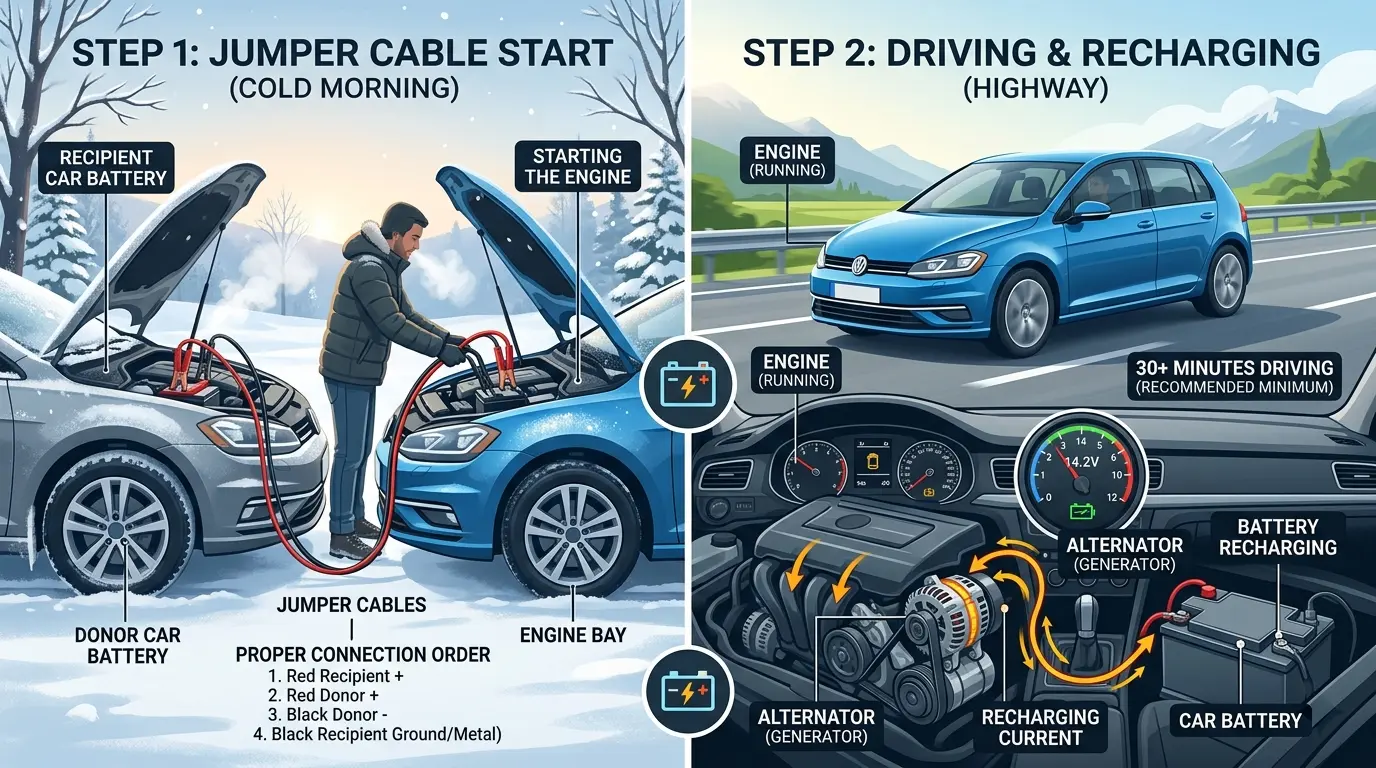
Picture this. You’re running late for work on a chilly Monday morning. You turn the key, and your car gives you that dreaded clicking sound. After a quick jump from a kind neighbor, the engine roars back to life. Now what? Most drivers shut off the engine the moment they reach their destination, and that’s exactly where the trouble starts.
After a jump start, drive your car for at least 30 minutes, ideally on the highway at speeds above 40 mph. This gives the alternator enough time to partially recharge the battery. For a fully drained battery, expect to drive 1 to 2 hours or use a dedicated battery charger overnight for complete recovery.
How Long Should You Drive After a Jump Start?
The standard rule among mechanics is simple. Drive for a minimum of 30 minutes after a jump start. However, that 30-minute mark only restores enough charge to start the car again later. It does not fully recharge the battery.
If your battery was completely drained, you’ll need to drive 1 to 2 hours of continuous driving to bring it close to full capacity. Short trips around the block won’t cut it. The alternator simply doesn’t have enough time to deliver a meaningful charge.
Why does driving time matter so much? Because every time you start your car, the battery uses a significant chunk of its stored energy. If you don’t replenish that charge through driving, the battery weakens with every start until it eventually dies again.
Also Read: How to Jump Start a Car: The Complete Step-by-Step Guide
Factors That Affect Charging Time
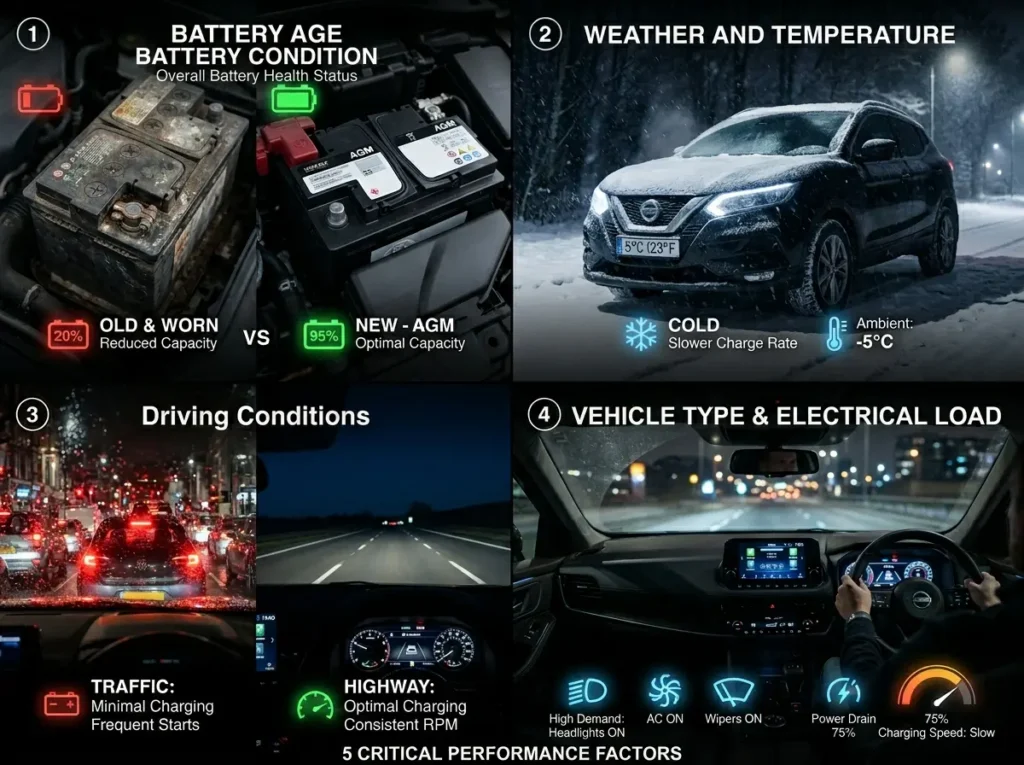
Not every battery charges at the same rate. Several real-world factors influence how long you actually need to drive after a jump start.
1. Battery Age and Condition
A battery older than 3 years takes longer to charge and holds less power overall. If your battery is 4 to 5 years old, even an hour of driving may not bring it back to full health. Older batteries develop internal resistance, which slows the charging process significantly.
2. Weather and Temperature
Cold weather is brutal on car batteries. In freezing temperatures, batteries lose up to 50% of their efficiency. If you jump-started your car on a cold morning, plan to drive longer than usual. Hot weather also affects charging by accelerating battery fluid evaporation.
3. Vehicle Type (Gas vs Hybrid)
Hybrid vehicles use a smaller 12V battery that charges differently from traditional gas cars. In hybrids, the battery often recharges through the high-voltage system, but it still requires consistent driving. Gas-powered vehicles rely entirely on the alternator, which works best at sustained higher RPMs.
4. Driving Conditions (City vs Highway)
Highway driving is far better than city driving for recharging. At consistent speeds of 40 to 60 mph, the alternator runs at optimal output. Stop-and-go city traffic, on the other hand, keeps the engine RPM low, which means less charging power for your battery.
5. Electrical Load (AC, Lights, Headlights)
Every accessory in your car draws power. If you’re running the AC, heated seats, headlights, and the stereo all at once, the alternator has less spare energy left to recharge the battery. Turn off non-essential electronics for at least the first 20 minutes of driving.
How a Car Battery Recharges While Driving?
Here’s the simple version. Your car has a component called the alternator. Once the engine is running, the alternator generates electricity, powers all your car’s electrical systems, and sends the leftover energy back to the battery to recharge it.
Think of the alternator as a small power plant under your hood. When you drive faster, it spins faster, generating more electricity. That’s why highway driving recharges your battery more efficiently than idling in your driveway.
The catch? The alternator is designed to maintain a healthy battery, not revive a dead one. That’s why a deeply drained battery may never fully recover from driving alone.
Driving Time vs Battery Charge Level
| Driving Time | Estimated Battery Charge Recovery | Notes |
|---|---|---|
| 10 minutes | 10 to 15% | Not enough to restart reliably |
| 30 minutes | 25 to 40% | Minimum recommended after a jump start |
| 1 hour | 50 to 70% | Good for moderate battery drain |
| 2 hours | 80 to 90% | Best for fully drained batteries |
| Overnight charger | 100% | Recommended for older or weak batteries |
Not sure if your battery is safe? Get fast roadside help or a battery check service from MG Towing and Recovery anywhere in your area. Call Now: 414-973-1902
Signs Your Battery Is Not Charging Properly
Watch for these red flags during and after your drive:
- Dim or flickering headlights, especially at idle
- The battery warning light stays on while driving
- Slow engine cranking when starting the car
- Electrical components like windows or radio acting sluggish
- A burning rubber smell, which may indicate alternator belt issues
- The car dies again shortly after being shut off
If you notice any of these signs, the issue may be with your alternator, not just the battery.
What to Do If Your Car Dies Again After Driving?
If your battery dies again within hours of a jump start, follow these steps:
- Get another jump start, but don’t drive far
- Head straight to an auto parts store like AutoZone or O’Reilly
- Ask for a free battery and alternator test, most stores offer this
- If the battery is bad, replace it immediately
- If the alternator is bad, do not keep driving on jump starts, you risk getting stranded
- Call roadside assistance if needed for a tow
A repeated dead battery almost always means one component has failed. Don’t waste money on multiple jumps when a single test can pinpoint the problem.
If your car keeps dying again and you need immediate help, call MG Towing and Recovery for fast 24/7 roadside assistance or emergency towing before you get stranded again. Click Here: 414-973-1902
Should You Idle Instead of Driving?
Many drivers think letting the car idle in the driveway will charge the battery just as well. It won’t.
When idling, the engine runs at low RPM, around 600 to 1000. The alternator produces minimal power at this speed, just enough to run the car’s electronics. There’s almost nothing left to recharge a depleted battery.
The verdict: Always drive, don’t idle. Twenty minutes of highway driving recharges more than two hours of idling.
Pro Tips From Mechanics
Here are a few insider tips I’ve learned from years working around vehicles and roadside calls:
- Disconnect short trips for a week. After a jump start, avoid quick errands. Combine your drives so you get longer continuous engine time.
- Use a trickle charger overnight. A $30 smart charger from any auto parts store can fully restore a battery in 8 to 12 hours, far better than relying on driving alone.
- Clean your battery terminals. Corrosion on the terminals reduces charging efficiency. A wire brush and baking soda paste do wonders.
- Check the alternator belt tension. A loose belt means weak charging. You can spot this with a quick visual check under the hood.
- Don’t ignore the battery light. That little dashboard light is the cheapest warning system you’ll ever get.
FAQs
Can I drive immediately after a jump start?
Yes. Once the car starts, drive right away. Idling wastes time and barely charges the battery.
Will a 15-minute drive recharge my battery?
No. Fifteen minutes only restores a small portion of the charge. Aim for at least 30 minutes minimum.
Is it bad to jump-start a car multiple times?
Frequent jump starts can stress your alternator and indicate a failing battery. If you’ve jumped your car more than twice recently, get it tested.
How long does it take for an alternator to fully charge a dead battery?
Roughly 1 to 2 hours of continuous highway driving, depending on battery condition and electrical load.
Should I turn off the AC after a jump start?
Yes, at least for the first 20 to 30 minutes. This lets the alternator focus on recharging instead of powering accessories.
Can a bad alternator drain a new battery?
Absolutely. A failing alternator can drain even a brand-new battery within hours. Always have both tested together.
Conclusion
If you’ve just jumped your car, plan to drive at least 30 minutes, ideally on the highway, with minimal accessories running. For a fully drained battery, an hour or two is much safer. And if your car keeps dying, don’t keep guessing. Get the battery and alternator tested before you end up stranded somewhere worse.