



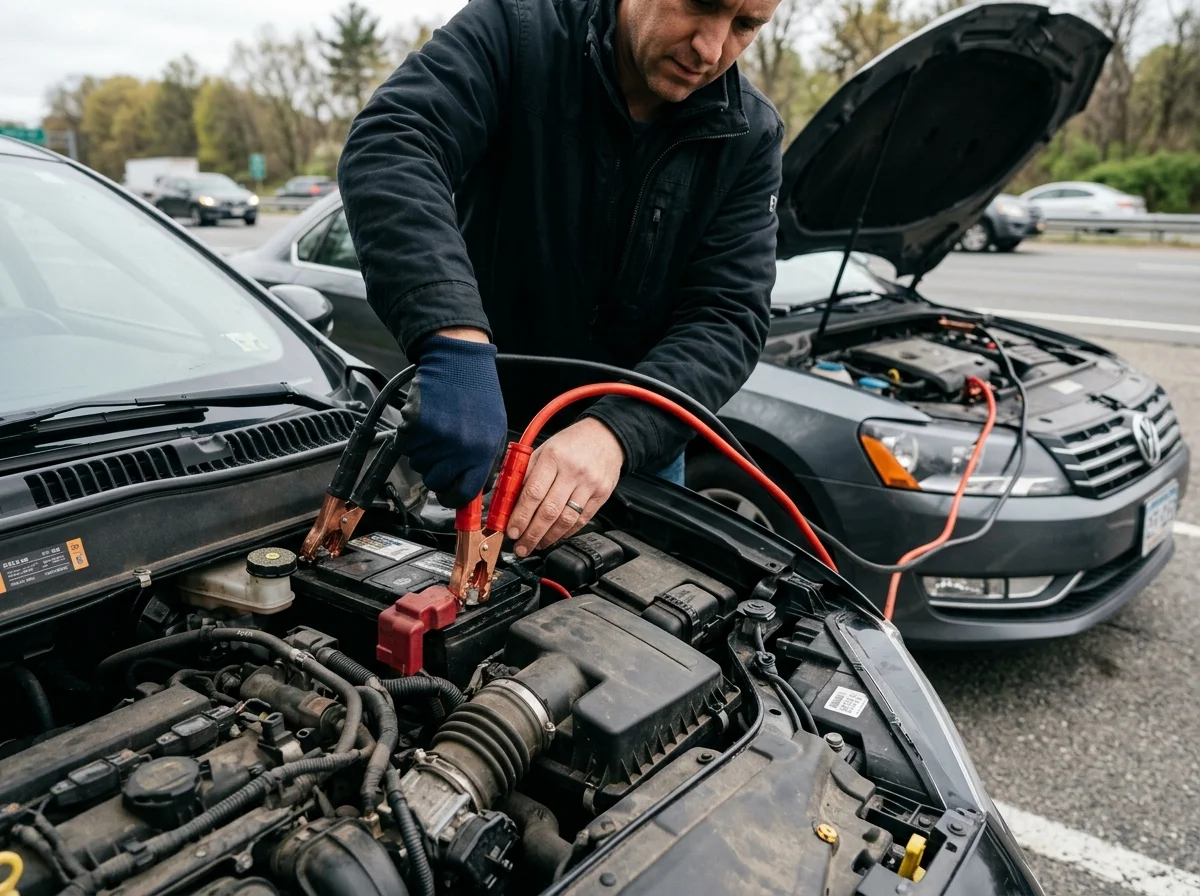
Few things kill a morning faster than turning your key and hearing that slow, defeated click instead of an engine. I have been jumping cars on the side of highways, in flooded parking lots, and in freezing driveways for years, and I can tell you that learning how to jump start a car is one of the most useful skills any driver can have.
This guide walks you through the exact jump start car steps a roadside professional uses. You will learn the right tools, the safest cable order, the dead battery solution that actually works, and the small tricks that prevent damage to your electronics. Whether you are a new driver or someone who has done this a few times but is not sure you are doing it correctly, this is the practical, no-nonsense walkthrough you need.
By the end, you will be able to handle this common roadside emergency calmly, safely, and without paying for a tow.
Stranded right now? Call MG Towing and Recovery for fast 24/7 jump start and towing assistance, we’ll reach you quickly anywhere in your area. Call Now: 414-973-1902
What Does It Mean When a Car Battery Is Dead
A “dead” battery rarely means the battery is finished forever. In most cases, it means the voltage has dropped below the level needed to crank the starter motor. A healthy 12-volt car battery sits at around 12.6 volts when fully charged. Once it falls below roughly 12.0 volts, you will start seeing weak cranks, dim dash lights, or no response at all.
There are three common reasons drivers run into this:
- You left the headlights, dome light, or radio on overnight.
- The battery is old (most last 3 to 5 years) and has lost its ability to hold charge.
- Cold weather has reduced the battery’s effective output, sometimes by 30 to 50 percent.
A jumpstart does not repair the battery. It borrows enough energy from another vehicle (or a portable jump pack) to start your engine, after which the alternator takes over and recharges the battery as you drive. Knowing this distinction matters, because if your battery is genuinely failing, you will be stranded again within days.
Also Read: Car Won’t Start? Top Signs You Need a Jumpstart Service
Tools You Need to JumpStart a Car
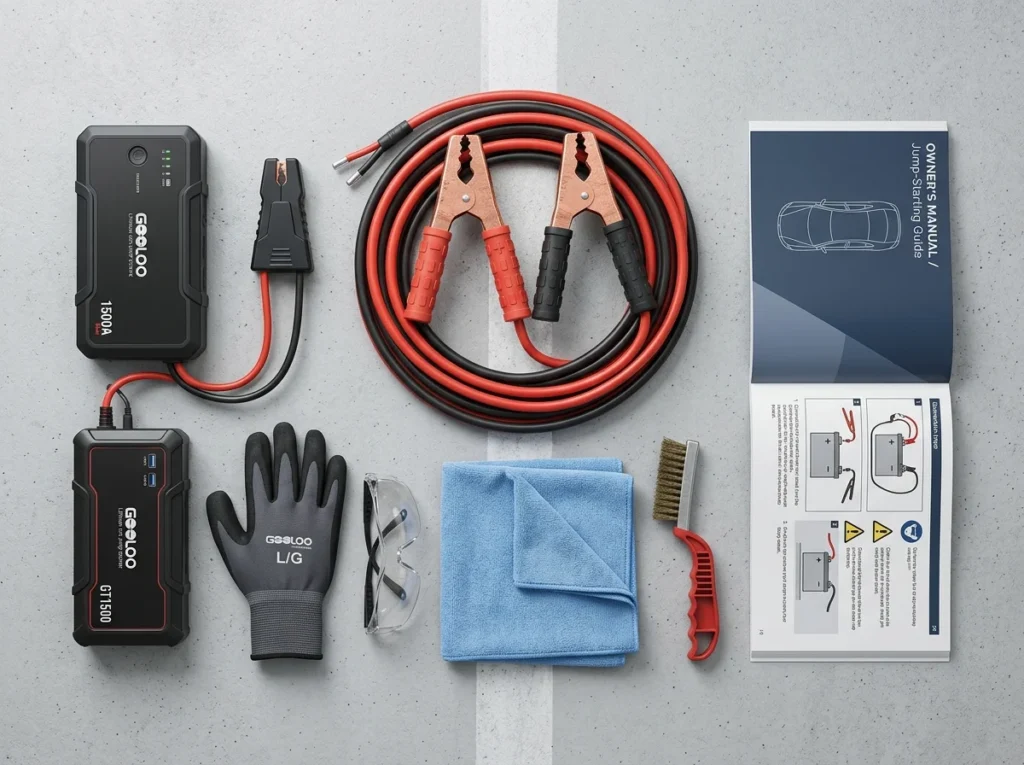
You do not need a workshop to handle this. Here is what should live in your trunk year-round:
- Jumper cables: At least 10 feet long and 4 to 6 gauge thickness. Thin cables sold at gas stations often cannot carry enough current for SUVs or trucks.
- A portable jump starter (recommended): A lithium-ion jump pack means you never need a second car. A 1000-amp peak unit will start almost any passenger vehicle.
- Safety gloves and glasses: Battery acid and sparks are real risks. Cheap protection prevents painful injuries.
- A clean rag or wire brush: For wiping off corrosion before you connect anything.
- Your owner’s manual: Some modern vehicles have remote jump points under the hood instead of accessible batteries. The manual tells you exactly where they are.
Insider tip: skip the cheap “emergency” cable kits. I have watched dozens of those melt or fail under load. Spend the extra money once and you are covered for the next decade.
Step-by-Step Guide to Jump Starting a Car
Follow these jumpstart car steps carefully. The order matters more than people realize, and skipping a step is how cables get welded to terminals or alternators get fried.
Step 1: Position Both Vehicles Safely
Pull the working car close enough that the cables can reach both batteries with slack to spare, but do not let the vehicles touch. Put both cars in Park (or Neutral for manuals), engage the parking brakes, and turn off ignitions, headlights, radios, and climate controls in both vehicles.
Roadside emergency tip: If you are on a highway shoulder, turn on hazard lights and place a warning triangle 50 feet behind your car if you have one. Drivers do not always notice a stopped vehicle.
Step 2: Locate Both Batteries
Open both hoods and find the batteries. On most cars they are obvious rectangular boxes with two terminals. On many newer European vehicles, the actual battery is in the trunk or under the back seat, and you will see labeled red and black jump posts under the hood instead. Use those, not anything else metal.
Identify the positive terminal (marked + and usually covered with a red plastic cap) and the negative terminal (marked – and typically black).
Step 3: Inspect the Dead Battery Before You Connect Anything
This is the step most people skip and the one that prevents serious accidents. Look for:
- Cracks or bulges in the battery case
- Liquid leaking around the terminals
- A strong rotten-egg smell (sulfur from leaking acid)
If you see any of these signs, stop. Do not jump start a damaged battery. Call roadside assistance instead. A swollen or cracked battery can rupture or even explode under load.
Step 4: Connect the Jumper Cables in the Correct Order
This is where the table below earns its place on your phone. Follow the sequence exactly. Each clamp must have a firm bite on bare metal, not on a painted surface or a corroded bolt.
| Cable Color | Connect To | Why It Matters |
| Red (positive) | Positive (+) terminal of the dead battery | Establishes the first link to the disabled battery before any current flows. |
| Red (positive) | Positive (+) terminal of the good battery | Completes the positive bridge between both batteries. |
| Black (negative) | Negative (-) terminal of the good battery | Begins the ground side from the healthy power source. |
| Black (negative) | Bare metal on the dead car’s engine block (not the battery) | Grounds the circuit safely away from hydrogen gas around the dead battery, reducing spark risk. |
Why ground the last clamp on the engine block instead of the dead battery’s negative terminal? A dying battery vents small amounts of hydrogen gas. The final connection always produces a small spark. Sparking near a vented battery has caused real explosions. Grounding on the engine block keeps that spark safely away.
Step 5: Start the Working Vehicle
Start the donor car and let it run for 2 to 3 minutes. Lightly press the accelerator to bring the engine to about 1500 RPM. This pushes more current through the cables and gives the dead battery a meaningful surface charge.
If the dead battery is severely depleted, give it 5 minutes before attempting a start. Patience here saves you from a second failed attempt that drains the donor battery.
Step 6: Start the Dead Vehicle
Now try to start the disabled car. If it fires up on the first try, do not turn it off. Let it run. If it cranks slowly and fails, wait another 2 to 3 minutes with the donor car running and try again. If after three attempts of 5 to 10 seconds each it still will not start, the issue is bigger than a flat battery.
Expert tip: Do not crank for more than 10 seconds at a time. Long cranks overheat the starter motor and can cause expensive damage.
Step 7: Disconnect the Cables in Reverse Order
With the previously dead car running, remove the cables in the exact reverse order you put them on:
- Black clamp from the engine block of the revived car
- Black clamp from the negative terminal of the donor car
- Red clamp from the positive terminal of the donor car
- Red clamp from the positive terminal of the revived car
Keep the clamps from touching each other or any metal surface while you work. A live cable tapping bodywork creates a loud arc and can damage electronics in either car.
Step 8: Drive for at Least 20 to 30 Minutes
Do not turn off the engine the moment you are running. The battery is nearly empty, and only sustained driving will let the alternator put back the charge it just lost. Highway driving recharges faster than stop-and-go traffic. Avoid heavy electrical loads (heated seats, blasting AC, loud audio) during this recovery drive.
Not sure if your car will start or battery is completely dead? Skip the guesswork, MG Towing and recovery provides professional roadside jump start and towing so you’re never stuck for long. Call Now: 414-973-1902
Safety Precautions You Must Follow
Battery work is generally safe, but the small risks are serious when they happen. Treat every jump start with the same care a professional would.
- Never let the red and black clamps touch while any end is connected to a battery. This creates a direct short circuit.
- Wear eye protection. Battery acid splashes happen, and they happen at face level.
- Do not smoke or use open flames. Hydrogen gas around a battery is invisible and ignites easily.
- Remove rings, watches, and metal bracelets. If a metal bracelet bridges a positive terminal and the chassis, it can heat to red-hot in under a second.
- Do not jump start a frozen battery. If the electrolyte is frozen (you may hear a sloshing sound when shaken, or see ice on the case), it can rupture under current. Let it thaw indoors first.
- Match voltage. Most cars are 12-volt. Never connect a 12-volt car to a 24-volt truck system.
Common Mistakes to Avoid
After watching many drivers attempt this, the same handful of mistakes keep showing up:
- Reversing polarity. Connecting red to negative and black to positive can blow fuses, fry the ECU, and ruin both batteries within seconds. Double-check the symbols every single time.
- Clamping onto corroded terminals. Heavy corrosion blocks current. The car will not start, and you will assume the jump failed.
- Using cables that are too thin. 10-gauge cables cannot deliver enough amps to crank a V6 or V8 engine, no matter how long you wait.
- Turning off the revived car too soon. If you shut it down before the alternator recharges the battery, you will be stuck again immediately.
- Forgetting to disconnect accessories. Headlights, radios, and AC pulling current during the jump waste the donor’s energy and slow the recovery.
- Trying to jump a hybrid using the wrong battery. Hybrids have a small 12-volt battery (often in the trunk) for accessories. Never connect cables to the high-voltage drive battery. Always check the manual.
What to Do If the Car Still Won’t Start?
You followed every step and the engine still refuses to crank. Run through this car battery troubleshooting checklist before giving up.
| Symptom | Likely Cause | Quick Fix | Long-Term Solution |
| Rapid clicking when turning the key | Battery too weak to turn the starter | Jumpstart the vehicle | Load-test the battery; replace if it fails |
| Dim headlights, slow cranking | Aging battery losing capacity | Drive 30+ minutes to recharge | Replace battery if it is over 4 years old |
| Nothing happens when you turn the key | Completely flat battery or loose terminal | Tighten clamps, then jump start | Inspect for parasitic drain at a workshop |
| Battery dies overnight repeatedly | Parasitic draw or failing alternator | Disconnect negative cable when parked | Get an alternator and draw test done |
| White or blue powder on terminals | Corrosion blocking current flow | Clean with baking soda paste and a wire brush | Apply terminal protector spray after cleaning |
| Swollen battery case | Overcharging or extreme heat damage | Do NOT jump start. Stop using the battery | Replace the battery and have charging system tested |
If after a proper 5-minute charge the dead car will not even click, the problem is probably not the battery at all. Likely culprits:
- A failed starter motor (you may hear a single loud clunk)
- A bad ignition switch
- A blown main fuse or fusible link
- An immobilizer or anti-theft system locking the engine
None of these are jump-startable problems. At this point, stop trying. Repeated cranking will only damage the starter further.
How to Prevent Battery Failure in the Future?
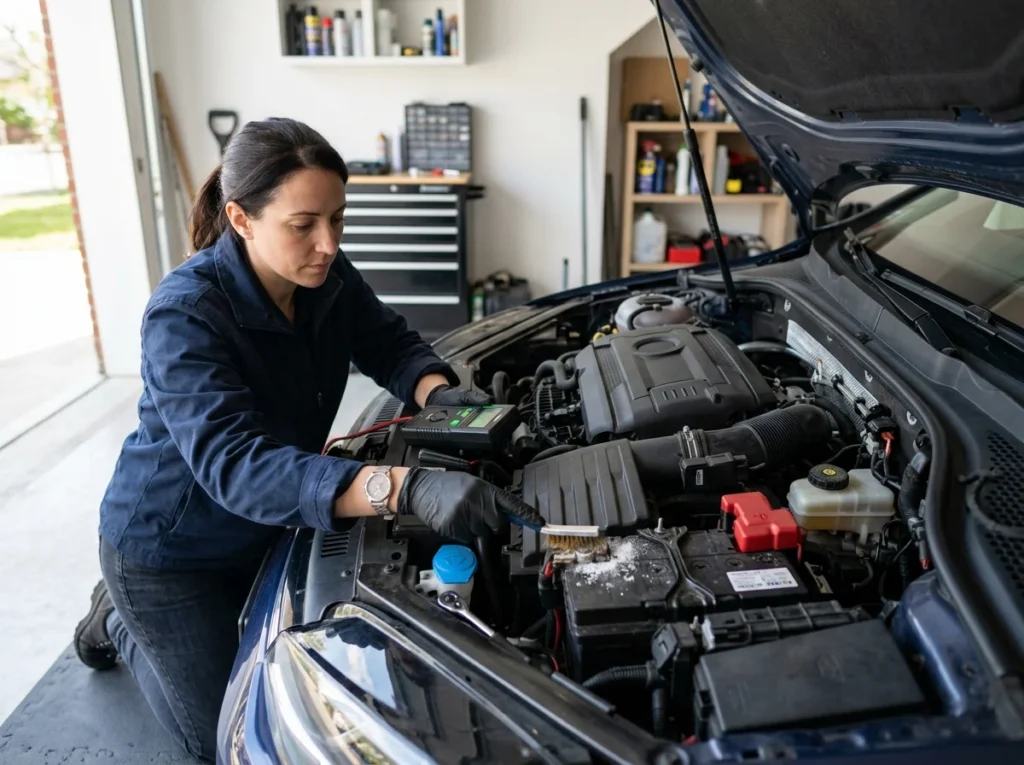
The best dead battery solution is the one you never have to use. A few simple habits keep your battery healthy for its full lifespan:
- Drive at least 20 minutes a few times a week. Short trips never let the alternator fully recharge the battery.
- Test your battery twice a year. Most auto parts stores do this for free in 5 minutes. Look for a CCA (cold cranking amps) reading at or above the rated value.
- Keep the terminals clean. A mix of baking soda and water dissolves corrosion. Dry thoroughly and apply dielectric grease afterward.
- Replace it before it fails. Most batteries last 3 to 5 years. Once you are past year 4, plan for replacement, especially before winter.
- Use a trickle charger if you do not drive often. If your car sits for weeks, a smart maintainer keeps the battery topped up without overcharging.
- Park in a garage during extreme weather. Heat actually kills batteries faster than cold by accelerating internal corrosion.
When to Call Roadside Assistance?
Knowing when to stop and call for help is part of being a smart driver, not a sign of weakness. Pick up the phone if any of these apply:
- The battery looks swollen, cracked, or is leaking fluid
- You smell burning plastic or sulfur near the engine bay
- You are not certain which terminal is positive and which is negative
- The vehicle is a hybrid or EV and the manual is not available
- You are in heavy traffic, on a narrow shoulder, or in any unsafe location
- Three jump attempts have failed
- The car starts but stalls immediately when cables come off (likely an alternator issue)
Most insurance policies and credit cards include some form of roadside assistance for free or for a small fee. Before you ever need it, find out what you already have access to. A 30-minute wait for a professional is always better than a damaged ECU or a hospital visit.
Frequently Asked Questions
Q1: How long should I let the working car run before trying to start the dead one?
Two to three minutes for a mildly drained battery, and up to five minutes for one that is completely flat. Give the dead battery a chance to absorb a surface charge first, otherwise the donor car has to push all the current through the cables at once, which can stress both vehicles.
Q2: Can I jumpstart a car in the rain?
Yes, you can. A 12-volt automotive battery does not produce enough voltage to shock you through wet skin. Modern cables are insulated. That said, keep the connections themselves dry where possible, watch your footing, and avoid working in standing water. Never jump a car in a flooded garage with electrical outlets nearby.
Q3: How many times can I jump start the same battery before it needs to be replaced?
There is no fixed number, but if a battery needs jumping more than twice in a few weeks, it is telling you it is finished. Modern lead-acid batteries are not designed to be deeply discharged. Each full discharge shortens the life noticeably. By the third or fourth jump, replacement is almost always cheaper than repeated tows.
Q4: Will jump starting damage my car’s electronics?
Done correctly, no. Done with reversed polarity or with both cars running and revving high, yes. Modern vehicles have sensitive ECUs and infotainment systems that can be permanently damaged by voltage spikes. Always confirm polarity before connecting, and avoid disconnecting cables while either engine is at high RPM.
Q5: Can I jump start a car with a portable jump pack instead of another car?
Absolutely, and honestly, this is what I recommend to every driver. A modern lithium jump pack the size of a paperback can start a typical car 20 to 30 times on one charge. You skip the awkwardness of flagging down a stranger, you skip the donor-car damage risk, and you can do it alone in under five minutes. The connection order is the same, except the pack itself is the source instead of a second car.
Q6: How long does it take for a car battery to recharge after a jump start?
Plan on at least 30 minutes of continuous driving for a moderately drained battery, and an hour or more if it was completely dead. City driving with frequent stops and accessories running can take twice as long. If you are not sure, drive home and put the car on a battery charger overnight to bring it back to full capacity.
Conclusion
Knowing how to jump start a car is one of those small skills that turns a panicked roadside moment into a 10-minute inconvenience. The process is straightforward once you respect the order: red to dead positive, red to good positive, black to good negative, black to bare metal on the dead car. Start, wait, drive, and you are back on the road.
The most important takeaway is that a jump start is a temporary fix, not a repair. Use it to get yourself home or to a workshop, then find out why the battery died in the first place. Test the battery, check the alternator, look for parasitic drains, and consider age. A battery that has been jumped repeatedly is a battery on its way out.
Keep a quality set of cables or a portable jump pack in your trunk, learn to recognize the early warning signs of a failing battery, and treat every jump start as the controlled, deliberate procedure it should be. Do that, and the next dead battery you encounter, whether yours or someone else’s, will be a problem you can confidently solve in minutes.