

Almost nobody researches towing until they need it. You are on the shoulder of the interstate with your hazards on, or standing in a parking garage staring at a car that will not shift out of Park, or looking at a fender sitting on top of a tire after a collision. That is when people start dialing.
The problem with calling cold is that the wrong truck shows up. A wheel-lift wrecker arrives for an all-wheel-drive SUV that should never be dragged on two wheels. A standard bed rolls up for a lowered sports car and cannot load it without scraping the front lip. A driver quotes a price on the phone, then hands you an invoice with three fees nobody mentioned.
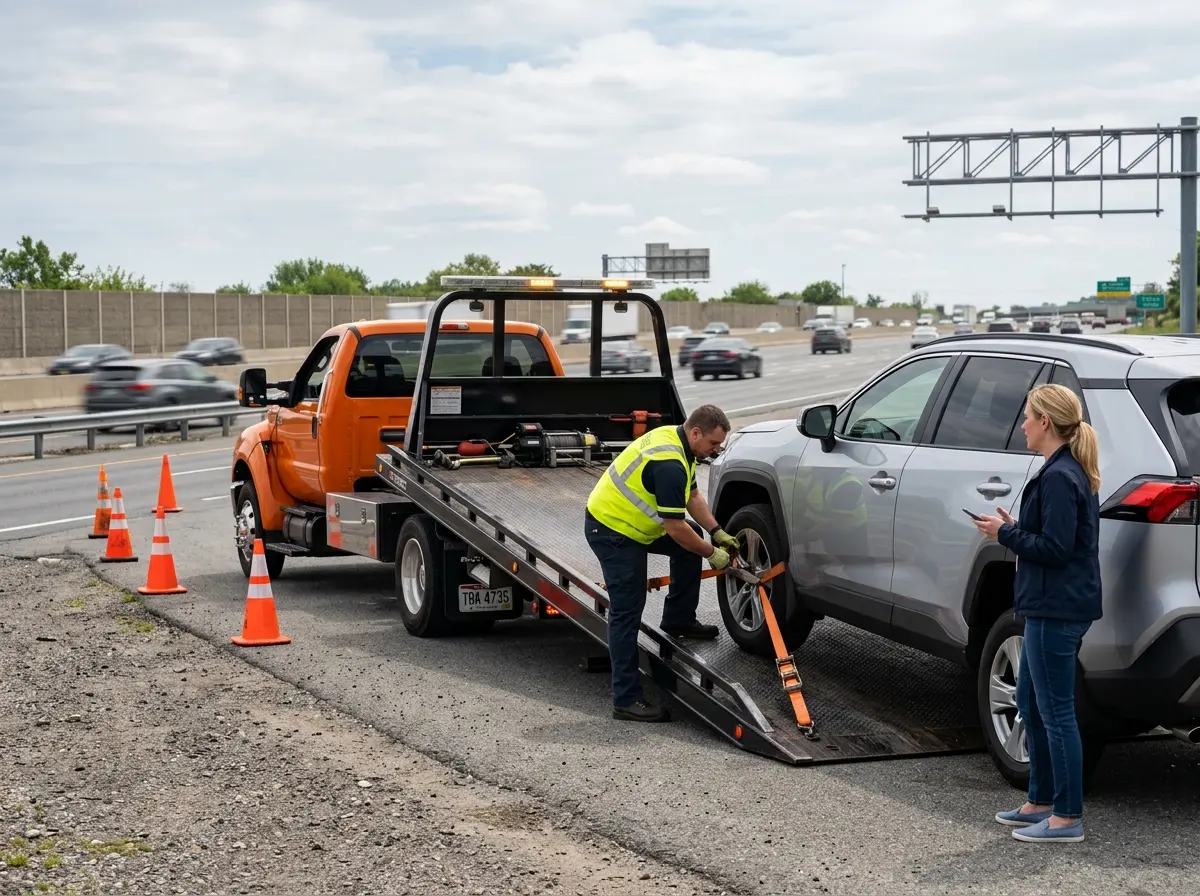
Flatbed towing solves most of that, because the vehicle rides fully supported on a level deck with no wheels turning. It is the method manufacturers specify for electric vehicles, and the safe choice for all-wheel-drive systems, luxury cars, and anything with drivetrain damage. Knowing that flatbed is the right method is only half the job. Knowing what to ask, what to expect, and what to have ready is what turns a bad roadside hour into a routine one.
This is not a rare situation. NHTSA‘s Crash Investigation Sampling System estimated roughly 2.55 million police-reported crashes in 2023 in which at least one passenger vehicle was towed from the scene, and AAA alone handles close to 30 million roadside assistance calls a year. Below are the 10 Things to Know Before Calling a Flatbed Towing Service:
1. Know When Flatbed Towing Is the Best Option
Use a flatbed tow truck whenever the wheels should not turn: all-wheel-drive and four-wheel-drive vehicles, electric vehicles, cars with transmission or axle damage, wrecked vehicles, and any low-clearance, classic, or high-value car.
On a wheel-lift tow, two wheels stay on the pavement and spin for the entire trip. On an AWD or 4WD vehicle, that motion feeds back through the transfer case and differentials while the engine is off and no fluid is circulating. That is how a 20-mile tow becomes a transfer case replacement. On an electric vehicle, spinning wheels turn the drive motors into generators.
The mistake most people make is assuming any tow truck handles any vehicle, then accepting whatever arrives because they feel stuck. Say the word “flatbed” in the first thirty seconds of the call and say why. Dispatchers route trucks based on what you tell them.
Pro Tip: If your car still rolls and steers freely, mention it. A rolling vehicle loads in minutes. A locked-up one needs skates, dollies, or a winch, which changes both the truck sent and the price quoted.
Need a flatbed tow? MG Towing & Recovery provides safe, damage-free flatbed towing across Milwaukee and surrounding areas. Call us 24/7. 414-973-1902
2. Understand the Cost Factors
Flatbed towing in the United States typically runs a hook-up fee of about $75 to $150 plus $3 to $7 per mile. Flatbed service generally costs 20 to 40 percent more than wheel-lift towing, and rates vary by region, time of day, and vehicle type.
Average Flatbed Towing Costs in The USA
| Distance | Typical Price Range |
|---|---|
| Hook-up plus first 5 miles | $95 to $175 |
| 10 miles | $125 to $250 |
| 25 miles | $175 to $350 |
| 50 miles | $250 to $500 |
| 100 miles | $400 to $750 |
| 250 miles and beyond | Usually a flat rate, often $2 to $7 per mile |
Ranges reflect published 2026 rates and industry surveys. Figures vary by region and provider: rural areas with few operators price higher than competitive metros.
Four things move the number most: time of day, since overnight, weekend, and holiday calls commonly add $50 to $100; recovery difficulty, since winching a car out of a ditch or snow is billed separately; vehicle type, since EVs, exotics, and oversized trucks carry a premium for extra labor and liability; and storage, which starts the moment your car sits in a yard because the shop was closed.
Common Mistake: Asking “how much per mile?” and stopping there. The per-mile rate is one line on the invoice. Ask for the total, out the door, to your specific destination.
3. Check Whether the Company Is Licensed and Insured
A legitimate flatbed towing company carries commercial auto liability, on-hook coverage protecting your vehicle while it is on the truck, and any state or municipal operating authority. Ask for proof before your car is loaded.
On-hook insurance is the one that matters to you, and it is not the same as general liability. On-hook pays for damage to your vehicle while it is in the company’s custody. Without it, if an operator drops your car during loading, you are pursuing an individual instead of an insurer.
Licensing is set at the state and sometimes city level, so there is no single national credential. Check your state’s public utilities commission, department of transportation, or motor vehicle agency for an operator lookup. Interstate transporters can be verified through FMCSA‘s carrier database using a USDOT number.
Expert Advice: Reputable operators do not flinch when asked for a company name, license or USDOT number, and confirmation of on-hook coverage. Hesitation is your answer.
4. Ask About Response Time
Typical roadside response runs 20 to 60 minutes nationally, with urban averages near the low end. Rural locations, severe weather, and holiday weekends routinely push waits past an hour.
“How long?” invites an optimistic guess. Ask better questions: Where is the truck coming from right now? Is it already on another call? Will I get a text with the driver’s name and ETA? AAA operates more than 63,000 towing and roadside service vehicles nationwide, and even at that scale, an ice storm or a multi-car pileup commits every truck in the region.
Safety Tip: Get out of the traffic lane if you safely can, exit on the side away from traffic, and wait behind a guardrail rather than in the car when you are on a highway shoulder. Move Over laws exist in all 50 states, but compliance is inconsistent. AAA Foundation research found tow operators are killed at roughly 43 deaths per 100,000 workers versus about three per 100,000 across all other industries, and 60 percent of surveyed roadside workers had experienced a near miss.
5. Prepare Important Vehicle Information
Before calling, have five things ready: your exact location, the year, make, and model, whether the car rolls and steers, why it stopped, and the destination address. This one habit prevents most wrong-truck dispatches.
Precise location matters most. “Northbound I-40 near the mall” is not dispatchable. A dropped pin, mile marker, exit number, or cross street is, and most map apps share a pin in two taps.
If the vehicle is in a parking garage, say so and give the posted clearance. Standard flatbeds need roughly 13 feet of vertical clearance to operate the deck, so a garage job often requires a small wrecker to pull the car into open air first.
6. Ask About Equipment and Tow Truck Type
Not all flatbeds are equipped alike. Ask whether the truck carries soft wheel straps rather than chains over the body, ramp extensions for low-clearance cars, skates for seized wheels, and a working winch.
Equipment that signals a serious operator:
- Wheel straps or tire baskets instead of frame hooks, so the tire is secured and the suspension works normally
- Ramp extensions or wood blocks that reduce the break-over angle for lowered cars
- Skates or go-jacks for vehicles with seized or missing wheels
- A wheel-lift mounted on the flatbed, letting one truck handle a garage extraction and the transport
Did You Know? Tesla’s owner manuals direct that the vehicle be transported by flatbed, and state that if no flatbed is available, all four wheels must be off the ground using wheel lifts and dollies for a maximum of 35 miles. Most EV makers publish similar guidance, and ignoring it can be treated as misuse in a warranty dispute.
7. Know What Services Are Included
Confirm before dispatch whether the quote covers winching, dolly or skate use, waiting time, tolls, gate fees, after-hours drop-off, and the first several miles. These line items turn a $150 estimate into a $340 invoice.
Ask one question: “Is that the total to move my car from here to this address, and what would add to it?” A professional dispatcher answers plainly. Winching, extended wait time at a closed shop, and secondary tows from an impound lot are the three most common add-ons.
Confirm drop-off procedure too. If the repair shop is closed, ask whether the company leaves the vehicle in the lot with keys in a drop box, or takes it to their yard, which starts storage fees.
8. Understand Insurance and Payment Options
Towing may be covered by an auto policy roadside endorsement, a motor club membership, a manufacturer warranty, or a credit card benefit. Most reimburse a capped amount per incident, commonly $50 to $200, so confirm your limit before assuming the tow is free.
| Source | What it usually covers |
|---|---|
| Auto policy roadside endorsement | A capped dollar amount per incident, often reimbursement based |
| Motor club membership | A set towing distance per call, with tiers commonly covering 5 to 200 miles |
| New vehicle warranty | Roadside assistance during the warranty term, often to the nearest dealer |
| Collision or comprehensive claim | Accident scene towing, subject to your deductible and policy terms |
If you are filing an accident claim, call your insurer before authorizing a tow when it is safe to do so. Some carriers dispatch a network provider and pay them directly, so you never front the cost.
Pro Tip: Ask which payment methods are accepted before the truck rolls. Some independents are cash or card only at the scene, and a highway shoulder at midnight is a bad place to discover that.
9. Read Reviews Before Choosing a Company
Look past the star rating. Read recent reviews for mentions of pricing disputes, vehicle damage, quoted versus final cost, and how the owner responded to complaints. Patterns matter more than any single review.
Look for reviews mentioning your vehicle type, especially EVs, exotics, or lifted trucks. Look for photos of loaded vehicles, which reveal strap technique and equipment condition. Be skeptical of five-star clusters posted in the same week with no detail, and remember that some search listings are lead brokers that sell your call to whoever bids, not the company that arrives.
Expert Advice: Save one vetted local towing company in your phone now. Choosing a professional towing company under pressure at 2 a.m. is how people end up with predatory operators.
10. Know What Happens After Your Vehicle Is Loaded
Once the vehicle is secured, photograph it on the deck, get a written invoice showing destination and total charges, and confirm who holds the keys. Your responsibility does not end when the car goes up the ramp.
Do this in the two minutes before the truck pulls away:
- Photograph all four corners while it is strapped down, creating a timestamped condition record
- Remove valuables, registration, garage remote, and anything you need in the next 48 hours
- Confirm the destination in writing, since a verbal address proves nothing later
- Get the driver’s name and the company’s dispatch number
- Ask when it will arrive and whether anyone must be present
If you want to ride along, ask first. Many companies allow one passenger in the cab and some do not, depending on insurance and seating. Never assume you have a ride from the scene.
Safety Tip: After an accident, do not let an operator who arrived uninvited load your vehicle. Unsolicited arrivals at crash scenes are a known problem in several metro areas, and release fee disputes can take weeks to resolve.
What Information Should You Give the Dispatcher?
| Information | Why It Matters |
|---|---|
| Exact location, ideally a dropped pin or mile marker | Determines the truck assigned and ETA accuracy |
| Year, make, and model | Confirms weight, drivetrain, and clearance |
| Whether it is AWD, 4WD, or electric | Decides whether a flatbed is mandatory |
| Does it roll, steer, and shift to neutral? | Determines need for skates, dollies, or a winch |
| What happened (breakdown, accident, flat, no start) | Signals whether recovery equipment is required |
| Destination address | Sets mileage and total price |
| Is the vehicle lowered or modified? | Determines whether ramp extensions are needed |
| Garage, basement, or off-road location | Clearance and access change the truck type |
| Will anyone ride along? | Cab seating and company policy vary |
| Keys available or locked inside? | Affects loading method and time on scene |
You will love to read: Can I Rent a Flatbed Tow Truck?
How to Choose a Reliable Flatbed Towing Company?
- Call the company directly, not a broker. Verify a physical local address, not just a phone number.
- Get the quote in writing. A text with the total, destination, and possible add-ons is enough.
- Confirm on-hook insurance by name.
- Ask what truck they are sending. A company that cannot describe its own equipment is subcontracting your call.
- Check they are actually staffed 24 hours. Plenty of listings advertise 24 hour flatbed towing and route after-hours calls to voicemail.
- Match specialty to vehicle. For EV, exotic, or classic car towing, ask how many they handle monthly.
- Confirm payment methods and the release process before the vehicle leaves.
Common Mistakes People Make
- Saying “I need a tow” without specifying flatbed for an AWD or electric vehicle
- Accepting a per-mile rate without asking for the total
- Leaving valuables and documents in the car
- Skipping photos at loading, which makes later damage claims hard to prove
- Waiting beside the vehicle in a live traffic lane
- Assuming insurance covers the full tow when most policies cap reimbursement
- Choosing the first search result mid-emergency instead of a vetted local towing company
- Not asking where the car goes if the shop is closed, which triggers storage fees
- Letting an uninvited operator load the vehicle after an accident
- Forgetting to ask about riding in the cab, then having no way home
Frequently Asked Questions
How much does flatbed towing cost?
Flatbed towing generally costs a hook-up fee of $75 to $150 plus roughly $3 to $7 per mile, putting most local tows between $95 and $250. A 100-mile tow commonly falls between $400 and $750. Prices vary considerably by region, vehicle type, and time of day, so always request a total quote rather than a per-mile rate.
Is flatbed towing safer than other methods?
Flatbed towing is the lowest-risk method for the vehicle, because nothing rotates, nothing drags, and the weight rests on a level deck instead of hanging from a lift. There is no drivetrain wear, no bumper scraping, and less exposure to road debris. It is the standard for damage free towing of luxury, electric, all-wheel-drive, and accident-damaged vehicles.
Can flatbed trucks tow lowered cars?
Yes, when the operator brings the right equipment. Low-clearance vehicles need ramp extensions, wood blocks, or a low approach angle to reduce the break-over point at the bottom of the ramp. Tell the dispatcher your car is lowered when you call. Without that detail, the driver may arrive without extensions and be unable to load safely.
Can I ride in the tow truck?
Usually yes, but always ask when you call. Most flatbeds have a passenger seat and many companies permit one rider, though policies differ based on insurance and cab seating. Children needing car seats and groups of passengers are common exceptions. If riding is not permitted, arrange other transportation before the truck arrives.
What is the difference between flatbed towing and a tow dolly?
A flatbed carries the whole vehicle on a level deck with all four wheels off the ground. A dolly lifts only two wheels and leaves the others rolling on pavement. Dollies cost less but are unsuitable for all-wheel-drive vehicles, electric vehicles, and cars with drivetrain damage, because the rolling wheels keep turning internal components.
Should I stay with my vehicle while waiting?
On a highway shoulder, exit on the side away from traffic and wait behind a barrier or guardrail. In a safe parking area, or in severe weather, staying in the vehicle with your seatbelt fastened is reasonable. Roadside collisions are the main danger during a breakdown, so distance from moving traffic is the priority.
What if I disagree with the final bill?
Ask for an itemized invoice before paying and photograph it. Many states cap non-consensual towing and storage rates and require posted price schedules, enforced by the state department of transportation, public utilities commission, or consumer protection office. Paying under protest and filing a complaint usually beats refusing payment and accruing storage fees.
The Bottom Line
The difference between a routine tow and an expensive one usually comes down to a two-minute conversation. Tell the dispatcher what you drive, whether it rolls, exactly where you are, and where it needs to go. Ask for the total, not the per-mile rate. Confirm the company is licensed and carries on-hook coverage. Photograph the vehicle before it leaves.
Flatbed towing costs more than a wheel-lift because it protects more. For an all-wheel-drive crossover, an electric vehicle, a lowered coupe, or anything that has been hit, that extra $40 or $80 is cheap next to a transfer case, a drive motor, or a bumper cover.
Save a vetted local flatbed towing service in your phone today. The best time to choose a towing company is any time other than the moment you need one.
Stranded on the road? From flatbed towing to roadside assistance, MG Towing & Recovery is available 24/7. Contact us now for immediate service. 414-973-1902