


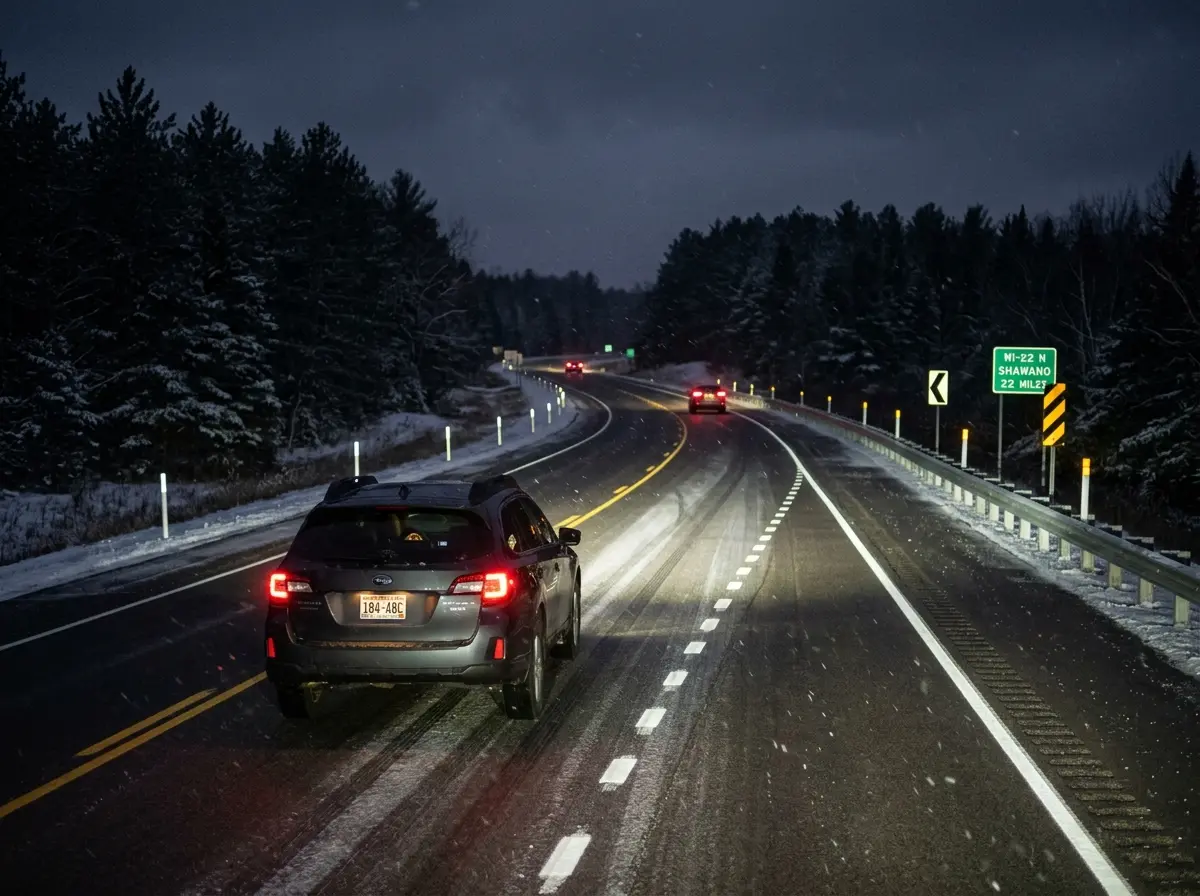
How to Stay Safe After Dark on Milwaukee Roads and Wisconsin Highways
Driving at night is a fundamentally different experience from driving in daylight and the statistics back that up. According to the National Safety Council, traffic fatality rates per mile driven are roughly three times higher at night than during the day.
Reduced visibility, driver fatigue, impaired drivers on the road, and the difficulty of judging speed and distance in the dark all contribute to a genuinely elevated risk that every driver should take seriously.
In Wisconsin, night driving carries a set of unique challenges that go beyond the universal concerns. The state’s long winters mean Milwaukee drivers spend months dealing with darkness that arrives by late afternoon. Fog rolls in off Lake Michigan and the surrounding waterways with little warning.
Rain-slicked roads reflect headlights in disorienting ways. Rural stretches of highway outside the city have minimal lighting and a real risk of deer crossings. And in the coldest months, ice patches form overnight on roads that looked fine when you last drove them.
The good news is that most night driving hazards are manageable if you know what to do. This guide covers the most important safe night driving practices for Wisconsin and Milwaukee drivers specifically from headlight management and dealing with glare, to navigating fog, rain, and wet roads after dark. Whether you drive after dark occasionally or every single day, these tips can genuinely reduce your risk.
Related Article: 7 Most Dangerous Roads in Milwaukee?
Why Night Driving Is More Dangerous: The Core Challenges
Reduced Visibility Is the Fundamental Problem
The human eye is simply not designed for driving at highway speeds in the dark. Even with headlights, your visible range drops dramatically compared to daylight conditions.
A typical low-beam headlight illuminates roughly 160 feet ahead, while high beams extend to about 500 feet. At 60 mph, your vehicle travels approximately 88 feet per second, meaning you have just under two seconds of reaction time between when you see a hazard at the edge of your low-beam range and when you reach it. That margin is razor thin.
Night driving visibility tips always begin with understanding this fundamental limitation. The solution is not simply to drive with high beams on constantly, it is a combination of proper headlight use, reduced speed, increased following distance, and sharp awareness of the road ahead.
Driver Fatigue Is a Serious Night Hazard
The human body’s circadian rhythm naturally prepares us for sleep as darkness falls. Driving after 10 p.m. or before 6 a.m. means fighting biology, and fatigue-related impairment shares many characteristics with alcohol impairment, slower reaction times, reduced peripheral vision, poor judgment, and microsleep episodes that can last several seconds. On a highway at 65 mph, a two-second microsleep means traveling 190 feet with your eyes effectively closed.
If you feel drowsy while driving at night in Wisconsin, do not push through it. Pull off at a rest area, a well-lit gas station, or a parking lot and rest. Caffeine can provide a short-term boost but is not a substitute for genuine alertness. Calling for a ride or getting a room for the night is always the better option.
More Impaired Drivers on the Road
Statistically, the hours between midnight and 3 a.m. on weekends see the highest concentration of impaired drivers on Wisconsin roads. Being a safe driver yourself is necessary but not sufficient, you also need to be alert to the behavior of vehicles around you.
Weaving, inconsistent speed, running red lights, and driving without headlights are all warning signs. Keep your distance, do not attempt to confront the driver, and if you witness clearly dangerous behavior, pull over safely and call 911.
| Wisconsin-Specific Fact: Wisconsin consistently ranks among the states with elevated rates of nighttime drunk driving incidents. The Milwaukee metro area, in particular, sees elevated incident rates on weekend nights. Heightened alertness between 10 p.m. and 4 a.m. on Fridays and Saturdays is well-justified by local data. |
Headlight Safety Tips: The Foundation of Night Driving Visibility
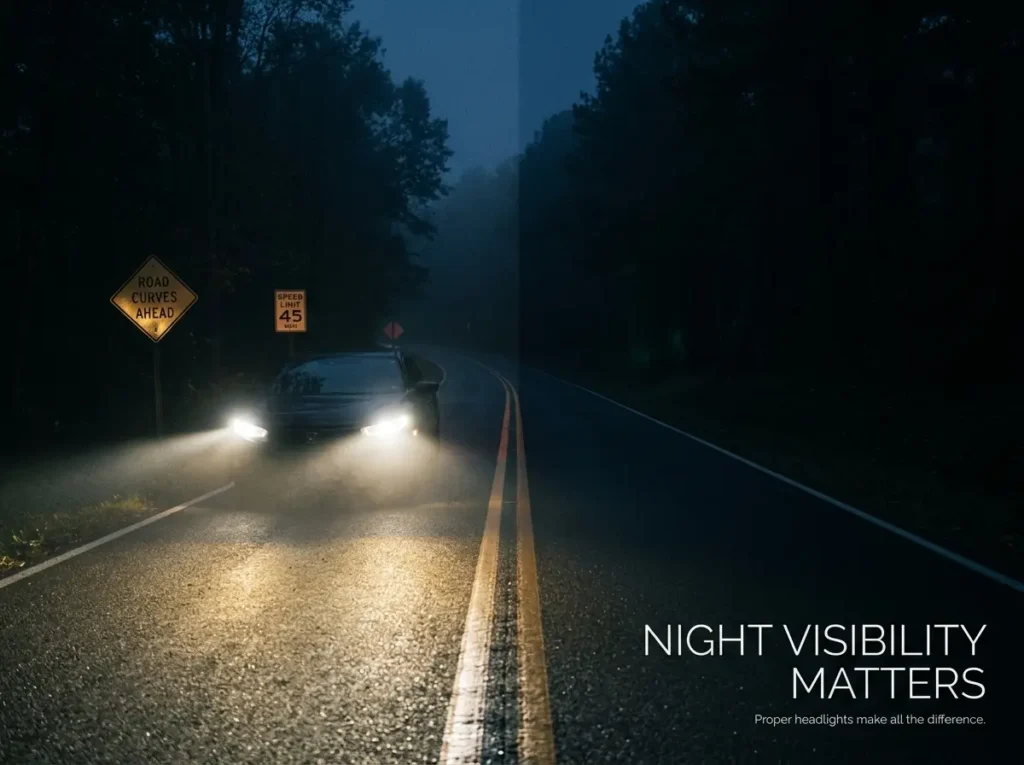
Your headlights are your single most important tool for driving at night safely. Most drivers underestimate how much headlight condition and usage habits affect both their own visibility and how visible they are to others. These headlight safety tips address both sides of that equation.
Keep Your Headlights Clean and Properly Aimed
Oxidized, yellowed, or dirty headlight lenses can reduce light output by up to 80 percent compared to a clean, clear lens. That is not a minor degradation, it is the difference between seeing a hazard in time to stop and not seeing it at all. Wisconsin’s road salt, grit, and winter grime accelerate headlight lens deterioration faster than in milder climates.
Check your headlights regularly and clean the lenses as part of your routine vehicle maintenance. If your lenses are yellowed or cloudy, headlight restoration kits are inexpensive and widely available, or a shop can replace them for a modest cost.
Also check that your headlights are properly aimed, headlights that are pointed too low illuminate less of the road ahead, while those aimed too high blind oncoming traffic.
Use Your Headlights Earlier Than You Think You Need To
A lot of drivers in Wisconsin tend to wait until it’s completely dark before switching on their headlights, but that’s actually a risky habit. The time around dusk about 30 to 60 minutes before nightfall is one of the most dangerous times to be on the road. It’s not quite dark enough for headlights to feel necessary, but visibility is already dropping quickly.
During this period, pedestrians, cyclists, and even other vehicles become much harder to notice, increasing the chance of accidents.
Turn on your headlights whenever you have any doubt about visibility. Most modern vehicles allow you to run headlights during the day without issue, and many states, including Wisconsin, legally require headlights in certain low-visibility conditions. A good personal rule: if you need to use your windshield wipers, your headlights should also be on.
High Beams: Use Them Correctly and Courteously
High beams dramatically extend your visibility in dark rural stretches, but they must be used responsibly. Switch to low beams whenever you are within 500 feet of an oncoming vehicle or within 300 feet of a vehicle you are following. In Wisconsin, this is not just courtesy, it is the law under Wisconsin Statute 347.12.
A practical habit: when you see oncoming headlights appear on a dark road, dim your high beams immediately and do not switch back until the vehicle has fully passed. This reduces the risk of temporarily blinding the other driver during a critical period.
Dealing with Glare from Headlights at Night
Glare from headlights at night, both from oncoming traffic and from reflective wet road surfaces is one of the most uncomfortable and dangerous aspects of night driving. Here is how to manage it effectively:
- Avoid staring directly at oncoming headlights instead, look toward the right edge of your lane or the road markings ahead of you.
- Use your night vision mirror setting (the small lever on the bottom of your rearview mirror) to reduce glare from vehicles behind you.
- If you wear glasses, ensure they have an anti-reflective coating, which dramatically reduces glare scatter.
- Keep your windshield clean inside and out, interior haze and smears massively amplify glare at night.
- Do not use heavily tinted lenses at night, even if they reduce glare they reduce overall visibility more than they help.
- If an oncoming driver blinds you with high beams, briefly slow down, focus on the road edge, and do not flash your own high beams in response.
Driving at Night in Rain: Wet Road Night Driving in Wisconsin
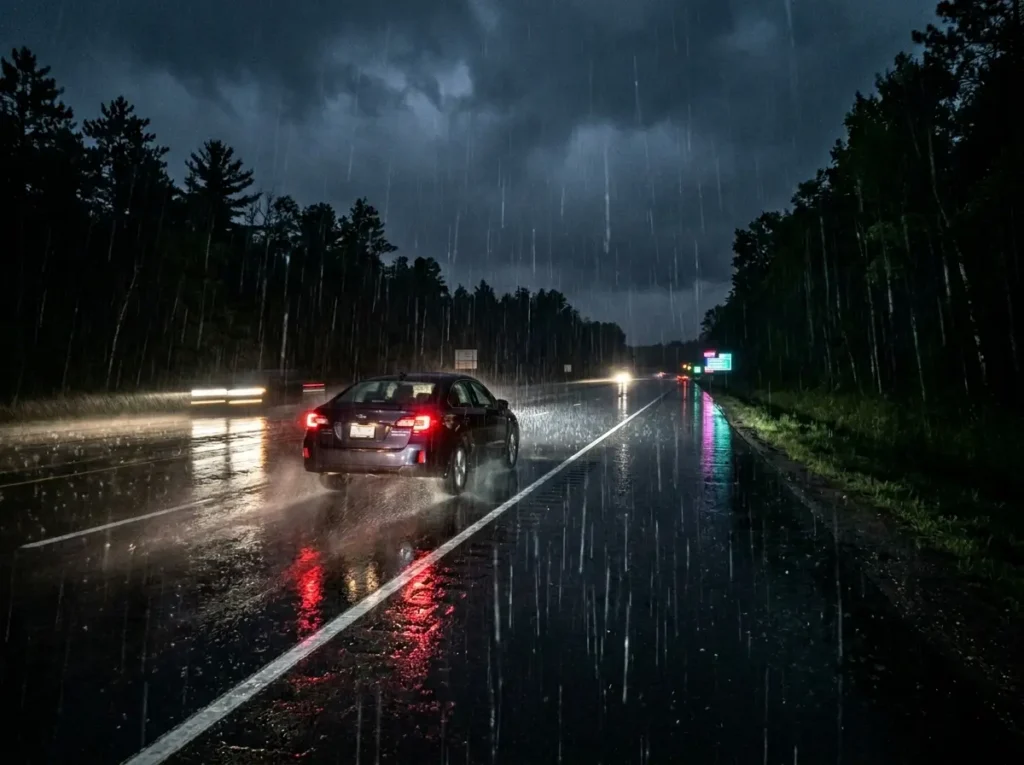
Rain at night creates a compounding hazard that is significantly more dangerous than either rain in daylight or dry roads at night. Wet road night driving demands a specific set of adjustments that go beyond simply slowing down.
Why Rain Makes Night Driving So Much Harder?
Rainwater on a road surface creates a mirror-like effect that reflects headlights, street lights, and oncoming traffic in all directions. This visual noise makes it harder to distinguish lane markings, road edges, and hazards ahead.
The glare from reflections on wet asphalt is one of the most disorienting experiences in everyday driving, and Wisconsin drivers who commute through Milwaukee’s lit streets are familiar with how a rainy night can turn a familiar road into a confusing maze of reflected light.
Additionally, wet roads significantly increase stopping distances. At 60 mph on a wet surface, your stopping distance can be 50 to 100 percent longer than on a dry road. Combined with reduced visibility, this is a genuinely dangerous combination that requires a meaningful reduction in speed.
Practical Tips for Driving at Night in Rain
- Slow down: Aim to reduce your speed by at least 10 to 15 mph below the posted limit on wet roads at night.
- Increase following distance: Double your normal following distance to at least four to five seconds
- Use low beams, not high beams: High beams reflect off rain and wet pavement and actually reduce forward visibility in heavy rain.
- When lines fade: Look for the reflective lane markers embedded in the road when painted lines become hard to see.
- Avoid sudden braking: Brake gradually and early to prevent skidding on wet surfaces
- At intersections: Be especially cautious at intersections where oil and debris accumulate and make surfaces slicker
- Watch for standing water: Hydroplaning can occur at speeds as low as 35 mph on a deeply puddled surface.
- Check your wiper blades before Wisconsin’s rainy season: Worn blades that smear rather than clear create their own visibility nightmare at night
| Hydroplaning Warning: Hydroplaning occurs when a layer of water builds up between your tires and the road, causing a complete loss of traction. If you feel your steering go light or your vehicle begin to drift, do not brake hard or turn sharply. Ease off the accelerator gradually and steer gently in the direction you want to go until your tires regain contact with the road. |
Foggy Night Driving Safety: Navigating Low Visibility in Wisconsin
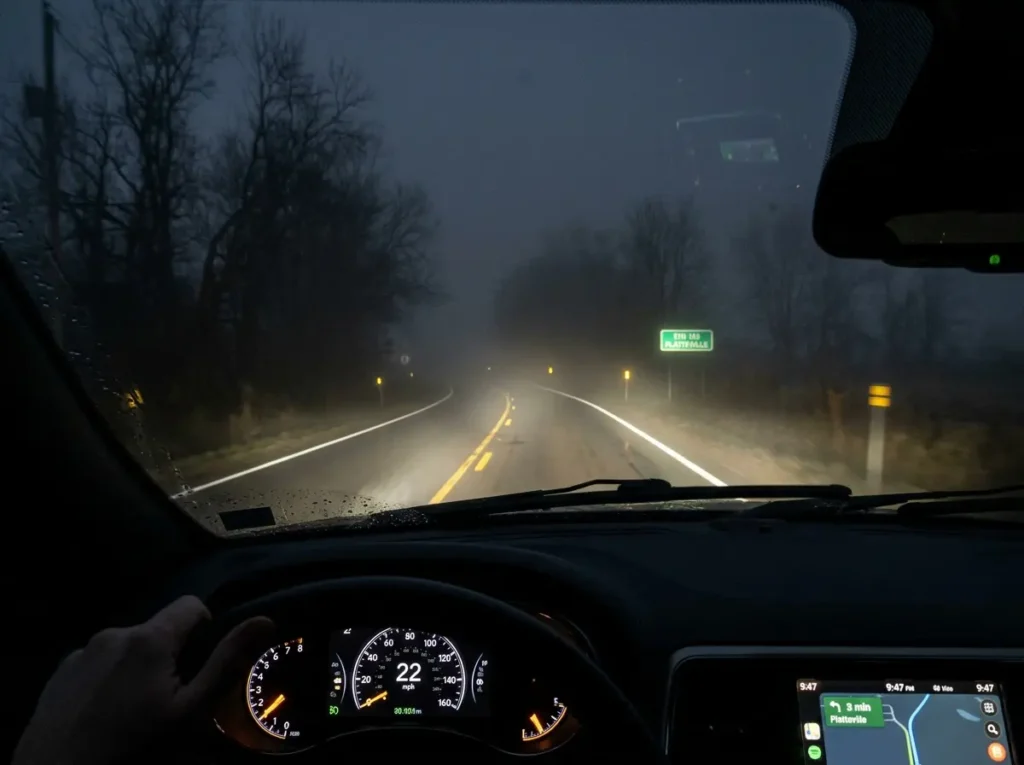
Fog is one of the most treacherous driving conditions Wisconsin drivers encounter, and it is particularly common in the Milwaukee area. Cold air from Lake Michigan mixing with warmer inland air creates dense fog events that can reduce visibility to just a few car lengths. Driving safely in low visibility fog conditions requires a completely different approach from normal night driving.
Use Low Beams or Fog Lights – Never High Beams in Fog
This is the single most important foggy night driving safety rule, and it is widely misunderstood. High beams in fog make visibility worse, not better.
The light from high beams reflects off the water droplets in fog and scatters back toward you, creating a bright white wall that obscures everything ahead. Low beams direct light toward the road surface and reduce this reflection effect.
If your vehicle has dedicated fog lights, the lower, wider-angled lights typically mounted below the front bumper, use them in fog conditions. They are specifically designed to illuminate the road directly ahead while minimizing the reflection that headlights produce in dense moisture.
Slow Down – More Than Feels Natural
When fog reduces visibility to 100 feet or less, the only safe speed is one where you can stop within your visible range. For most drivers in dense fog, that means speeds well below 30 mph, even on highways. Yes, this will feel uncomfortably slow. It is the correct choice.
The most dangerous thing you can do in fog is drive at a speed that assumes clear conditions ahead. Vehicles stopped in the road, animals, and road debris can appear with virtually no warning in dense fog. Driving slowly in low visibility is not overcaution, it is basic physics.
Increase Following Distance Dramatically in Fog
Low visibility driving tips all emphasize following distance, and fog makes it the most critical factor of all. Maintain at least double your normal following distance in fog, and triple it in dense conditions.
Rear-end collisions are among the most common fog-related crashes because drivers follow too closely and cannot stop in time when the vehicle ahead slows or stops suddenly.
Use Road Markings and Edge Lines as Guides
When you cannot see far ahead in fog, redirect your focus to the road immediately in front of you. The right edge line the white painted or reflective line marking the road’s right edge is your most reliable guide for staying in your lane without drifting. Using this reference point rather than trying to track far ahead helps you maintain lane position when the center of the road is invisible.
| If Fog Becomes Too Dense to Drive Safely: Pull completely off the road not just onto the shoulder, but into a parking lot, rest area, or as far from the travel lanes as possible. Turn off your headlights (which can cause following drivers to drive toward your light, thinking you are in the lane) and keep your hazard lights on. Wait for the fog to lift before continuing. Your arrival time is not worth your life or anyone else’s. |
Wisconsin-Specific Night Driving Hazards to Know
Night driving in Wisconsin and around Milwaukee comes with a handful of hazards that drivers from other regions may not be familiar with. Recognizing these local conditions is part of driving safely in Wisconsin after dark.
Deer Crossings Are a Year-Round Risk
Wisconsin has one of the highest rates of deer-vehicle collisions in the United States, and the risk is highest at night particularly during the October through December rut season when deer movement peaks. Outside of Milwaukee’s urban core, virtually any road through wooded or agricultural areas carries a meaningful deer risk after dark.
Deer frequently travel in groups, so if you see one cross the road, slow down and watch for more. Scan the road edges with your peripheral vision, not just straight ahead. If a collision with a deer is unavoidable, brake firmly and stay in your lane, swerving can cause a far worse accident than the deer impact itself.
Black Ice Forms Overnight on Wisconsin Roads
Black ice, a thin nearly invisible layer of ice that forms when temperatures drop just below freezing on wet or damp pavement is one of the most dangerous night driving hazards in Wisconsin. It forms most readily on bridges, overpasses, shaded stretches of road, and areas where water drains across the pavement.
Black ice offers virtually no visual warning and almost no traction. If you encounter it, the vehicle will feel like it is suddenly floating. Respond by easing off the accelerator, making no sudden steering inputs, and allowing the vehicle to slow naturally. Do not brake hard, and do not panic-steer.
Construction Zones Are Common and Especially Hazardous at Night
Milwaukee and the surrounding area has extensive ongoing road construction, and many projects involve lane shifts, temporary markings, and reduced shoulders that are confusing in daylight and genuinely dangerous at night. Construction-zone accidents kill more workers at night than during the day, and driver disorientation from changed road geometry is a leading cause.
When approaching construction zones at night, reduce speed well before the zone begins, pay close attention to temporary signage, and be prepared for sudden lane shifts or narrowing. Treat the posted construction speed limit as a real limit, not a suggestion.
Milwaukee Urban Night Driving: Specific Challenges
Within Milwaukee’s city limits, night driving presents a different set of hazards from rural Wisconsin. Pedestrians, some of whom may be impaired, distracted, or dressed in dark clothing are harder to see at intersections and mid-block crossings.
Cyclists are a significant presence on Milwaukee’s streets and are often less visible than cars. Animals including deer, raccoons, and foxes are present even within city neighborhoods, particularly near the Milwaukee River corridor and wooded parks.
Within the city, reduce speed at poorly lit intersections, give cyclists and pedestrians extra buffer space, and never assume a crosswalk is empty just because you do not immediately see anyone in it.
| Wisconsin Night Hazard | When It Peaks | Key Response |
| Deer crossings | Oct – Dec, dusk to dawn | Scan road edges, slow down on rural roads |
| Black ice | Nov – Mar, overnight and early morning | Ease off gas, no sudden inputs |
| Dense Lake Michigan fog | Spring and fall, especially near the lakefront | Low beams, slow down dramatically |
| Construction zone hazards | Spring through fall, year-round | Reduce speed early, follow temporary signs |
| Impaired drivers | Fri – Sat nights, midnight to 3 a.m. | Keep distance, call 911 if dangerous |
| Pedestrians in dark clothing | Year-round, especially winter | Slow at intersections, check crosswalks |
Practical Night Driving Safety Checklist for Wisconsin Drivers
Before and during every night drive in Wisconsin, run through these safe night driving habits to keep yourself and others protected.
Before You Drive
- Clean your windshield inside and out, interior haze is a major source of night glare
- Check that all exterior lights are working: headlights, taillights, brake lights, and turn signals
- Clean your headlight lenses if they are visibly dirty or fogged
- Adjust your mirrors to minimize glare from following vehicles
- Check the weather forecast, know whether rain, fog, or freezing temperatures are expected along your route
- Make sure you are rested, if you are already tired before you start, do not drive
While Driving
- Reduce speed to match actual visibility, not just the posted limit
- Increase following distance to at least three to four seconds in clear conditions, more in rain or fog
- Use high beams on dark rural roads and dim them promptly for oncoming traffic
- Keep your eyes moving scan ahead, check mirrors, watch road edges
- Avoid looking directly at oncoming headlights, use the right edge of the road as your reference
- Take breaks every two hours on longer night drives, fatigue is cumulative and sneaks up on you
- Stay off your phone entirely, distracted driving at night is even more dangerous than during the day
If Something Goes Wrong at Night
- If your vehicle breaks down, get fully off the road, turn on hazard lights, and call for roadside assistance
- Stay in your vehicle on highways, standing on a dark shoulder is extremely dangerous
- If you feel unsafe in your breakdown location, call 911 in addition to your roadside provider
- Keep MG Towing & Recovery’s number saved in your phone for 24/7 emergency towing and roadside assistance in Milwaukee
Stranded After Dark in Milwaukee? MG Towing & Recovery – 24/7 Emergency Towing & Roadside Assistance. Call Now: 414-973-1902
Frequently Asked Questions: Night Driving in Wisconsin
What is the most dangerous time to drive at night in Wisconsin?
The highest-risk window is between midnight and 3 a.m. on Friday and Saturday nights, when driver fatigue and impaired driving incidents peak. Dusk, roughly 30 to 60 minutes before full dark, is also disproportionately dangerous because visibility is reduced but many drivers have not yet turned on their headlights.
Should I use high beams or low beams in fog?
Always use low beams or dedicated fog lights if your vehicle has them in fog. High beams reflect off fog particles and scatter back toward you, creating a bright glare wall that reduces forward visibility. Low beams direct light toward the road surface and provide better actual visibility in foggy conditions.
How far ahead can I see with standard headlights at night?
Standard low-beam headlights illuminate roughly 160 to 200 feet ahead. High beams extend that range to approximately 350 to 500 feet. At 60 mph, your vehicle covers about 88 feet per second, meaning low beams give you roughly two seconds of reaction time to a hazard at the edge of your visible range. This is why reducing speed at night is so important.
What should I do if a deer runs in front of my car at night?
Brake firmly and stay in your lane. Do not swerve to avoid the deer, swerving at speed can cause you to lose control or collide with oncoming traffic, which is typically more dangerous than the deer impact. After safely stopping or passing the collision point, pull off the road and assess your vehicle for damage. If the deer is in the road and poses a hazard to other drivers, call 911.
What are the signs of black ice on Wisconsin roads?
Black ice is nearly invisible, which makes it so dangerous. Warning signs include: road surface that looks slightly wet or shiny despite dry weather, other vehicles ahead behaving erratically without obvious reason, and a sudden feeling of your steering going very light or unresponsive. Bridges, overpasses, and shaded areas are especially prone to black ice formation on cold nights.
Drive Smart After Dark – Milwaukee and Beyond
Night driving in Wisconsin demands more from every driver. Reduced visibility, unpredictable weather, fatigue risks, and local hazards like deer, black ice, and Lake Michigan fog create a combination that daytime driving simply does not match. But none of these hazards are unmanageable with the right knowledge and habits.
The most important thing you can take from this guide is that night driving safety is not about fear it is about making small, deliberate adjustments that stack up into a dramatically safer experience. Clean headlights. Appropriate speed. More following distance. Eyes that move rather than stare. Knowing when to pull over and rest or wait out bad weather.
And if the night does not go as planned, if your vehicle breaks down on a dark Milwaukee road or out on a Wisconsin highway. MG Towing & Recovery is here around the clock. Our 24/7 emergency towing and roadside assistance service covers Milwaukee and the surrounding area every single day of the year. Save our number before you need it. Safe travels.