

The Complete Driver’s Guide to Towing Methods, Vehicle Safety & Making the Right Call in Milwaukee
Most drivers have no reason to think about tow truck methods until the moment they need a tow and by then it is too late to do the research. You are standing on the side of a Milwaukee road, your vehicle is disabled, and a tow truck is on the way. What you do not know is that the type of tow truck headed toward you matters enormously and that the wrong method for your specific vehicle can cause thousands of dollars in damage to your drivetrain, transmission, suspension, or body that your insurance may not cover.
The two most commonly discussed towing methods are flatbed towing and hook-and-chain towing. They could not be more different in how they handle your vehicle, the risks they carry, and the situations where each is appropriate. Yet many drivers have no idea what distinguishes them and some towing companies, particularly in the lower-cost segment, will use whichever method is easiest for them rather than whichever method is safest for your vehicle.
This guide gives you everything you need to understand both towing methods in detail: how each works mechanically, what types of vehicles each is appropriate for, what specific damage the wrong method can cause, how costs compare in Milwaukee, and how to confidently tell any towing provider exactly what your vehicle needs. This is knowledge that protects your vehicle and your wallet.
Related Articles:
The Difference Between Roadside Assistance and Towing?
How Much Does a Tow Truck Cost in Milwaukee?
What Is Flatbed Towing? How It Works and Why It Is the Gold Standard
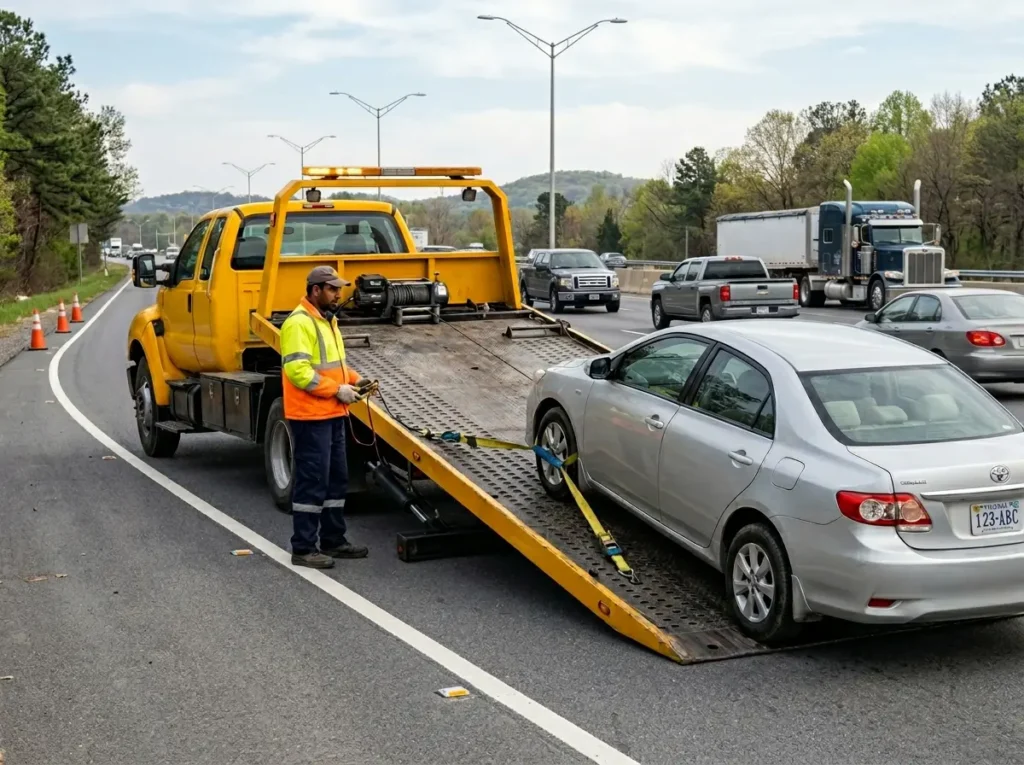
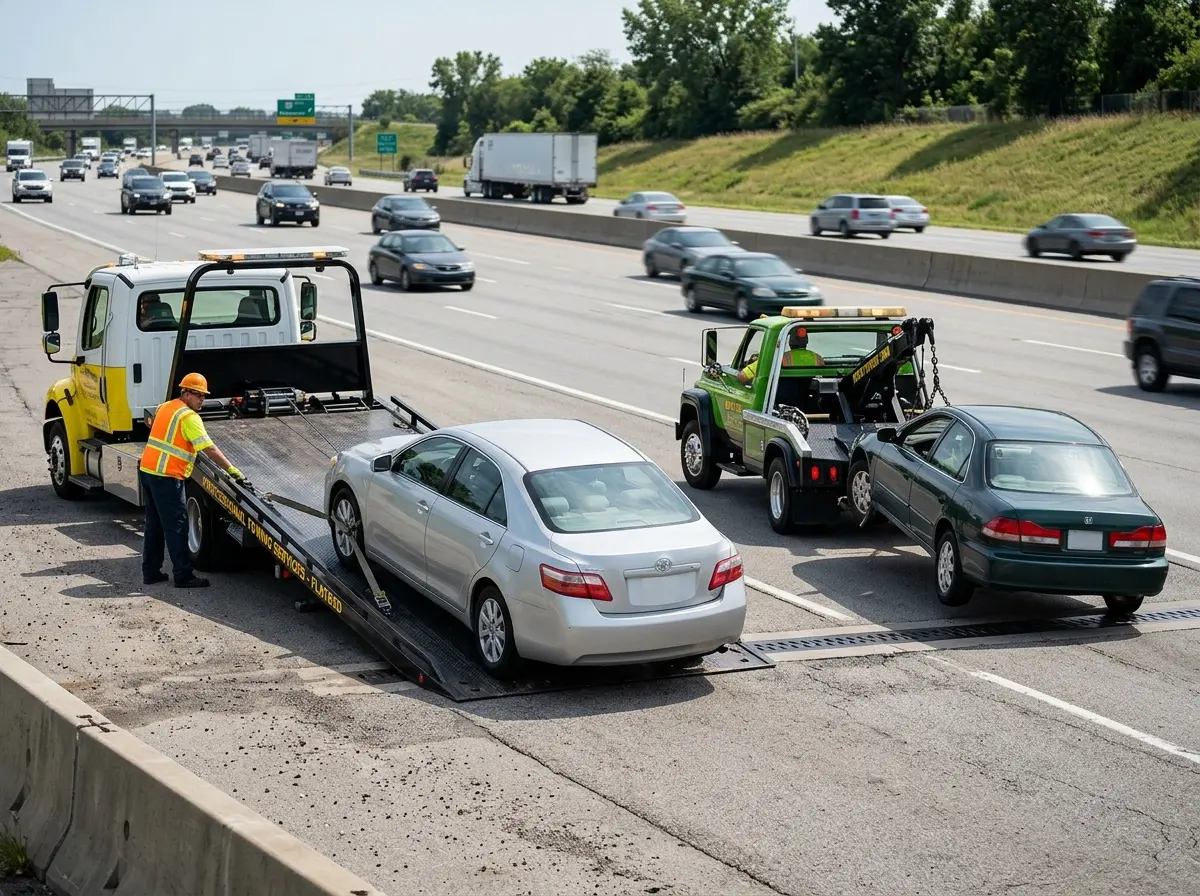
A flatbed tow truck also called a rollback truck, features a long, flat steel platform mounted on the truck’s rear frame. This platform is connected to a hydraulic system that allows it to tilt at an angle, lowering the rear edge to ground level like a ramp.
Once a vehicle is loaded either driven up the ramp, rolled up, or winched up using the truck’s cable system the platform returns to horizontal and the vehicle is secured with heavy-duty wheel straps and load binders at all four wheels.
The defining feature of flatbed towing is absolute: once your vehicle is on that platform, all four wheels are completely off the ground and remain that way for the entire journey. The vehicle is not dragged, rolled, or partially supported, it rides entirely on the flat bed, motionless relative to the road surface, protected from every form of road-contact stress.
Why Flatbed Is Considered the Safest Towing Method?
The safety advantages of flatbed towing flow directly from that one core feature, no road contact. Consider what happens to a vehicle when its wheels are on the ground during towing with other methods: tires wear, wheel bearings experience unintended loads, brakes can drag, and every bump and imperfection in the road translates directly into stress on suspension components, CV joints, and axles. None of that happens on a flatbed.
Additional safety advantages of flatbed towing include:
- There’s no risk of drivetrain damage because AWD and 4WD vehicles stay completely still, so the transfer case and differentials aren’t affected.
- It avoids transmission stress since automatic transmissions aren’t meant to spin at road speeds without the engine running. A flatbed prevents this issue entirely.
- Tire wear isn’t a concern because the wheels remain fixed in place, so there’s no scrubbing during turns.
- There’s no chance of tow equipment touching or damaging the vehicle body. Only secure, purpose-built wheel straps are used.
- The vehicle stays stable throughout the trip and won’t shift or roll when it’s properly secured on the flatbed.
- It’s also the safest option for heavily damaged vehicles, as cars with structural issues, missing wheels, or suspension problems can be loaded easily without needing them to function.
What Types of Vehicles Always Require Flatbed Towing?
For certain vehicle categories, flatbed towing is not just preferable — it is the only method that will not cause damage:
- All wheel drive and four wheel drive vehicles should be towed carefully because leaving any wheels on the road can damage the transfer case and differentials, leading to very expensive repairs.
- Luxury vehicles like BMW, Mercedes, Audi, Porsche, Cadillac, and Tesla often have low ground clearance, advanced AWD systems, and sensitive electronics, making flatbed towing the safest option.
- Classic and vintage cars need extra protection since their original parts and finishes are irreplaceable, so a low impact towing method is always preferred.
- Sports cars and low clearance vehicles have delicate parts like spoilers and diffusers that can easily get damaged with traditional towing methods.
- Motorcycles require proper balance and secure strapping, which makes flatbed towing the only safe choice compared to standard towing.
- Vehicles that have been in an accident may already have structural damage, and towing them with wheels on the road can make the damage worse.
- Long distance transport is safer with a flatbed because it prevents wear and tear that can happen when a vehicle stays in contact with the road for many miles.
| MG Towing & Recovery Standard: At MG Towing & Recovery, our flatbed towing service in Milwaukee is available 24/7 for all vehicle types. When in doubt about which method your vehicle requires, our dispatchers will ask the right questions, including your vehicle’s drive system, clearance, and condition to ensure the right equipment is sent. We never default to the cheaper method when a vehicle needs a flatbed. |
What Is Hook-and-Chain Towing? The Method, the History, and the Risks
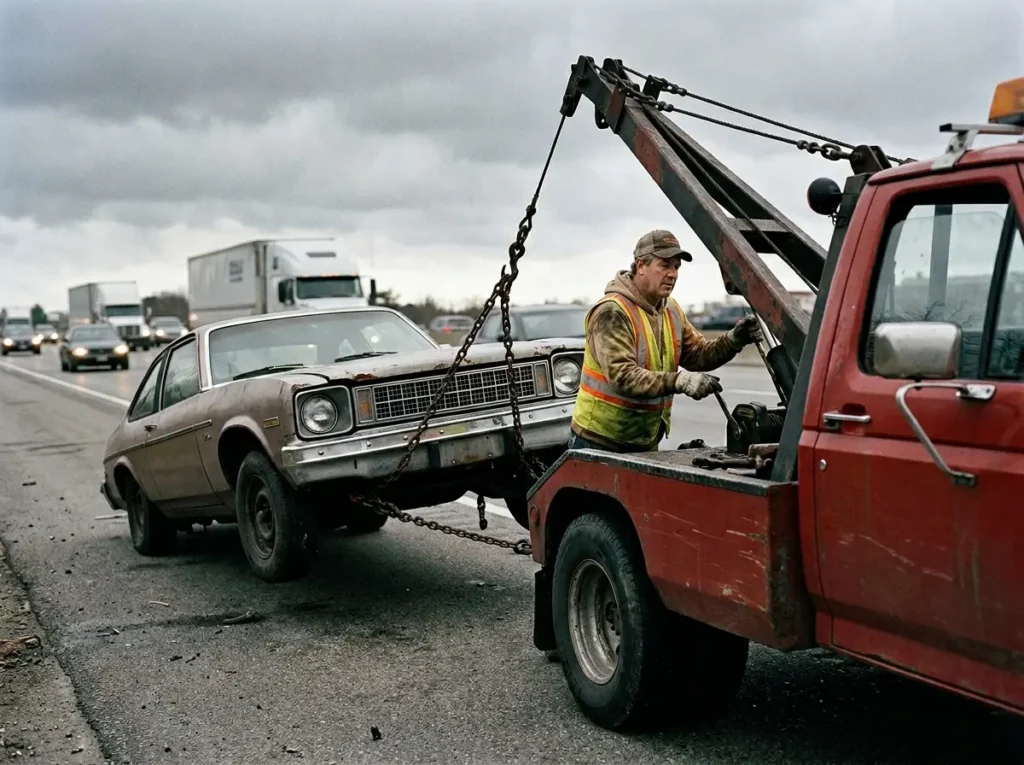
Hook-and-chain towing, sometimes called sling towing, is an older towing technique where chains or a metal hook are attached to the vehicle’s frame or axle, and the front or rear of the vehicle is lifted off the ground using the tow truck’s boom and winch. The opposite end of the vehicle remains on the road, with those two wheels dragging along during the tow.
This method was the industry standard for decades before the development of wheel-lift and flatbed alternatives. You have probably seen it in old movies and television: a tow truck with a crane arm at the rear, chains wrapped around a vehicle’s bumper or undercarriage, the car riding at a tilted angle with two wheels rolling on the ground. It is a recognizable image, and one that represents a largely outdated practice in professional towing today.
How Hook-and-Chain Towing Actually Works?
In a hook-and-chain tow, the operator positions the tow truck in front of or behind the vehicle to be towed. A boom arm extends from the rear of the truck, and chains or a J-hook are lowered and connected to the vehicle’s frame, axle, or tow points.
The boom lifts one end of the vehicle clear of the ground, typically the drive end, or the end closest to the tow truck, while the opposite end’s wheels remain on the road surface.
The tow truck moves forward or backward while your vehicle follows behind at an angle, with two wheels staying on the road the whole time. Because those wheels keep rolling during the tow, this method can lead to most of the common damage risks.
Where Hook-and-Chain Towing Still Has Legitimate Uses
It would be inaccurate to say that hook-and-chain towing is never appropriate. There are specific, limited situations where this method remains a legitimate professional choice:
- Junk or salvage vehicle removal, when a vehicle has no value beyond scrap and damage during towing is irrelevant
- Off-road recovery in certain terrain situations, where a boom and chain setup can reach a vehicle that a flatbed cannot access
- Specific heavy industrial recovery, where chains are used as part of a larger multi-point rigging setup
In standard roadside towing for working vehicles, including everything from a simple breakdown to accident recovery, hook-and-chain towing should not be used. If a tow truck operator tries to use hook-and-chain towing on your running or valuable vehicle, you are within your rights to refuse and request a flatbed instead.
| Do Not Allow Hook-and-Chain on These Vehicles: Never allow hook-and-chain towing on any AWD or 4WD vehicle, any luxury or sports car, any classic or collector vehicle, any motorcycle, any vehicle with accident damage, or any vehicle with low ground clearance. The risk of serious and expensive mechanical damage from these combinations is not theoretical, it is routine. A legitimate, professional towing company will not attempt hook-and-chain on these vehicle types. |
Specific Damage Hook-and-Chain Towing Can Cause to Your Vehicle
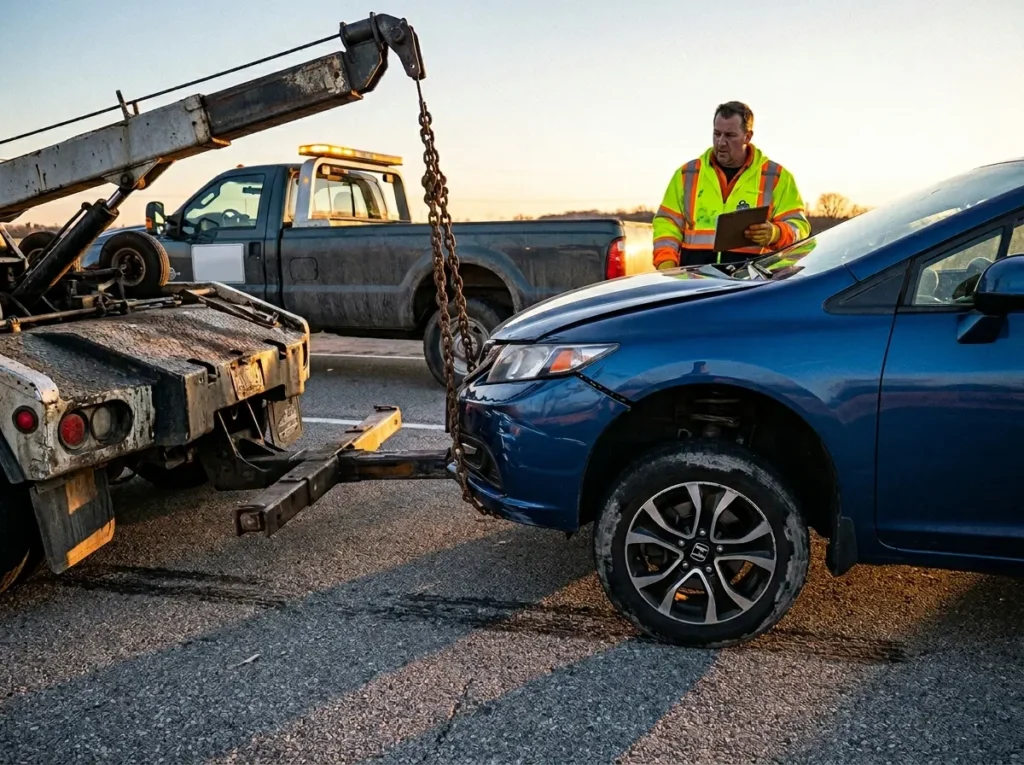
The potential damage from using the wrong towing method is not abstract. Here is a specific, vehicle-system-by-vehicle-system breakdown of what can go wrong when hook-and-chain towing is applied to vehicles that should have been on a flatbed.
1. Transmission Damage
This is the most common and expensive type of damage caused by improper towing. In automatic vehicles, the transmission depends on a pump powered by the engine for lubrication. When the engine is off and the car is towed with drive wheels on the ground, internal parts keep spinning without proper lubrication.
This can quickly cause heat damage, wear, and shifting issues that may lead to complete failure. Repair costs can range from $1,500 to over $4,000.
2. Transfer Case and Differential Damage on AWD and 4WD Vehicles
All-wheel-drive and four-wheel-drive vehicles are especially vulnerable to drivetrain damage when towed incorrectly. Their systems include transfer cases, differentials, and prop shafts designed to keep all wheels moving at the same speed or remain stationary together.
When two wheels stay on the ground, the drivetrain is forced to spin unevenly without proper lubrication from a running engine, leading to serious wear or failure. Repairs often range from $500 to $2,500 or more, especially on luxury or off-road vehicles today frequently.
3. Front End and Suspension Damage
When a chain or hook is attached to a vehicle’s frame or axle to lift the front end, the points used often are not designed for that load and can bend, crack, or become deformed. This can lead to costly subframe repairs or even replacement, and suspension parts may also suffer damage from the unusual stress.
During turns, the rear wheels experience extra side pressure, which increases wear on wheel bearings, tie rod ends, and ball joints due to unsafe towing conditions.
4. Body and Exterior Damage
Hook and chain towing makes physical contact with your vehicle’s undercarriage, frame, or bumpers using metal chains. Even with padding, it can scratch paint, dent panels, crack plastic bumper covers, and damage undercarriage parts.
Low ground clearance vehicles like sports cars and European sedans are especially at risk, with possible damage to spoilers, diffusers, and exhaust systems. Classic cars are even more vulnerable, as chain contact can permanently harm original paint, chrome trim, and vintage panels, reducing value and authenticity.
5. Tire and Wheel Damage
Two wheels dragging along the road during a hook-and-chain tow experience continuous wear, even if the tow is relatively short. More critically, when the tow truck turns or navigates curves, the trailing wheels experience significant lateral scrubbing force,, the tire tread being dragged sideways rather than rolling straight.
This irregular wear pattern can render a tire unsafe well before its tread is visually depleted. Wheel bearings in the trailing wheels also experience off-axis loading that can accelerate bearing wear and lead to premature failure.
| Real Cost Perspective: The cost difference between flatbed towing and hook-and-chain towing on any given tow is typically $20 to $50. The cost of transmission repair from being towed improperly with two drive wheels on the ground is $1,500 to $4,000 or more. The cost of transfer case damage on an AWD vehicle is $500 to $2,500. The cost difference does not remotely justify the risk and no reputable towing company will argue that it does for your vehicle type. |
Other Towing Methods: The Full Picture
The towing industry uses more than just flatbed and hook-and-chain. Understanding the full range of professional towing methods gives you a more complete picture of what a tow truck service in Milwaukee might deploy for different situations.
Wheel-Lift Towing
Wheel-lift towing is the modern replacement for hook-and-chain in most standard towing scenarios. Instead of chains attached to the frame, a wheel-lift system uses a metal yoke that cradles the vehicle’s front or rear wheels directly. The yoke cradles the tires without touching the vehicle’s body or frame, and lifts the cradled end completely off the ground, though the opposite two wheels still remain on the road.
Wheel-lift towing is safer than hook-and-chain because it eliminates chain contact with the vehicle body and distributes the lift through the wheels rather than the frame.
However, it still leaves two wheels on the road, meaning it shares some of the drivetrain and road-contact risks of hook-and-chain for AWD and 4WD vehicles, and it remains unsuitable for very low-clearance vehicles or vehicles with severe damage.
Wheel-lift towing is appropriate for standard FWD and RWD vehicles in working condition for short-distance, local tows. It is faster to deploy than a flatbed, costs slightly less, and is perfectly safe for the vehicle types it is designed for.
Integrated Towing
Integrated tow trucks combine a wheel-lift system with a boom, giving operators more flexibility for accessing vehicles in tight spaces or recovering vehicles that cannot be straightforwardly wheel-lifted. Often used for repossession work and municipal towing, integrated trucks are a step up in versatility from basic wheel-lift.
Heavy-Duty and Rotator Towing
For large commercial vehicles, buses, multi-vehicle accidents, and recovery operations that require lifting vehicles in complex orientations, such as a vehicle that has rolled over on an embankment, heavy-duty boom trucks and rotator cranes are deployed. These specialized vehicles can handle weights and recovery scenarios that standard tow trucks cannot, and they require operators with advanced training and certification.
| Method | Wheels on Road | Best For | Not Suitable For |
| Flatbed / Rollback | None – all four raised | All vehicle types, any damage level, long distance | Very heavy commercial vehicles (use heavy-duty) |
| Wheel-Lift | Two wheels remain on road | FWD/RWD standard vehicles, short local tows | AWD/4WD, luxury, low-clearance, damaged vehicles |
| Hook-and-Chain | Two wheels on road, chain contact | Salvage/junk vehicle removal only | Any valued or functional vehicle |
| Heavy-Duty / Rotator | Varies by setup | Commercial trucks, rollovers, complex recovery | Standard passenger vehicles |
Vehicle-by-Vehicle Guide: Which Towing Method Is Right for Your Car?
Different vehicles have different towing requirements, and knowing what your specific vehicle needs before you call for a tow is one of the most practical pieces of automotive knowledge a driver can have.
1. All-Wheel-Drive and Four-Wheel-Drive Vehicles
Flatbed towing is mandatory for AWD and 4WD vehicles. No exceptions. The interconnected drivetrain architecture of these vehicles makes any towing method that leaves wheels on the road a direct risk for transfer case and differential damage. If a tow truck operator suggests wheel-lift or hook-and-chain for your AWD or 4WD vehicle, decline firmly and request a flatbed. Any reputable tow truck service will confirm this.
2. Front-Wheel-Drive Vehicles
FWD vehicles can be towed with wheel-lift by lifting the rear wheels, the non-driven axle, for short local tows without drivetrain risk. However, flatbed remains the safest overall choice, particularly for longer distances, vehicles under warranty, or any vehicle with low ground clearance. For a simple short breakdown tow with a standard FWD car, wheel-lift by a reputable operator is generally acceptable.
3. Rear-Wheel-Drive Vehicles
RWD vehicles should be towed using either a wheel-lift or a flatbed, with the rear (drive) wheels lifted off the ground. If a rear-wheel-drive vehicle is towed with the rear wheels still on the road, it can lead to serious transmission damage, similar to what happens with AWD vehicles.
The front wheels should not be lifted while allowing the rear wheels to drag, as this is not the correct method for RWD towing. Using a flatbed is the safest option because it keeps all wheels off the ground and removes any risk of drivetrain damage.
4. Luxury Car Towing
Luxury vehicles require flatbed towing in every situation. This is not merely a preference, it is an industry standard backed by most manufacturer towing specifications. BMW, Mercedes-Benz, Audi, Porsche, and similar manufacturers explicitly specify flatbed towing in their owner’s manuals for breakdown situations.
Beyond the drivetrain protection, the lower ride height of many luxury vehicles makes wheel-lift loading a ground-clearance risk. Choosing anything other than flatbed for luxury car towing is choosing to accept preventable damage risk.
5. Classic Car Towing
Classic car towing must use a flatbed and ideally an enclosed flatbed for high-value vehicles. The reasoning is multi-layered: original mechanical components that may be fragile, original paint and bodywork that cannot be matched or replicated, vintage suspension systems not designed for modern towing loads, and the irreplaceable nature of the vehicle as a whole.
Classic car collectors universally regard flatbed as the only acceptable transport method, and most specialty classic car insurance policies require it.
6. Sports Car and Low-Clearance Vehicle Towing
Sports cars and lowered vehicles, whether factory-built or modified, can be difficult to tow with a wheel-lift system. Because these vehicles sit very close to the ground, even a slight ramp angle or incorrect yoke placement can cause the underside to scrape.
This can lead to damage to body kits, exhaust systems, oil pans, and other low-hanging parts. Using a flatbed with a carefully controlled loading angle is the safest way to prevent any risk of damage during transport.
7. Motorcycle Towing Methods
Motorcycles cannot be towed by any conventional method, they cannot be wheel-lifted or hook-and-chained without causing severe damage or simply falling over. Motorcycle towing requires a flatbed truck with appropriate wheel chocks and tie-down points.
The motorcycle is loaded upright onto the flatbed, secured at the handlebars and frame, and transported in the fully stable, upright position. Any towing company that suggests a different approach for motorcycle towing does not have the right equipment for the job.
8. Accident-Damaged Vehicle Towing
Vehicles that have been in accidents require flatbed towing regardless of their drive system, size, or value. The reasons are both practical and protective: a damaged vehicle’s structural integrity may be compromised in ways that make wheel-lift or hook-and-chain loading unsafe, and further stress during towing can worsen existing damage.
Flatbed transport keeps the vehicle static and supported across its full footprint, minimizing additional stress on any compromised structure. For insurance and legal reasons, pre-tow documentation of the vehicle’s exact condition is also far easier and more thorough with a flatbed approach.
Need Safe, Professional Flatbed Towing in Milwaukee? MG Towing & Recovery – The Right Truck for Every Vehicle, 24/7. Call Now: 414-973-1902
Flatbed vs. Hook-and-Chain Towing: Cost Comparison in Milwaukee
One of the most common reasons drivers end up with the wrong towing method is cost, either the driver chooses the cheaper option without understanding the risks, or an unscrupulous provider defaults to a lower-cost method without disclosing it. Here is a clear breakdown of towing costs in Milwaukee for both methods.
| Service | Flatbed Towing Cost | Hook-and-Chain / Wheel-Lift Cost |
| Local tow under 5 miles | $85 – $200 | $60 – $150 |
| Mid-range tow 5–15 miles | $150 – $300 | $100 – $225 |
| Long-distance tow 15–30+ miles | $250 – $500+ | $175 – $400+ |
| Luxury / classic vehicle | $150 – $400+ | Not recommended – avoid |
| Motorcycle towing | $75 – $175 | Not applicable – flatbed only |
| After-hours surcharge | $25 – $75 extra | $25 – $75 extra |
| Accident vehicle towing | $100 – $350+ | Not recommended – avoid |
The True Cost Comparison: Method vs. Repair
The price difference between flatbed towing and wheel-lift or hook-and-chain for a standard local tow is typically $25 to $50. That modest premium should be evaluated against the potential repair costs that the wrong method can generate:
- Transmission repair or replacement: $1,500 – $4,000+
- Transfer case repair (AWD/4WD): $500 – $2,500
- Differential repair: $400 – $1,500
- Subframe or frame damage repair: $500 – $2,000+
- Wheel bearing replacement: $200 – $500 per wheel
- Low-clearance body damage (spoilers, diffusers, exhaust): $300 – $2,000+
Viewed from this perspective, choosing flatbed towing over a cheaper alternative is not an extravagance, it is straightforward risk management.
How to Get Affordable Towing Services in Milwaukee Without Compromising Safety?
Affordable towing in Milwaukee does not have to mean accepting the wrong method for your vehicle. Here is how to get fair pricing on proper towing:
- Ask for a quote that specifies flatbed towing before agreeing, a reputable company quotes flatbed rates transparently.
- Check whether your auto insurance includes towing coverage or whether a roadside assistance plan covers the cost.
- Call a local Milwaukee towing company like MG Towing & Recovery directly, local providers often have more competitive pricing than nationally dispatched services that add routing overhead.
- Never choose a towing company based solely on the lowest quote, a tow that saves you $30 and destroys your transfer case is not a bargain.
How to Choose the Right Tow Truck for Your Situation?
The next time you need a tow in Milwaukee, use this decision framework to make sure the right equipment is on the way before it arrives.
Questions to Ask Any Towing Provider
- Do you have flatbed trucks available right now, and is one being dispatched for my vehicle?
- What is the towing method you plan to use, and why is it appropriate for my vehicle’s drive system?
- Do you have experience towing vehicles like mine, AWD, luxury, classic, motorcycle, low-clearance?
- Can you provide a flat-rate quote that specifies the method and includes all fees before you arrive?
- Do you carry insurance that covers any additional damage caused during towing?
Red Flags from a Towing Company
- They arrive with a wheel-lift truck for an AWD, luxury, or damaged vehicle without explanation
- They are unable or unwilling to explain which towing method they will use
- They refuse to quote a price before arriving and loading the vehicle
- They pressure you to make a quick decision without giving you time to ask questions
- The truck has no visible company identification, license plate, or operator credentials
Why MG Towing & Recovery Is the Right Choice for Milwaukee Towing?
MG Towing & Recovery operates a modern, well-maintained fleet of flatbed tow trucks in Milwaukee. Our operators are trained in proper vehicle handling for all vehicle types like standard sedans, AWD and 4WD vehicles, luxury imports, classic cars, motorcycles, and accident-damaged vehicles. We do not default to cheaper methods to save time or cost, we send the right equipment for your specific vehicle every single time.
When you call MG Towing & Recovery for towing in Milwaukee, our dispatcher will ask about your vehicle’s make, model, drive system, and condition before dispatching because those details determine what truck to send.
Our pricing is transparent and quoted before we arrive. Our operators document vehicle condition before loading. And our 24/7 availability means we are there whether your towing need happens at noon on a Tuesday or at 3 a.m. on a winter Saturday.
FAQs: Towing Methods and Vehicle Safety
Q. Is wheel-lift towing always bad for my car?
Wheel-lift towing is suitable for short local tows, especially for front-wheel-drive sedans when handled by a professional. However, it may not be ideal for AWD, 4WD, luxury, classic, low-clearance, motorcycles, or damaged vehicles, as it can increase risk. Flatbed towing remains the safest option for all vehicle types.
Q. Can I request a flatbed tow even if the company dispatched a wheel-lift truck?
You have the right to request the proper towing method before your vehicle is loaded. If a wheel-lift truck arrives when your vehicle needs a flatbed, ask for a flatbed. A reputable company will comply. If refused, choose another provider.
Q. My owner’s manual says to use flatbed towing. Does that matter?
Yes, it matters. If the owner’s manual specifies flatbed towing, it’s because the vehicle’s drivetrain, electronics, or design can be damaged by other methods. Following this guidance also helps protect your warranty, since improper towing that causes damage may lead the manufacturer to deny repair coverage.
Q. How do I know which towing method was used on my car?
If present, you can observe the tow directly. If absent and arranged by police or insurance, request the towing company’s incident report detailing equipment and method used. If new issues appear, have a mechanic inspect and document for insurance claims.
Q. Does insurance cover damage caused by improper towing?
Any damage from improper towing is the towing company’s responsibility, not yours. Professional tow companies carry insurance for this. Take photos of any new damage right away, file an insurance claim, and seek legal advice if needed. Avoid signing any release form until you fully inspect your vehicle.
The Bottom Line: Your Vehicle Deserves the Right Method
Choosing between flatbed towing and hook and chain or wheel lift towing is more than just a cost or preference decision. For many vehicles, it can determine whether your car arrives safely at the repair shop or ends up with serious damage like transmission issues, transfer case failure, or body scratches that lead to expensive repairs.
Flatbed towing is widely considered the safest method because it keeps the vehicle completely off the road, removing all contact-related risks. It is especially recommended for AWD and 4WD vehicles, luxury and classic cars, motorcycles, sports cars, accident-damaged units, and long-distance transport.
MG Towing & Recovery offers reliable flatbed towing in Milwaukee available 24/7. Our team focuses on safe, damage-free transport every time, ensuring your vehicle is handled with care from pickup to drop-off.