

Every minute, somewhere in America, a driver is stranded on the side of the road. A flat tire. An accident. A dead battery in a parking lot at 2 a.m. Someone has to show up. That “someone” runs a tow truck business, and chances are, they’re making a very good living doing it.
If you’ve been searching for a recession-resistant business with steady demand, low competition in many local markets, and strong profit margins, the towing industry deserves a serious look. According to IBISWorld, the U.S. towing services industry generates over $11 billion in annual revenue, with more than 60,000 active businesses nationwide. Demand keeps climbing as vehicle ownership grows and roadside breakdowns remain constant year after year.
This guide walks you through exactly how to start a towing company the right way, from your first business plan to your first paying customer. No fluff. Just the real steps, real numbers, and the mistakes you need to avoid.
Also Read: What Is Flatbed Towing and When Is It Needed?
What is a Tow Truck Business?
A tow truck business provides vehicle recovery, transport, and roadside assistance services. Operators move disabled, illegally parked, impounded, or accident-damaged vehicles from one location to another using specialized trucks.
Common services include:
- Emergency roadside towing after breakdowns or accidents
- Private property impound for apartment complexes, businesses, and HOAs
- Police-contracted towing for accidents and abandoned vehicles
- Long-distance vehicle transport for dealerships and private owners
- Heavy-duty towing for semis, RVs, and commercial vehicles
- Roadside assistance including jump-starts, tire changes, and lockouts
- Repossession services for lenders and finance companies
The beauty of this industry is its 24/7 demand. Cars break down at every hour, in every weather condition, in every city.
Step-by-Step Guide to Starting a Tow Truck Business
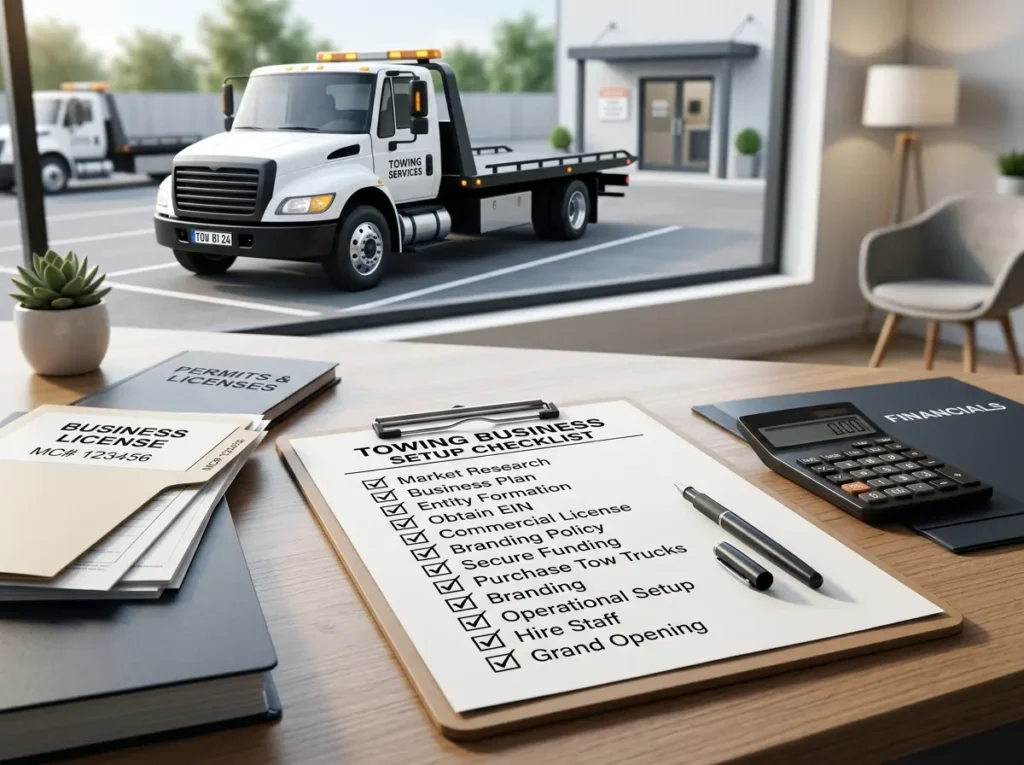
Step 1: Market Research and Business Plan
Before buying a single truck, study your local market. Drive around. Count the towing companies listed on Google Maps. Check their reviews. Call a few and ask for a tow quote (pretend to be a customer). You’ll learn their pricing, response times, and service gaps in under an hour.
Your tow truck business plan should include:
- Target market (residential, commercial, police contracts, or motor clubs)
- Competitor analysis with pricing comparisons
- Service area radius
- Startup capital and funding plan
- Revenue projections for year 1, 2, and 3
- Break-even analysis
A solid plan is also what banks and the SBA need to approve financing.
Step 2: Choose Your Niche
Picking the right niche decides which truck you buy, what license you need, and who your customers are.
- Local/light-duty towing: Sedans, SUVs, small trucks. Lowest startup cost.
- Long-distance towing: Moving vehicles across states. Higher rates per job.
- Heavy-duty towing: Semis, buses, RVs. Requires specialized trucks ($150K and up) but pays $500 to $2,000 per job.
- Police/municipal contracts: Steady volume but competitive bidding.
- Private property/impound: High volume in urban areas.
- Motor club contracts (AAA, Agero, Urgent.ly): Reliable call volume but lower per-call rates.
Most new owners start with light-duty local towing and expand from there.
Step 3: Business Registration and Legal Structure
Register your business as an LLC in most cases. It protects your personal assets if a tow goes wrong (and sometimes it will). You’ll need to:
- Choose a business name and check state availability
- File LLC or corporation paperwork with your Secretary of State
- Get a federal EIN from the IRS (free at irs.gov)
- Open a business bank account
- Register for state and local taxes
Expect to spend $100 to $500 on registration depending on your state.
Step 4: Licenses and Permits
This is where most first-time owners get tripped up. Tow truck requirements vary dramatically by state and city.
You will likely need:
- USDOT Number if operating across state lines or above a certain weight
- Motor Carrier (MC) Authority from the FMCSA for interstate towing
- State tow operator license (required in TX, CA, FL, NY, and many others)
- Local business license from your city or county
- Police tow rotation permit if you want municipal contracts
- Vehicle storage facility license if you plan to impound
California, for example, requires a Tow Truck Driver Certificate from the CHP. Texas requires operators to register with TDLR. Always check with your state’s Department of Transportation before buying equipment.
Step 5: Insurance Requirements
Insurance is non-negotiable. Skipping coverage will end your business after the first incident.
Minimum coverage to carry:
- Commercial auto liability: $750,000 to $1 million
- On-hook coverage: Protects vehicles in tow ($50K to $100K)
- Garagekeepers insurance: Covers vehicles stored on your lot
- General liability: $1 million standard
- Workers’ compensation: Required in most states once you hire
Expect annual premiums between $7,000 and $15,000 per truck for a new operator.
Step 6: Buying Tow Trucks and Equipment
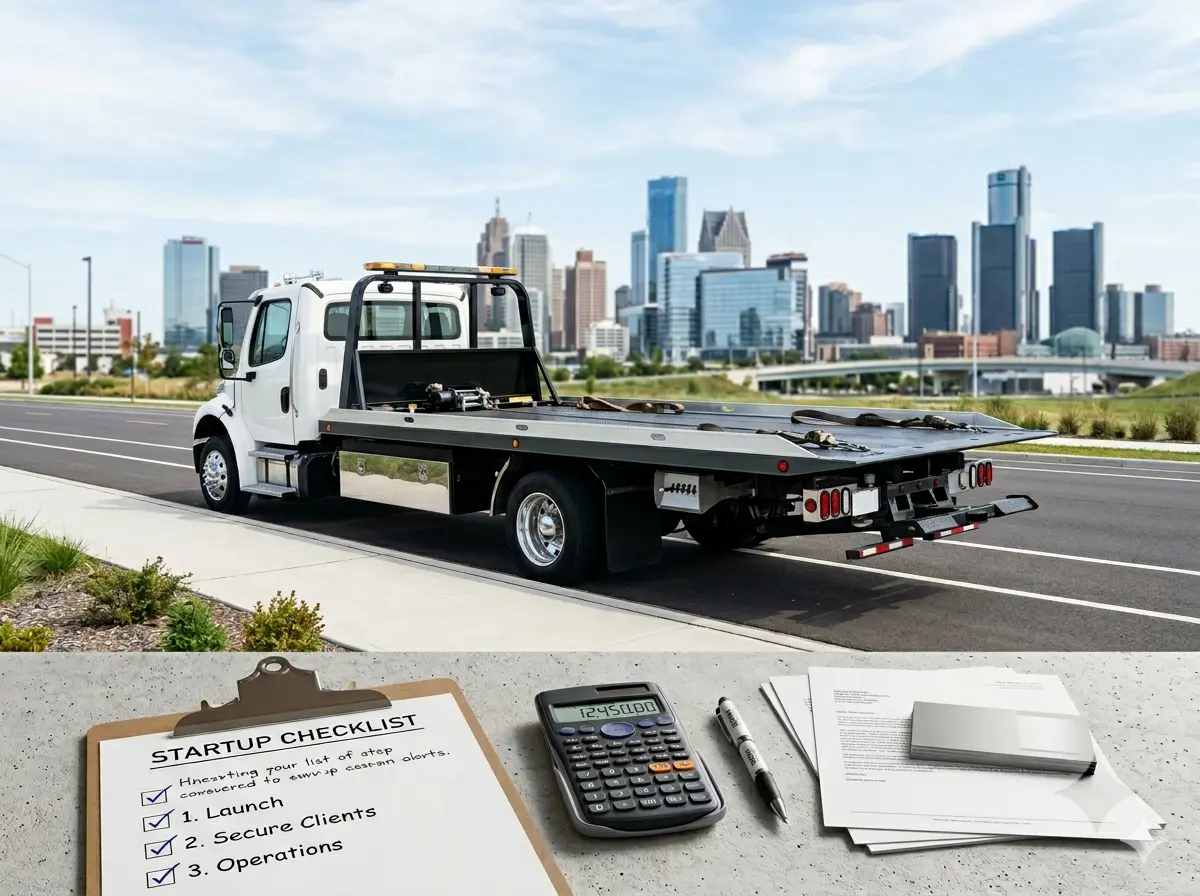
A new flatbed tow truck costs $90,000 to $130,000. A used one in good shape runs $35,000 to $70,000. Starting with one reliable used truck is smart. Don’t overspend before you have revenue.
Essential equipment:
- Tow truck (flatbed or wheel-lift)
- Heavy-duty chains, straps, and J-hooks
- Dollies for AWD vehicles
- Safety cones and flares
- Dash cam (protects you in disputes)
- GPS tracking
- Fuel cards
- Magnetic signs or vehicle wrap
Step 7: Hiring Drivers and CDL Requirements
For light-duty trucks under 26,000 lbs GVWR, drivers generally need a regular driver’s license plus a clean MVR. For medium and heavy-duty trucks, drivers need a Commercial Driver’s License (CDL), Class B or Class A depending on weight.
Always run:
- Motor vehicle record check
- Background check
- Drug screening
- DOT physical (for CDL drivers)
Pay ranges from $15 to $25 per hour, or a 25% to 40% commission split on each tow.
Step 8: Pricing Strategy
Your pricing directly impacts profit. Research local rates, then price competitively.
Typical pricing structure:
- Hook fee (base rate to attach vehicle): $75 to $125
- Per-mile fee: $3 to $7 per mile
- After-hours fee: $50 to $100 extra
- Heavy-duty rates: $250 to $500 per hour
- Storage fees: $25 to $75 per day
Never lowball to win business. It attracts cheap customers and kills your margin.
Step 9: Set Up a Dispatch System
For the first year, your phone can be your dispatch. Once you scale past one truck, invest in dispatch software like Towbook, TOPS, or Ranger SST. These tools automate job assignments, invoicing, and reporting. Expect to pay $60 to $200 per month per truck.
Step 10: Marketing and Lead Generation
More on this below, but the short version: show up on Google, partner with local businesses, and answer every call within three rings.
Also Read: How to Start a Roadside Assistance Business?
Startup Costs Breakdown
Here’s a realistic range of what it costs to launch a one-truck towing operation.
| Item | Estimated Cost (Low) | Estimated Cost (High) |
|---|---|---|
| Business registration & licenses | $300 | $1,500 |
| Tow truck (used vs. new) | $35,000 | $130,000 |
| Equipment (chains, dollies, etc.) | $2,000 | $6,000 |
| Insurance (annual) | $7,000 | $15,000 |
| Dispatch software | $700 | $2,400 |
| Website & branding | $500 | $3,000 |
| Marketing (first 3 months) | $1,000 | $5,000 |
| Storage lot lease | $500 | $3,000 |
| Working capital | $5,000 | $15,000 |
| Total | $52,000 | $180,900 |
Most new owners get started with $55,000 to $75,000 by buying a used truck.
Types of Tow Trucks You Can Use
Choosing the right truck depends on your niche. Here’s how the four main types compare.
| Truck Type | Best For | Price Range | Pros | Cons |
|---|---|---|---|---|
| Flatbed | Luxury cars, AWD, long-distance | $90K to $150K | Safest for vehicles; widely preferred | Higher upfront cost |
| Hook and Chain | Wrecked vehicles only | $25K to $50K | Cheap, simple | Damages modern cars; mostly phased out |
| Wheel Lift | Repos, impound, tight spaces | $55K to $90K | Fast, maneuverable, affordable | Not ideal for AWD or damaged cars |
| Integrated (Heavy-Duty) | Semis, buses, RVs | $150K to $400K+ | Highest-paying jobs | Major capital, requires CDL-A |
For most startups, a flatbed or wheel lift is the best first purchase.
Licenses, Permits, and Legal Compliance
Compliance is where towing companies get shut down fast. The Federal Motor Carrier Safety Administration (FMCSA) requires a USDOT number for most towing operations, and interstate haulers need MC Authority.
Real-world examples:
- In Florida, operators need a Wrecker Operator License from local law enforcement plus FDOT compliance
- In New York City, tow companies serving NYPD rotations must register with the DCWP and pass inspections
- In Texas, all tow operators must be licensed through TDLR, and consent tows require an additional permit
Safety compliance also matters. DOT requires drivers to follow Hours of Service rules if using trucks over 10,001 lbs, and all trucks must display DOT numbers visibly. Annual vehicle inspections are mandatory in most states.
Skipping any of this can trigger fines from $1,000 to $25,000 per violation.
How Much Can You Earn?

Earnings vary by location, niche, and hours of operation. A single truck running light-duty tows in a mid-size city can realistically gross $120,000 to $250,000 per year.
| Scenario | Tows per Month | Avg. Price per Tow | Monthly Revenue | Annual Revenue |
|---|---|---|---|---|
| Part-time (1 truck) | 60 | $125 | $7,500 | $90,000 |
| Full-time (1 truck) | 120 | $150 | $18,000 | $216,000 |
| 3-truck operation | 360 | $160 | $57,600 | $691,200 |
| Heavy-duty specialist | 40 | $750 | $30,000 | $360,000 |
Net profit margins typically run 20% to 30% after fuel, insurance, maintenance, and labor. Owners who secure motor club or police contracts often hit 35% once fleet size allows for volume discounts on insurance and fuel.
Factors that affect income:
- Number of trucks
- Service area population
- Contracts with motor clubs, police, and businesses
- Fuel prices
- Driver retention
Best Marketing Strategies for Tow Truck Businesses
Most tow calls start on a smartphone during a stressful moment. Winning those calls comes down to showing up first in local search.
1. Google Business Profile
Claim and optimize your Google Business Profile. Add photos of your trucks, list every service, collect reviews from every happy customer, and respond to every review (good or bad). This single step drives more calls than most paid ads.
2. Local SEO
Build a simple website targeting keywords like “tow truck near me,” “24 hour towing [your city],” and “cheap towing [your city].” Create dedicated pages for each service and each city you serve. Make sure your site loads fast on mobile.
3. Emergency Search Keywords
People searching “car stuck in ditch near me” or “jump start service open now” are ready to pay right now. Bid on these in Google Ads. Expected cost per click runs $8 to $25, but conversion rates are strong.
4. Strategic Partnerships
- Police departments: Join the rotation list
- Auto repair shops: Offer a referral commission
- Insurance companies: Get added to their approved vendor lists
- Motor clubs: AAA, Agero, Quest, Urgent.ly all send consistent jobs
- Parking lots and property managers: Sign exclusive impound contracts
- Dealerships: Handle their vehicle deliveries
5. Referral Programs
Offer $20 to $50 to body shops and mechanics for every tow they send your way. This one tactic has built entire towing empires.
Common Mistakes to Avoid
- Underinsuring the business. One accident without proper coverage can wipe you out.
- Pricing too low to win customers. You’ll work harder for less and burn out in a year.
- Ignoring local SEO. If you’re not on Google Maps, you don’t exist to customers.
- Buying too much truck, too soon. A $150K new flatbed looks great but crushes cash flow.
- Hiring the wrong drivers. Bad drivers damage vehicles, lose customers, and create insurance claims.
- No written contracts with motor clubs or police rotations. Always get it in writing.
- Poor record-keeping. Missed DOT compliance deadlines lead to fines and shutdowns.
Tips to Scale Your Towing Business
Once your first truck is profitable, scale strategically:
- Add a second truck only after the first is booked consistently. If one truck runs 100+ tows per month, it’s time.
- Offer 24/7 service. Most tow calls happen nights and weekends. Competitors who close at 6 p.m. hand you their business.
- Win municipal contracts. Cities bid out tow rotation lists every few years. A single contract can guarantee 200+ tows per month.
- Diversify services. Add roadside assistance, repossession, or heavy-duty towing to spread risk.
- Invest in fleet management software. Real-time GPS and dispatch software boost productivity 20% to 40%.
- Build a storage lot. Impound fees alone can generate $5,000 to $20,000 per month in passive revenue.
- Franchise or partner regionally. Once you have 5+ trucks, licensing your brand or partnering with nearby operators opens new markets.
Conclusion
The towing industry rewards operators who plan carefully, price smartly, and show up when others won’t. You don’t need a fleet of trucks or a million-dollar bank account to start. You need one reliable truck, proper licensing, solid insurance, and the hustle to answer the phone at 3 a.m.
Start small. Serve customers well. Reinvest your profits. Within two to three years, a well-run towing company can scale from a single-truck operation into a multi-truck business generating six to seven figures annually.
The road is open. The next breakdown call is coming. Make sure it rings your phone.
FAQs About How to Start a Tow Truck Business
Here are some of the frequently asked questions from the people who are thinking about starting a tow truck business in USA.
How much does it cost to start a tow truck business?
Starting a tow truck business typically costs between $52,000 and $180,000. The biggest expense is the truck itself, which ranges from $35,000 used to $130,000 new. Other major costs include insurance ($7,000 to $15,000 annually), licensing, equipment, and working capital.
Do I need a CDL to drive a tow truck?
You only need a CDL if your tow truck has a gross vehicle weight rating (GVWR) over 26,000 pounds or if you’re towing heavy-duty vehicles. Most light-duty flatbeds and wheel-lift trucks can be operated with a standard driver’s license, though your state may require an additional tow operator certification.
Is owning a tow truck business profitable?
Yes. A single tow truck can generate $120,000 to $250,000 in annual revenue, with profit margins of 20% to 30%. Operators with municipal contracts, motor club agreements, or heavy-duty specialization often earn significantly more. The key to profitability is controlling costs on insurance, fuel, and maintenance.
What insurance do I need for a tow truck business?
You need commercial auto liability ($750,000 to $1 million minimum), on-hook coverage for vehicles being towed, garagekeepers insurance for stored vehicles, general liability, and workers’ compensation if you hire employees. Expect to pay $7,000 to $15,000 per truck per year.
How do I get towing contracts with police or cities?
Contact your local police department and city clerk to ask about their tow rotation list or request for proposals (RFP) process. You’ll need a valid tow operator license, proper insurance, a secure storage facility, and often a bid submission. Most cities re-bid these contracts every 2 to 5 years.
What is the best type of tow truck for a beginner?
A used flatbed truck is the best choice for most new operators. Flatbeds handle nearly any vehicle type (including luxury, AWD, and damaged cars) without causing damage, making them the safest and most versatile option. A quality used flatbed costs $35,000 to $70,000 and can pay for itself within 12 to 18 months.