

The Complete Driver’s Guide to Flatbed Tow Service in Milwaukee
If you have ever called a towing company and been asked whether you need a flatbed or a wheel-lift truck, you may have found yourself wondering what the difference actually is and why it matters. The answer matters more than most drivers realize. The wrong type of tow truck for your vehicle can cause expensive mechanical and cosmetic damage that far exceeds the cost of the tow itself.
Flatbed towing is widely considered the gold standard of vehicle transport. Whether you are dealing with a car breakdown, recovering from an accident, transporting a luxury vehicle, or getting a motorcycle moved across the city, a flatbed tow truck offers a level of safety and protection that other towing methods simply cannot match.
In this guide, we break down exactly what flatbed towing is, how it works, which vehicles and situations require it, and what you can expect to pay for flatbed towing in Milwaukee. If you want to make an informed decision the next time your vehicle needs to be moved, this is the guide to read.
Related Article: Ultimate Guide to Towing and Recovery in Milwaukee, WI
What Is Flatbed Towing?
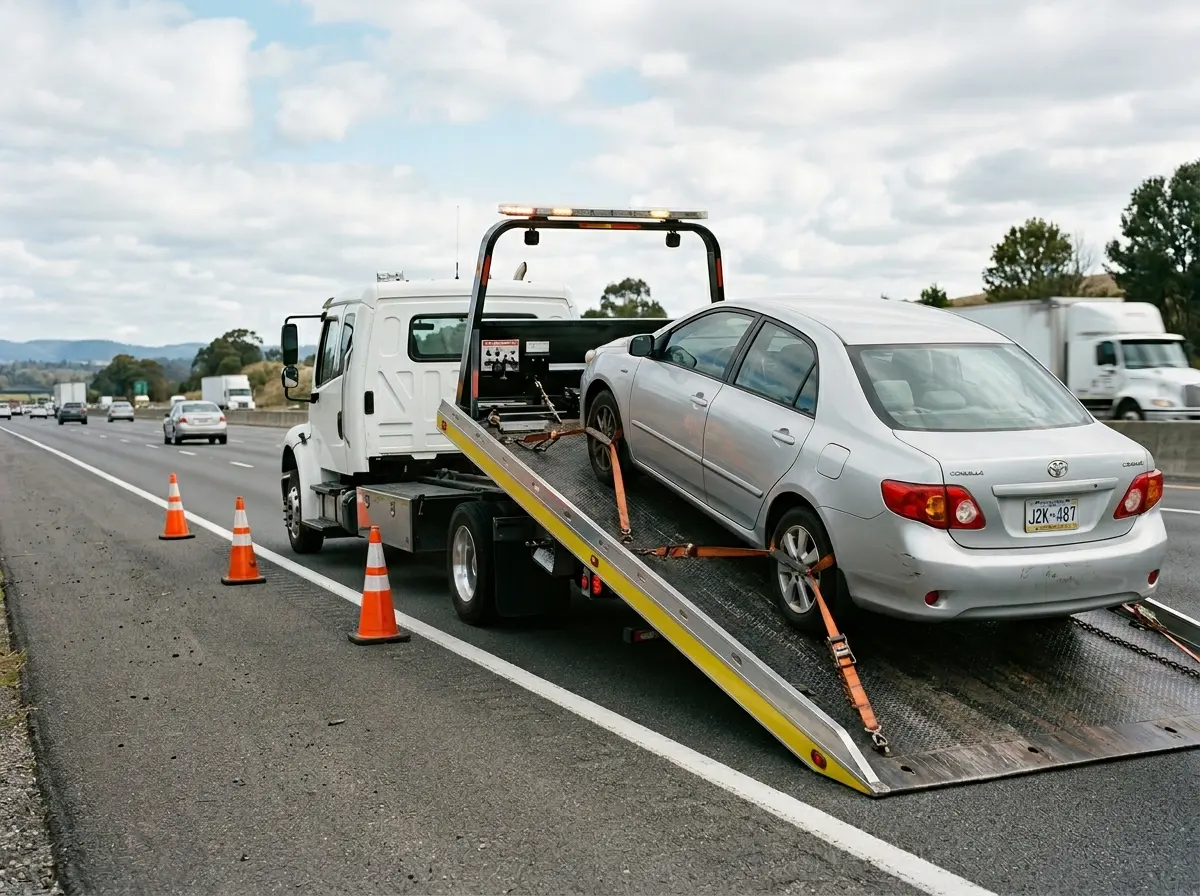
A flatbed tow truck also called a rollback tow truck is a specialized vehicle with a long, flat platform mounted on its rear. That platform can be hydraulically tilted and lowered to ground level, allowing a vehicle to be driven, rolled, or winched directly onto it. Once the vehicle is secured on the bed, the platform is raised back to horizontal and locked in place for transport.
Unlike wheel-lift or hook-and-chain towing methods, which only support either the front or rear axle while the other wheels stay in contact with the road and may drag, flatbed towing lifts the entire vehicle completely off the ground.
All four wheels are placed securely on the platform and remain elevated throughout the journey. This full suspension is what makes flatbed towing the safest and most versatile towing method available.
How Does a Flatbed Tow Truck Work?
The mechanics of a flatbed tow truck are straightforward but impressively effective. Here is what the process looks like from start to finish:
- The driver positions the flatbed truck in front of or beside the vehicle to be towed
- The hydraulic system tilts the flat platform at an angle, lowering the rear edge to the ground like a ramp
- The disabled vehicle is either driven onto the bed under its own limited power, rolled on manually, or winched up using the truck’s built-in cable winch system
- The vehicle is centered on the platform and all four wheels are secured using heavy-duty straps and wheel chocks
- The platform is hydraulically raised back to level and locked into the transport position
- The vehicle travels with all four wheels completely off the ground for the entire tow
The result is a smooth, stable, road-contact-free transport that protects the vehicle’s drivetrain, transmission, tires, and undercarriage throughout the journey.
| Key Distinction: With wheel-lift towing, two of your vehicle’s wheels remain in contact with the road throughout the tow. Every mile traveled puts wear on those wheels, tires, and wheel bearings. With flatbed towing, zero wheels touch the road eliminating all road-contact risk entirely. |
Flatbed vs. Wheel-Lift Towing: What Is the Difference?
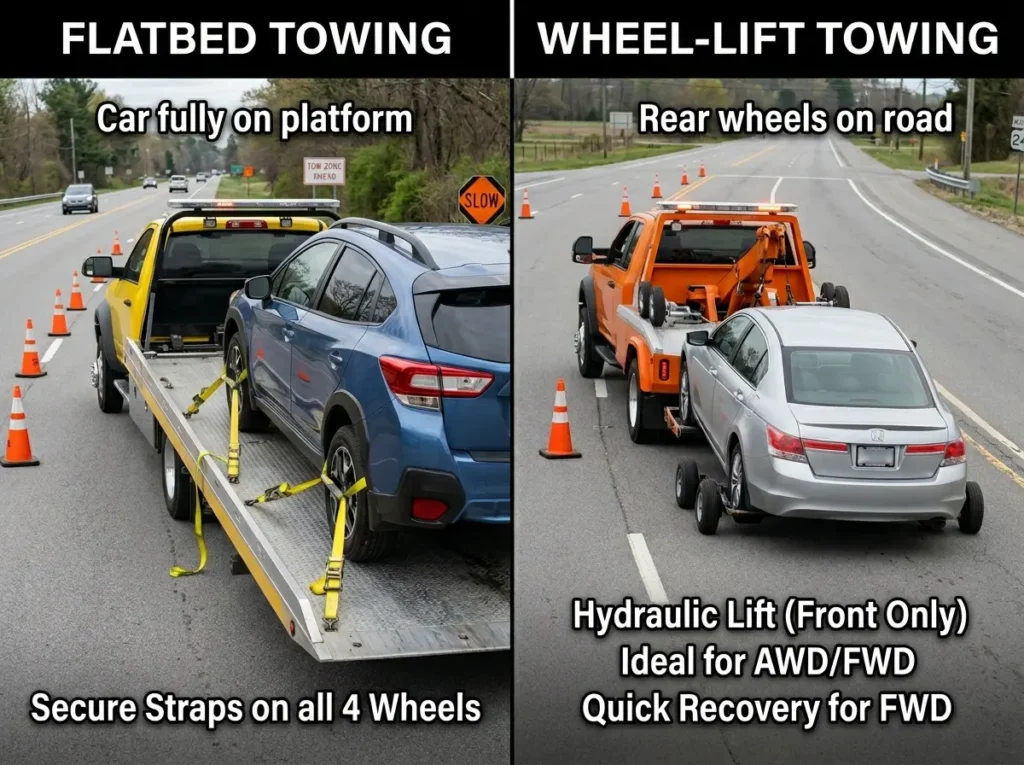
To truly understand the value of flatbed towing service, it helps to compare it directly with the most common alternative: wheel-lift towing. Both methods have legitimate uses, but they are not interchangeable.
| Feature | Flatbed Towing | Wheel-Lift Towing |
| Wheels on road during tow | None – all four wheels raised | Two wheels remain on road |
| Drivetrain stress | Zero | Moderate to significant |
| Best for AWD/4WD vehicles | Yes – required in most cases | Not recommended |
| Suitable for severely damaged vehicles | Yes | Often not possible |
| Risk of additional damage | Very low | Moderate |
| Cost | Slightly higher | Slightly lower |
| Best for luxury/classic cars | Yes – highly recommended | Not recommended |
| Best for motorcycles | Yes – only safe option | No |
The bottom line is simple: wheel-lift towing is acceptable for basic short-distance tows of standard two-wheel-drive vehicles in working condition. For anything more complex damage, drivetrain type, vehicle value, or distance, flatbed towing is the right choice.
Need Flatbed Towing in Milwaukee? MG Towing & Recovery – Professional Flatbed Tow Service, Available 24/7. Call Now: 414-973-1902
When Is Flatbed Towing Required or Strongly Recommended?
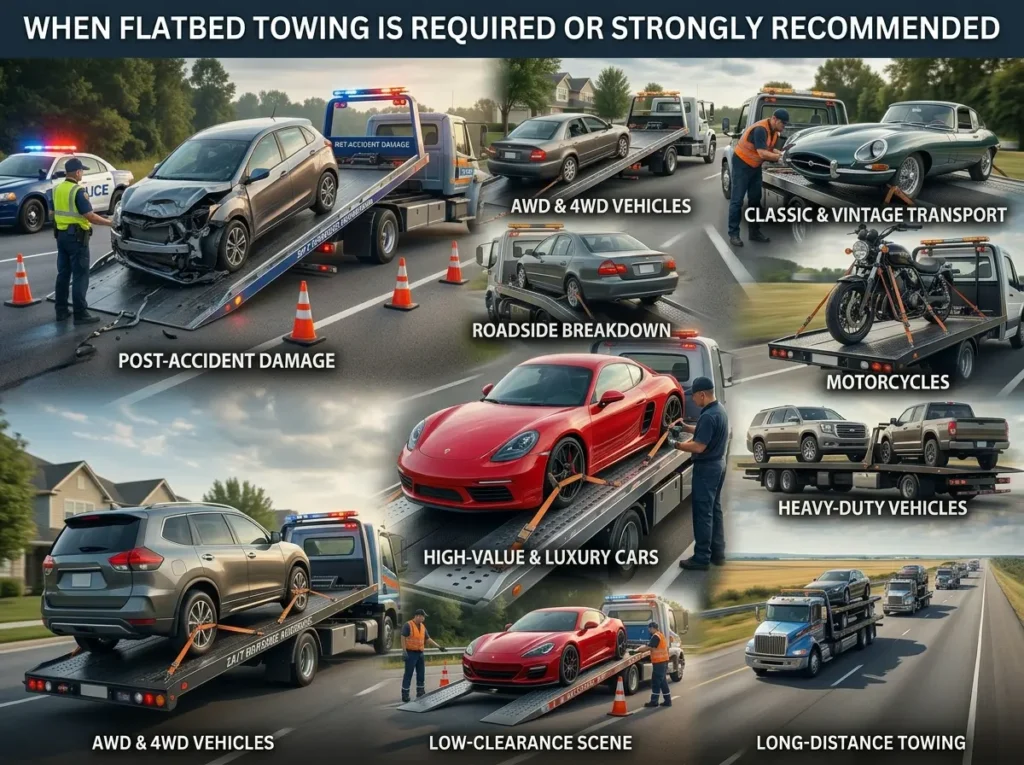
Not every towing situation calls for a flatbed, but there are many scenarios where it is not just preferable it is the only responsible option. Here is a comprehensive breakdown of when flatbed towing is needed.
1. After a Vehicle Accident
Accident vehicle flatbed tow is one of the most common and important applications. When a vehicle has been in a collision, there is often hidden structural, mechanical, or drivetrain damage that is not visible from the outside.
Towing a crash-damaged vehicle with a wheel-lift can stress compromised components, cause additional frame damage, and worsen problems that might have otherwise been repaired.
Flatbed towing keeps the entire vehicle stable and stationary during transport, protecting everything from the suspension geometry to the fuel system. Any reputable towing company will recommend or require flatbed transport for accident-damaged vehicles.
2. All-Wheel Drive and Four-Wheel Drive Vehicles
This is one of the most technically critical applications for flatbed towing. AWD and 4WD vehicles have drivetrain systems that are designed to have all four wheels either stationary or turning at roughly the same speed.
When a wheel-lift tow truck raises only the front or rear axle, the other two wheels remain on the road and rotate freely but the drivetrain’s internal components are not moving at the same rate.
This mismatch can cause serious damage to the transfer case, differential, and transmission, components that can cost thousands of dollars to repair. For any AWD or 4WD vehicle, flatbed towing is not optional. It is a mechanical necessity.
3. Car Breakdown Flatbed Towing
When a vehicle has broken down and cannot be driven or safely rolled, car breakdown flatbed towing is often the cleanest solution. Whether the issue is a seized engine, a snapped axle, a locked-up transmission, or complete electrical failure, a flatbed truck can load and transport the vehicle without requiring any of its systems to function.
The winch system on a flatbed truck can pull even completely immobile vehicles onto the platform, making it the most versatile option for breakdown recovery regardless of what has gone wrong mechanically.
4. Luxury Car Flatbed Towing
For luxury vehicles think BMW, Mercedes-Benz, Audi, Porsche, Cadillac, Lincoln, or Tesla flatbed towing is the industry-standard recommendation. Luxury cars often have lower ground clearance, complex AWD or hybrid drivetrain systems, advanced electronic suspension components, and body panels with tight tolerances that make them particularly vulnerable to the kind of contact and stress involved in wheel-lift towing.
Beyond the mechanical considerations, luxury vehicles are also expensive enough that the small premium paid for flatbed towing service is insignificant compared to the cost of drivetrain or body damage caused by an inappropriate towing method.
5. Classic Car Flatbed Transport
Classic and vintage vehicles deserve particular care when being moved. Classic car flatbed transport has become the undisputed standard in the collector car community for good reason.
Vintage vehicles often have fragile mechanical components, original paint and bodywork that cannot be replicated, and suspension systems that were not designed to withstand the stresses of modern towing methods.
Classic car flatbed transport ensures the vehicle rides entirely on the platform, completely protected from road contact, vibration from uneven road surfaces, and weather exposure. Many collectors will not allow their vehicles to be moved any other way.
6. Motorcycle Flatbed Towing
Motorcycles present a unique towing challenge because they cannot be towed by conventional methods without risking serious damage.
Motorcycle flatbed towing is the correct approach the bike is secured upright on the platform using wheel chocks and tie-down straps, protecting the frame, exhaust, fairings, and mechanical components throughout transport.
Never allow a motorcycle to be dragged or wheel-lifted. The structural design of motorcycles makes them incompatible with conventional towing methods, and damage from improper towing can be total.
7. SUV Flatbed Towing and Truck Flatbed Towing
Large SUVs and pickup trucks can be challenging to tow because of their weight, size, and drivetrain systems. Many modern full-size SUVs, especially those with all-wheel drive or four-wheel drive, are best transported using flatbed towing. This method keeps the drivetrain fully protected and helps prevent issues like tire wear, suspension strain, or damage during transport.
Flatbed towing is also commonly used for trucks after commercial vehicle accidents, off-road recoveries, or breakdowns where the vehicle cannot be safely moved with standard towing equipment.
Heavy-duty flatbed towing relies on reinforced platforms and high-capacity hydraulic systems designed to safely lift and transport larger, heavier vehicles without risk of further damage.
8. Vehicles with Low Ground Clearance
Sports cars, modified lowered vehicles, and many European sedans have minimal ground clearance that makes wheel-lift towing impractical or impossible without damaging the bumper, chin spoiler, or undercarriage.
A flatbed truck’s tilting ramp design allows these vehicles to be loaded at a controlled angle, protecting low-hanging components that would otherwise scrape or catch during a conventional tow.
9. Long-Distance Vehicle Transport
Any time a vehicle needs to be transported over a long distance whether it is being moved to a dealership, a distant repair shop, or transported as part of a relocation, flatbed towing is the preferred method.
Reducing road contact over long distances protects tires, wheel bearings, suspension components, and the drivetrain from cumulative wear and stress.
| MG Towing & Recovery Recommendation: If you’re ever unsure whether your vehicle needs a flatbed tow, it’s always safer to choose one. The price difference between flatbed towing and wheel-lift towing is usually small. However, the cost of using the wrong towing method can be far higher if it leads to drivetrain damage, often running into thousands of dollars in repairs. |
Flatbed Towing Cost in Milwaukee: What to Expect?
One of the most common questions drivers ask is how much does flatbed towing cost? The honest answer is that costs vary based on distance, time of day, vehicle type, and whether any special equipment or services are required. Here is what Milwaukee drivers can expect to pay.
Typical Flatbed Towing Cost in Milwaukee
| Service | Typical Cost Range | Notes |
| Local Flatbed Tow (Under 5 miles) | $70 – $100 | Standard car or SUV |
| Mid-Range Flatbed Tow (5–15 miles) | $90 – $150 | Common Milwaukee metro range |
| Long-Distance Flatbed Tow (15–30+ miles) | $150 – $500+ | Depends heavily on mileage |
| Luxury or Classic Car Flatbed | $120 – $400+ | Higher care and handling |
| Motorcycle Flatbed Towing | $75 – $175 | Shorter distances typical |
| Heavy-Duty Flatbed (Trucks/Large SUVs) | $250 – $600+ | Requires specialized equipment |
| After-Hours/Emergency Surcharge | $25 – $75 additional | Nights, weekends, holidays |
| Winch Recovery onto Flatbed | $75 – $250 additional | For immobile vehicles |
What Factors Affect Flatbed Towing Cost?
Several variables influence the final price you will pay for flatbed tow service in Milwaukee:
- Distance: The single biggest factor; most companies charge a base hook-up fee plus a per-mile rate.
- Time of day: After-hours, weekend, and holiday calls typically carry a surcharge.
- Vehicle size and weight: Heavier vehicles require more capable equipment and often cost more.
- Special handling requirements: Low-clearance vehicles, inoperable vehicles, and motorcycles may involve additional setup time.
- Winching: If the vehicle cannot roll onto the platform under its own momentum, winching adds to the cost.
- Storage: If your vehicle is held at the tow yard after transport, daily storage fees apply separately.
Is Flatbed Towing Covered by Insurance?
In many cases, yes. If you have collision coverage and your vehicle was in an accident, your insurer will typically cover towing costs as part of the claim. If you have a roadside assistance endorsement on your policy or a standalone roadside membership, flatbed towing may be covered up to a certain dollar amount or mileage limit.
Always call your insurance provider before assuming you will pay out of pocket. Many Milwaukee drivers discover after the fact that their towing costs would have been partially or fully reimbursed but missed the window for filing a timely claim.
What to Expect During a Flatbed Tow?
If you have never used a flatbed towing service before, knowing what to expect makes the experience less stressful. Here is a quick walkthrough of what a professional flatbed tow looks like from your perspective.
- You call your towing provider and describe your situation, vehicle type, and location
- The dispatcher confirms whether a flatbed is appropriate for your vehicle and situation, and gives you an estimated arrival time
- When the driver arrives, they will assess the vehicle and choose the best loading method, ramp-up or winch
- Before loading, a professional driver will document the vehicle’s existing condition, noting any pre-existing damage
- The vehicle is loaded, centered on the platform, and secured with heavy-duty wheel straps all four wheels are immobilized
- You will be asked to confirm the destination a repair shop, dealership, your home, or a storage facility
- The driver transports your vehicle safely to the destination, where it is unloaded by reversing the loading process
- You receive an itemized invoice detailing all charges before or at the time of service
A good flatbed towing operator will communicate throughout the process, treat your vehicle with care, and answer any questions you have about the tow. If a driver is dismissive, rushes the loading process, or skips the condition documentation step, those are warning signs worth noting.
Why MG Towing & Recovery Is Milwaukee’s Flatbed Towing Expert?
MG Towing & Recovery operates a modern fleet of flatbed tow trucks serving Milwaukee and the surrounding metro area. We have built our reputation on handling vehicles of every type from everyday sedans and SUVs to luxury imports, classic cars, and motorcycles with the care and professionalism each one deserves.
Here is what sets our flatbed towing service apart:
- Modern, well-maintained flatbed trucks capable of handling standard cars, large SUVs, trucks, motorcycles, and specialty vehicles
- Experienced operators trained in proper loading, securing, and transport for all vehicle categories
- 24/7 emergency flatbed towing availability across Milwaukee, 365 days a year
- Transparent, upfront pricing you know exactly what you are paying before we touch your vehicle
- Pre-tow condition documentation as standard practice on every job
- Direct insurance billing to simplify your claims process
- A genuine understanding of Milwaukee’s roads, neighborhoods, and traffic because we are a local company, not a national call center
Whether you need car flatbed towing after a breakdown, an accident vehicle flatbed tow following a collision, classic car flatbed transport for a prized vehicle, or heavy-duty flatbed towing for a large truck or SUV, MG Towing & Recovery has the equipment, training, and local expertise to do it right.
Frequently Asked Questions About Flatbed Towing
Below are some of the FAQs about Flatbed Towing.
Q. Is flatbed towing always more expensive than wheel-lift towing?
Generally, yes but the difference is usually modest, often $20 to $50 for a local tow. When you weigh that small premium against the potential cost of drivetrain damage from improper towing, flatbed is almost always the better value.
Q. Can any vehicle be towed on a flatbed?
Virtually any passenger vehicle, SUV, truck, or motorcycle can be transported on a flatbed. The platform accommodates a wide range of vehicle sizes and weights, and the adjustable ramp angle allows even very low-clearance vehicles to be loaded safely.
Extremely heavy commercial vehicles may require a specialized heavy-duty flatbed or a different recovery method.
Q. Do I need to be present when my vehicle is flatbed towed?
You do not need to be physically present, but it is strongly recommended. Being present allows you to verify the condition documentation, confirm the destination, and ask questions. If you cannot be there, designate a trusted person to oversee the process and take photos before loading.
Q. How do I know if my vehicle needs a flatbed or a regular tow?
A reliable towing company will assess your vehicle and recommend the appropriate method. As a general guideline: if your vehicle is AWD, 4WD, a luxury or classic car, a motorcycle, has been in an accident, or has significant mechanical damage, request a flatbed. When in doubt, ask the dispatcher and explain your vehicle type and situation.
Q. Is flatbed towing available 24 hours a day in Milwaukee?
Yes. MG Towing & Recovery provides 24/7 emergency flatbed towing in Milwaukee and the surrounding area. Whether your breakdown happens at midnight on a Tuesday or during a Sunday snowstorm, our team is available and ready to respond.