

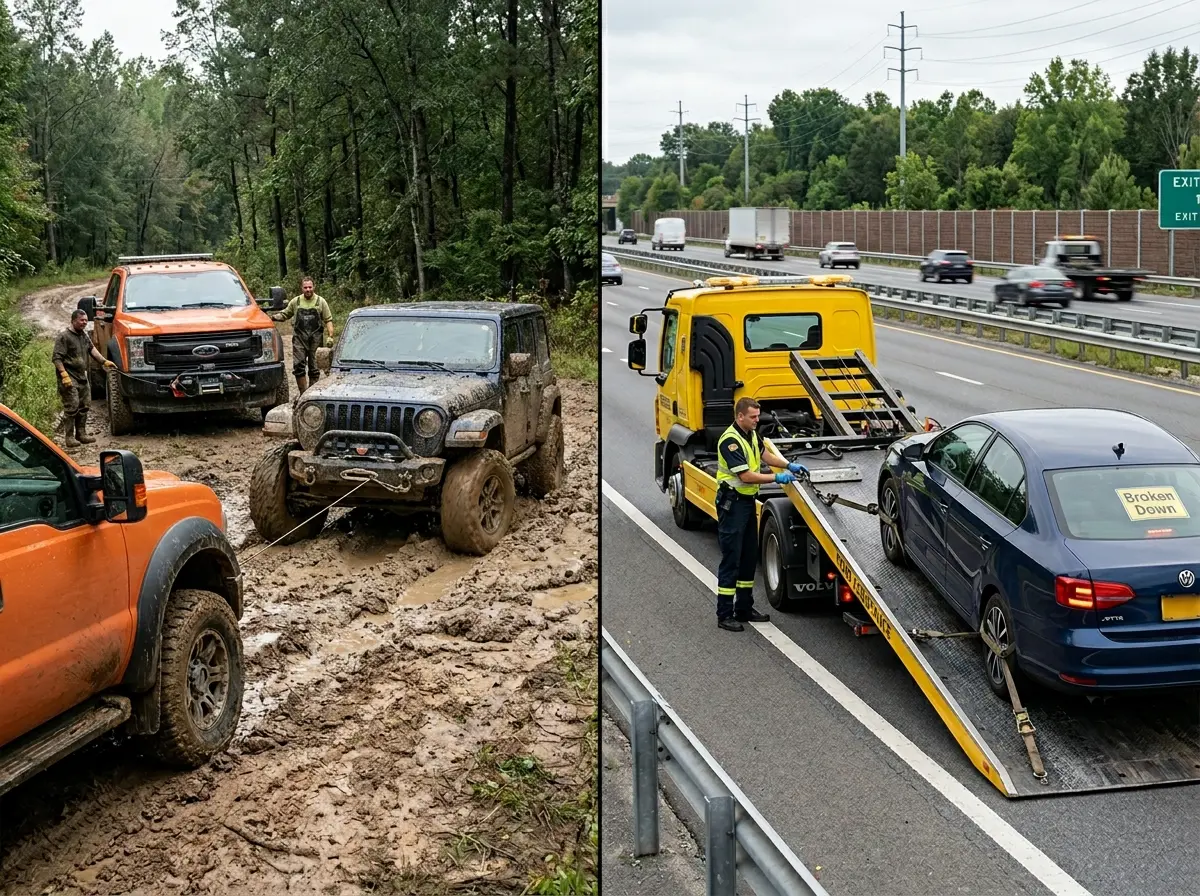
A winch-out recovers a stuck but operational vehicle. Towing transports a broken-down or undriveable vehicle. These are different services and calling the wrong one can delay help and increase your bill.
You’re driving on a rain-soaked back road when your front tires suddenly sink into soft mud. The wheels spin. The car doesn’t move. You pick up your phone to call for help and the question hits you: do I need a winch-out or a tow truck? Most drivers have no idea there’s a meaningful difference. And that confusion can cost you time, money, and in some situations unnecessary damage to your vehicle.
This guide explains everything you need to know about winch-out services versus towing: what each service is, how it works, when to use one over the other, what it costs, and how to stay safe while you wait for help. Whether you’re a daily commuter, an off-road enthusiast, or a fleet manager, understanding this distinction is practical knowledge that every driver should have.
Stuck right now or unsure what service you need? Call MG Towing & Recovery LLC for fast roadside help in Milwaukee. We’ll send the right truck the first time, no delays, no extra costs. Call Now: 414-973-1902
What Is a Winch-Out Service?
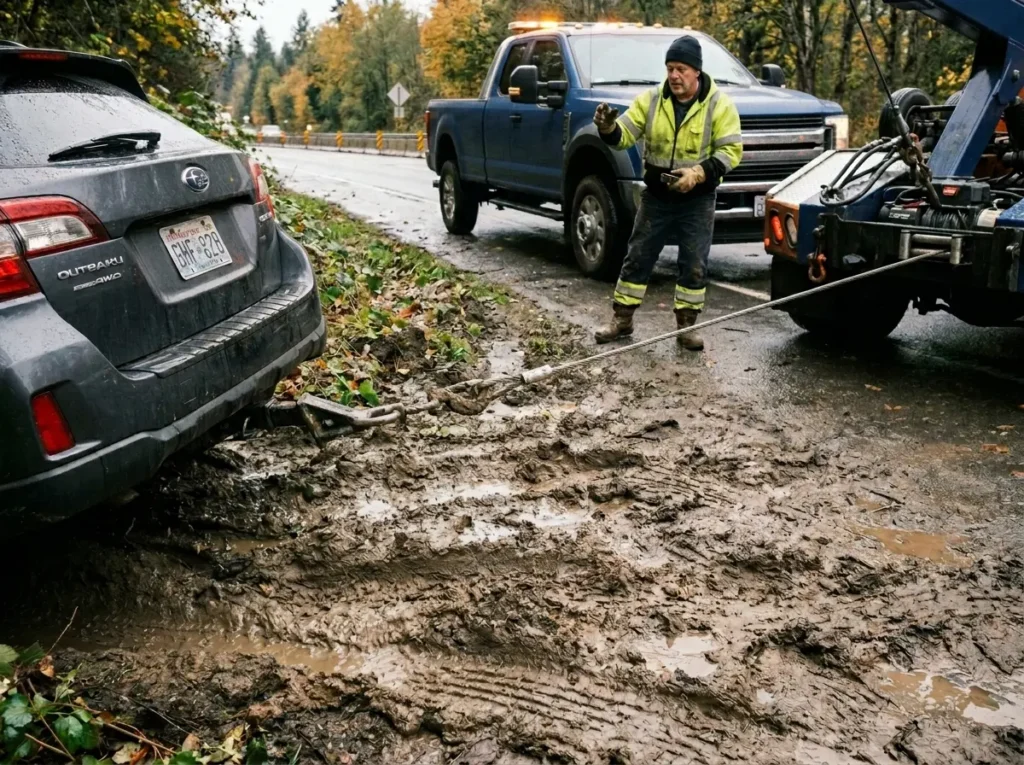
A winch-out servicem, sometimes called vehicle extraction or vehicle recovery is a specialized roadside assistance operation designed to pull a physically stuck vehicle back to solid, drivable ground. The defining characteristic of a winch-out is that the vehicle is stuck, not broken down.
The engine may run perfectly. The brakes may be fine. The only problem is that the vehicle cannot move because of the terrain it’s trapped in.
The equipment at the heart of this service is a winch: a motorized spool of heavy-duty steel cable or synthetic rope mounted to a recovery truck. The operator attaches the cable to a rated recovery point on your vehicle, typically a factory tow hook or reinforced frame bracket and slowly retracts the cable, drawing your vehicle out of whatever it’s trapped in.
How a Winch-Out Works?
The extraction process is far more deliberate than it looks from the outside. Here is what a professional winch-out typically involves:
- The operator arrives and assesses the vehicle’s position, the angle of the stuck wheels, and the ground conditions around the vehicle.
- Recovery points on the vehicle’s frame are inspected to ensure they are rated to handle the pulling load.
- The winch cable is extended from the recovery truck and secured to the vehicle’s recovery point.
- Pulleys or snatch blocks may be added to redirect the cable angle and multiply the effective pulling force.
- The winch motor engages slowly and steadily, maintaining controlled tension throughout the pull.
- The operator monitors the extraction continuously, adjusting speed and angle as needed to prevent sudden jerks or vehicle rolling.
- Once on stable ground, the driver can typically start driving immediately.
The critical word here is control. Unlike a simple yank with a tow strap, a professional winch allows the operator to start, pause, and adjust the pull with precision. This slow, steady force is what protects the vehicle from being damaged during extraction and what protects bystanders from dangerous cable snap.
Types of Terrain That Typically Require a Winch-Out
- Deep mud or waterlogged ground that swallows tires
- Soft sand on beaches or desert trails where vehicles “sink”
- Roadside ditches after a vehicle slides off the shoulder
- Snow-packed embankments or icy pull-offs
- Steep off-road inclines or rocky slopes where traction is lost
- Flooded road edges after heavy rain
What Is Towing?
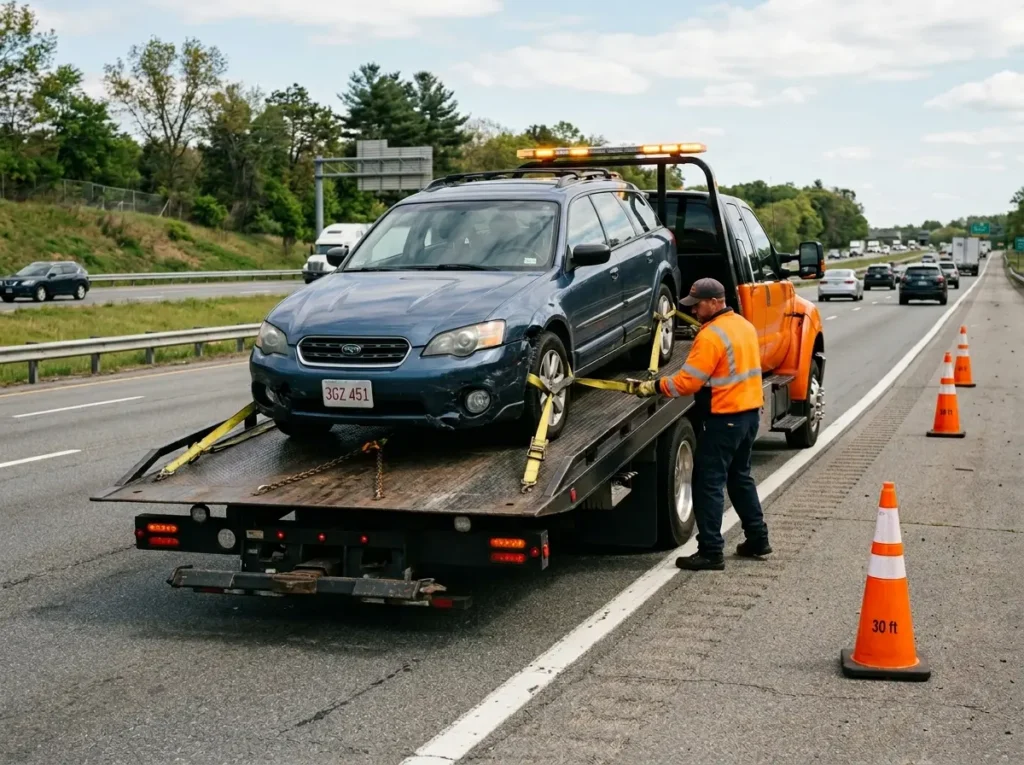
Towing is very different in purpose. While a winch out focuses on recovery, towing is all about transport. A tow truck picks up your vehicle either by loading it onto a flatbed or by lifting its drive wheels and moves it from one place to another. Most of the time, your vehicle is taken to a repair shop, dealership, body shop, or a storage facility.
Towing is the appropriate service when a vehicle cannot be driven, regardless of how well it is positioned on the road. A car sitting perfectly on the pavement with a seized engine needs to be towed. A car buried axle-deep in a muddy field with a running engine needs to be winched out.
Types of Tow Trucks
There are two primary types of tow trucks you are likely to encounter:
1. Flatbed Tow Truck
The entire vehicle is loaded onto a flat platform that tilts down to road level, allowing the car to be driven or winched onto the bed. All four wheels are off the ground during transport. This is the safest method for all-wheel drive vehicles, luxury cars, low-clearance vehicles, and any car with significant underbody or drivetrain damage. It also eliminates wear on the vehicle’s tires and drivetrain during the journey.
2. Wheel-Lift Tow Truck
A metal yoke slides under either the front or rear wheels, lifting one end of the vehicle off the ground while the other end rolls on the road. This method is typically used for shorter distances and standard passenger vehicles with no serious damage. It is faster to attach but carries slightly more risk for certain vehicle types.
Professional towing companies assess your vehicle’s condition, weight, and drive configuration before deciding which method is safest and most appropriate.
Related Article: Flatbed vs. Hook-and-Chain Towing
Winch-Out vs. Towing: Key Differences at a Glance
The table below summarizes the most important differences between the two services:
| Factor | Winch-Out Service | Towing Service |
| Purpose | Vehicle recovery – extract from a stuck position | Vehicle transport – move to another location |
| Vehicle condition | Stuck but still operational | Broken down, damaged, or undriveable |
| Common situations | Mud, snow, ditch, sand, soft shoulder, off-road | Engine failure, accident, snapped axle, total loss |
| After service ends | Driver typically drives the vehicle away | Vehicle delivered to repair shop or storage |
| Typical cost (USD) | $50 – $200 (basic recovery) | $75 – $300+ depending on distance |
| Time on scene | 15 – 45 minutes | 30 – 60 minutes |
| Can be combined? | Yes – winch-out is often the first step before a tow | Yes – tow follows after extraction if needed |
These differences matter practically. Dispatching the wrong service type means sending a truck that may not carry the right equipment, which delays your rescue and may result in two separate call-out fees. When you call for help, being accurate about your situation gets you the right truck on the first attempt.
When Do You Need a Winch-Out?
Call for a winch-out service when your vehicle is physically immobilized but is not mechanically damaged. The clearest indicator is that your wheels are spinning but the vehicle is not moving, you have lost traction or your vehicle is held in place by the terrain around it.
Common scenarios where a winch-out is the appropriate call include:
1. Stuck in Mud or Soft Ground
This is the most frequent winch-out situation. After heavy rain, roadside shoulders and unpaved turnouts can turn into soft traps that look firm but give way under vehicle weight. Even four-wheel drive vehicles get stuck in saturated soil if the wheels sink below the tread line.
Spinning wheels dig the vehicle deeper with every attempt to reverse out, which is why stopping and calling a professional immediately saves both time and further damage.
2. Slid Off the Road into a Ditch
A common outcome of wet roads, black ice, or a momentary lapse in attention. If the vehicle lands in a shallow ditch with no significant impact damage, the engine and drivetrain are likely fine. What is needed is extraction, pulling the vehicle back up onto the road surface. This is a textbook winch-out job.
3. Trapped in Snow or Ice
Winter driving produces two distinct scenarios. One is getting stuck in a snowbank where the vehicle buries itself after drifting off the road. The other is sliding on ice into a position where the vehicle is angled or wedged and cannot gain traction to self-recover. Both are winch-out situations if the vehicle itself is undamaged.
4. Off-Road Recovery
Off-road enthusiasts regularly encounter winch-out scenarios as a normal part of trail driving, crossing creek beds, navigating steep rocky descents, or crossing soft desert terrain. Even purpose-built off-road vehicles get stuck. In these cases, a winch-out returns the vehicle to drivable terrain so the adventure can continue.
Soft Roadside Shoulder
One of the most underestimated winch-out causes is pulling onto what appears to be a solid highway shoulder — only to feel the vehicle sink into soft soil or gravel. This happens frequently along interstate highways after rainfall. The vehicle isn’t broken. It doesn’t need a repair shop. It just needs to be pulled back onto the pavement. This is a winch-out, not a tow.
If your vehicle is stuck but still starts, runs, and would drive normally if it were back on solid ground – you need a winch-out.
If your car is stuck in mud, snow, or a ditch, don’t keep spinning your wheel it only makes things worse. Call MG Towing & Recovery LLC for professional winch-out service in Milwaukee and nearby areas. We’ll get you back on the road safely. Call Now: 414-973-1902
When Do You Need a Tow Truck?
Call for a tow truck when your vehicle cannot be driven not because of where it is, but because of what is wrong with it. Towing is the right answer when the vehicle needs to be taken somewhere else to be repaired or assessed, regardless of whether it is sitting neatly on the road or partially in a ditch.
Common towing scenarios include:
1. Engine Failure or Won’t Start
A vehicle that refuses to start, has lost oil pressure, has overheated to the point of engine damage, or has seized is not going anywhere under its own power. It needs to be towed to a mechanic. Attempting to drive a seriously compromised engine even a short distance can cause catastrophic and expensive damage.
2. Transmission or Drivetrain Failure
Automatic and manual transmissions can fail suddenly, leaving the vehicle unable to engage any gear. A snapped CV axle, broken driveshaft, or shattered differential makes the vehicle impossible to drive safely. These situations all require towing.
3. Post-Accident Vehicle Removal
After a collision, structural damage, airbag deployment, or wheel misalignment can make a vehicle dangerous or illegal to drive. Law enforcement will typically require vehicle removal from the road, and insurance companies often require towing to a certified collision repair center rather than driving a potentially unsafe vehicle.
4. Flat Tire in a Dangerous Location
While a flat tire in a safe parking lot might be handled with a spare, a flat tire on a busy highway shoulder, a narrow bridge, or a high-speed interchange is a safety emergency. Having the vehicle towed a short distance to a safe location or tire shop is often the right call.
5. Mechanical Breakdown
Alternator failure, fuel pump failure, a broken timing belt, or a dead battery that cannot be jump-started all mean the vehicle is not going anywhere on its own. These are standard towing situations that roadside assistance programs handle daily.
If your vehicle is on solid ground but cannot be driven due to mechanical or structural failure – you need a tow, not a winch-out.
Can You Need Both Services at the Same Time?
Yes, and this is more common than most drivers realize. The two services are not always mutually exclusive, and understanding how they work together can prevent confusion when you call for help.
Consider this scenario: a driver slides off a rainy highway into a roadside ditch. The vehicle lands at a steep angle. The engine is still running. On the surface, this looks like a simple winch-out and it is, initially. The vehicle is extracted from the ditch and pulled back onto the road. But once on level ground, it becomes clear that the landing bent the front control arm and knocked the wheel out of alignment. The car is now undriveable. What started as a winch-out now requires a tow.
Professional recovery companies anticipate this. Most experienced tow trucks carry winching equipment on board, allowing the operator to extract the vehicle first and then assess whether a tow is needed second. When you call, describing your situation accurately allows the dispatcher to send a truck equipped for both possibilities.
Another combined scenario involves heavy vehicles like semi-trucks or construction equipment that have left the road. Extraction from soft ground using a winch is step one. Towing, or in heavy cases, a rotator or heavy recovery crane, may follow once the vehicle is stable.
Related Article: The Difference Between Roadside Assistance and Towing?
How Much Does Each Service Cost?
Costs vary by region, time of day, terrain difficulty, vehicle type, and the company you call. The figures below represent general ranges for standard passenger vehicles in the United States in 2026. Always ask for a quote before the service begins.
Winch-Out Service Costs
A basic winch-out, pulling a standard car from a roadside ditch or soft shoulder, typically runs between $50 and $150. More complex extractions involving steep angles, deep mud, or large vehicles can push costs to $200 or higher. If multiple winch lines or snatch blocks are required to increase pulling power, additional fees may apply.
Towing Service Costs
Standard towing starts around $75 to $100 for a hook-up fee, with per-mile charges typically ranging from $2 to $4. A 20-mile tow to a local repair shop might run $100 to $175. Long-distance towing, flatbed transport of a luxury or AWD vehicle, or nighttime emergency calls all increase the total cost, sometimes exceeding $300 or more.
Insurance and Roadside Assistance Coverage
Many auto insurance policies include roadside assistance as an optional add-on, and programs like AAA cover both basic winch-outs and towing up to specified mileage limits. Before calling a private tow company, check your coverage it may cover the full cost or significantly reduce your out-of-pocket expense. Keep your insurance card and roadside assistance membership information easily accessible in your vehicle.
Calling the right service the first time saves you from paying two separate call-out fees. Describing your situation accurately to the dispatcher is the single most effective way to control costs.
Safety: Why You Should Always Call a Professional?
Both winch-outs and towing look deceptively simple from the outside. They are not. Vehicle recovery is one of the most common causes of on-scene injuries and additional vehicle damage when attempted without proper training and equipment.
The Real Risks of DIY Winching
Consumer-grade tow straps, chains, and light-duty winches mounted to pickup trucks can handle minor recoveries under ideal conditions. However, the majority of stuck vehicle situations involve more force than these tools are rated for and overloading them is dangerous.
1. A steel winch cable under tension that snaps can recoil with enough force to cause serious injury or death to anyone standing nearby. Synthetic rope is safer in this regard but still dangerous under sudden failure.
2. Attaching a recovery cable to a bumper, tow ball, or any non-rated anchor point can rip off body panels or bend the vehicle’s frame, turning a simple recovery into a costly repair.
3. Pulling at the wrong angle can flip a vehicle sideways or cause it to roll, especially on slopes.
4. Consumer winches are often not rated for the weight of modern vehicles, especially SUVs and trucks. Exceeding a winch’s rated capacity causes failure without warning.
What Professional Operators Do Differently?
Professional winch-out and towing operators are trained to assess the full situation before touching any equipment. They inspect recovery points, calculate safe pull angles, evaluate ground stability under their own truck, and position the winch line to minimize risk.
They carry safety equipment including gloves, reflective gear, winch line dampeners (which absorb cable snap energy), and proper personal protective equipment.
That expertise is what you are paying for and it is worth it. A professional extraction that takes 30 minutes costs a fraction of what an improperly executed DIY recovery can cost in vehicle repairs, not to mention the potential for personal injury.
What to Do While Waiting for Help?
- Stay inside the vehicle if you are on or near a busy road, most roadside fatalities involve people standing near their vehicles, not inside them.
- Turn on your hazard lights immediately so other drivers can see you.
- If you must exit the vehicle, move well away from traffic and stay visible.
- Do not spin the wheels repeatedly this digs the vehicle deeper into soft ground and may damage the drivetrain.
- If you are in a dangerous position (on a curve, at the bottom of a hill, partially blocking traffic), call emergency services (911) in addition to a recovery service.
- Give the dispatcher your exact location using GPS coordinates, mile markers, or nearby landmarks.
What to Tell the Dispatcher When You Call?
The quality of the information you give the dispatcher directly determines how quickly and effectively help arrives. A vague description sends the wrong truck. A clear description sends the right one, with the right equipment, on the first attempt.
When you call a roadside assistance or towing company, be prepared to share the following:
- Your exact location, GPS coordinates from your phone’s maps app, mile markers on the highway, or the nearest street intersection and recognizable landmark.
- The make, model, and year of your vehicle, this determines equipment requirements. A Honda Civic and a Ford F-250 need different recovery approaches.
- Whether your vehicle is a front-wheel drive, rear-wheel drive, all-wheel drive, or four-wheel drive, AWD and 4WD vehicles require flatbed transport to avoid drivetrain damage.
- What happened and what the vehicle’s current condition is, stuck in mud, slid into ditch, engine won’t start, just had an accident, etc.
- Whether the engine still runs and whether all four wheels can turn.
- Whether there are any safety hazards nearby, oncoming traffic, water, unstable ground, gas smell, or fire.
The more detail you provide, the better equipped the arriving team will be and the faster your situation will be resolved.
Frequently Asked Questions
What is the main difference between a winch-out and towing?
A winch-out is a vehicle recovery service that extracts a stuck vehicle from difficult terrain and returns it to drivable ground. Towing is a transport service that moves a broken-down or undriveable vehicle to a repair shop or another location. A winch-out is about getting unstuck. Towing is about getting somewhere.
Is a winch-out cheaper than towing?
Generally, yes. A basic winch-out typically costs less than towing because no transportation is involved, the service is complete once the vehicle is back on solid ground. However, complex extractions involving steep terrain, buried vehicles, or heavy equipment can cost significantly more. Always request a quote before service begins.
Can I do a winch-out myself?
Light-duty self-recovery is possible with proper equipment in low-risk situations for example, a light pickup truck mildly stuck on a dirt road, with a properly rated winch, correct attachment points, and no safety hazards nearby.
However, the majority of real-world winch-out situations involve more force, worse angles, and greater risk than consumer equipment and untrained operators can safely handle. The cost of professional recovery is almost always less than the cost of vehicle damage or medical bills from a DIY gone wrong.
Does car insurance cover winch-outs and towing?
Many comprehensive auto insurance policies include optional roadside assistance coverage that covers both winch-outs and towing up to specified mileage limits. Roadside assistance membership programs such as AAA also cover these services.
Check your policy documentation or call your provider before engaging a private service, you may be fully or partially covered.
What if my vehicle needs both a winch-out and a tow?
This is common. A vehicle stuck in a ditch may need to be winched out first and then towed if the recovery reveals hidden damage, a bent suspension component, broken axle, or damaged tire.
Most professional tow trucks carry winching equipment, so the operator can handle both steps with a single truck. Describe your full situation to the dispatcher so the right equipment arrives the first time.
How long does a winch-out take?
A straightforward winch-out typically takes between 15 and 45 minutes from the operator’s arrival. More complex extractions involving steep angles, deep mud, heavy vehicles, or difficult access can take longer. Wait times before the operator arrives vary by location and time of day.
Is winching dangerous for my vehicle?
When performed correctly by a trained professional using rated equipment and proper attachment points, winching causes no damage to your vehicle. The risk of vehicle damage comes from improper technique attaching cables to non-rated points, pulling at bad angles, or applying sudden shock loads instead of steady tension.
Final Thoughts
Understanding the difference between a winch-out and towing is not just automotive trivia it is practical knowledge that can reduce stress, save money, and protect your vehicle the next time something goes wrong on the road.
The core principle is straightforward: if your vehicle is stuck, call for a winch-out. If your vehicle is broken, call for a tow. When you are unsure, describe your situation as completely and accurately as possible to the dispatcher and let the professional determine which service to send.
Need a tow or winch-out right now? MG Towing & Recovery LLC is available 24/7 in Milwaukee, WI and surrounding areas. Whether you’re stuck or broken down, our team will respond quickly with the right equipment. Call now and get back on the road without the stress.