

The Complete Milwaukee Driver’s Guide to Safe Towing Methods for High-Value, All-Wheel-Drive, and Specialty Vehicles
Your vehicle is one of the most significant investments you will ever make. For drivers of all-wheel-drive SUVs, luxury sedans, exotic sports cars, and classic collector vehicles, that investment is often substantial and in the event of a breakdown, accident, or any situation requiring a tow, the difference between a properly executed tow and an improperly handled one can mean the difference between a vehicle that drives away from the repair shop intact and one that arrives with thousands of dollars in additional drivetrain or cosmetic damage.
The hard truth is that not every tow truck operator has the training, equipment, or knowledge to safely handle every type of vehicle. The towing methods that work perfectly well for a basic two-wheel-drive commuter sedan can cause serious, expensive damage to an AWD crossover, a low-slung sports car, or a meticulously maintained classic.
Understanding why and knowing what to ask for and what to refuse is knowledge that every owner of a higher-value vehicle should have before they ever need a tow.
This guide explains precisely how professional tow truck operators safely transport AWD vehicles, luxury cars, exotic sports cars, and classic vehicles in Milwaukee. It covers the specific risks each vehicle type faces during improper towing, the correct methods and equipment for each, a towing safety checklist you can use in the moment, and how to identify a towing company in Milwaukee that is genuinely qualified to handle your vehicle.
Related Article: What Is Flatbed Towing and When Is It Needed?
Why Towing Method Matters More Than Most Drivers Realize?
Many drivers assume a tow is a tow, a truck shows up, hooks your car, and takes it somewhere. For a standard rear-wheel-drive or front-wheel-drive vehicle in good mechanical condition, this simplified view mostly holds. But for a significant portion of vehicles on Milwaukee roads today, the method of towing is a technical decision with real mechanical consequences.
The Hidden Costs of Improper Towing
Improper towing damage falls into two broad categories: drivetrain damage and cosmetic or structural damage. Drivetrain damage from incorrect towing can be insidious because it often does not manifest immediately.
A transfer case or differential damaged by being towed with wheels on the ground may show no immediate symptom but fail catastrophically at highway speed two weeks later. By that point, connecting the damage to the tow requires expertise, and liability becomes contested.
Cosmetic and structural damage is more immediate but equally costly. A luxury vehicle with tight body tolerances scratched by an improperly positioned chain or strap, a low-clearance sports car whose chin spoiler was torn off by loading it onto a flatbed at an angle its geometry cannot accommodate, a classic car’s original paint damaged by a chain wrap, these are real outcomes of towing that was technically capable but not matched to the vehicle’s specific requirements.
The Most Vulnerable Vehicle Types
- All-wheel-drive and four-wheel-drive vehicles: The most mechanically vulnerable to incorrect towing method; drivetrain damage from wheel-on-road towing can cost $3,000 to $8,000 or more to repair.
- Luxury sedans and SUVs: Air suspension systems, low ride height, complex electronics, and tight body tolerances all create specific handling requirements.
- Exotic and sports cars: Extreme low clearance, carbon fiber components, wide body kits, and performance suspension demand specialized loading technique.
- Classic and vintage vehicles: Fragile original components, irreplaceable bodywork, and non-standard frame geometry require careful, custom handling.
- Hybrid and electric vehicles: High-voltage battery systems and regenerative braking systems require specific towing protocols to avoid electrical damage.
Need AWD or Luxury Car Towing in Milwaukee? MG Towing & Recovery – Professional Flatbed Towing for All Vehicle Types, 24/7. Call Now: 414-973-1902
| The Core Principle of Safe Towing for Sensitive Vehicles: Every vehicle has specific towing requirements that depend on its drivetrain type, ground clearance, suspension design, and overall condition. A professional towing company does not apply a one-size-fits-all approach. They assess the vehicle first, confirm the correct method, and use the right equipment for that specific vehicle, every time. |
AWD Vehicle Towing: The Drivetrain Risk Explained
Of all the vehicle-specific towing risks, AWD and 4WD drivetrain damage from incorrect towing is the most common, the most expensive, and the most preventable. Understanding the mechanics behind this risk is essential for any AWD vehicle owner.
Why AWD Vehicles Cannot Be Wheel-Lift Towed?
In an all-wheel-drive vehicle, all four wheels are mechanically connected through a transfer case and differentials. The system is engineered to transfer power to whichever wheels have traction, which requires that all four wheels are able to turn at varying but mechanically managed speeds relative to each other.
When a wheel-lift tow truck raises only the front or rear axle of an AWD vehicle, the other two wheels remain in contact with the road and rotate freely as the vehicle is towed. But in the drivetrain, the stationary components, the differential gears, transfer case internals, and driveshaft are being subjected to rotation they were not designed to handle without lubrication flowing through a running engine.
This is called dry towing damage, and it is a real mechanical failure mode that AWD drivetrain engineers specifically warn against.
The lubrication systems of transfer cases and rear differentials are splash-lubricated meaning they depend on the spinning of internal gears to distribute lubricant. When those components are forced to rotate during a wheel-lift tow without the engine running, the lubricant is not distributed properly, and metal-on-metal contact occurs at speed.
The resulting damage ranges from accelerated wear to complete component seizure, and repair costs routinely exceed $5,000.
The Only Safe Method: Flatbed Towing for All AWD Vehicles
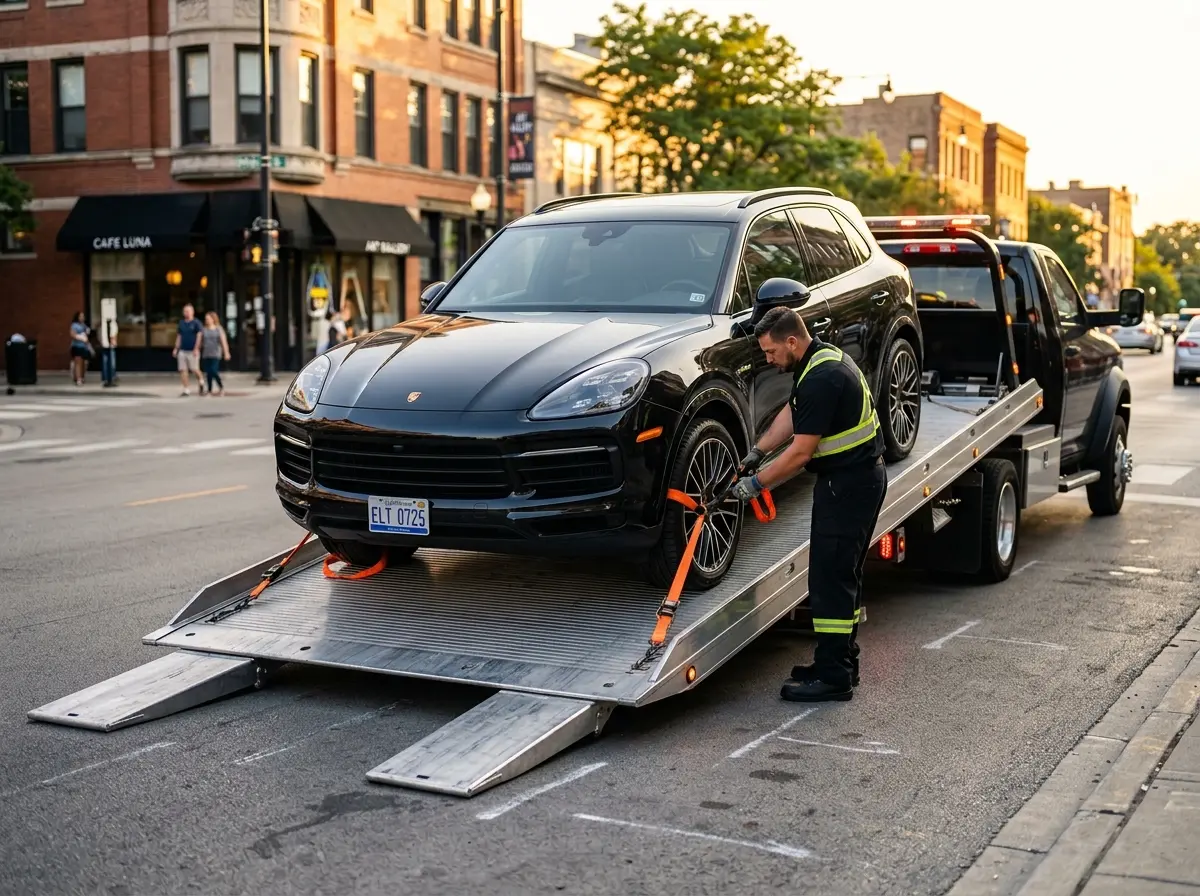
The solution is straightforward: all-wheel-drive and four-wheel-drive vehicles must be transported on a flatbed tow truck with all four wheels completely off the ground. With all four wheels raised, no drivetrain components rotate during transport, and there is zero risk of lubrication starvation or forced mechanical operation without engine power.
This is not a preference or a recommendation it is the technical requirement for protecting AWD drivetrain systems during towing. Every major AWD vehicle manufacturer specifies flatbed towing in their owner’s manuals.
Any towing company that proposes wheel-lift towing for an AWD or 4WD vehicle is either unaware of this requirement or is prioritizing their operational convenience over your vehicle’s protection.
| Owner’s Manual Requirement: Check your vehicle’s owner’s manual for the towing section. For the vast majority of AWD and 4WD vehicles including Toyota RAV4, Honda CR-V, Subaru Outback, Ford Explorer, Jeep Grand Cherokee, BMW X-series, Mercedes GLE, Audi Q-series, and essentially all modern all-wheel-drive vehicles, the manual explicitly states that flatbed towing with all four wheels off the ground is required. Carry this knowledge and assert it confidently if a tow operator proposes anything different. |
Protecting AWD Vehicles During Towing in Milwaukee
Beyond the fundamental requirement of flatbed transport, these specific practices protect AWD vehicles throughout the towing process:
- Confirm all four wheels are securely on the flatbed before the truck moves not just the front or rear pair.
- Ensure the vehicle is in neutral or park as specified by the manufacturer, some AWD systems have specific gear selector requirements for transport.
- Verify that the transmission is in the recommended position for flat towing if for any reason flatbed is not available, though this should be a last resort only and varies by specific vehicle model
- Document the vehicle’s condition before loading with photographs particularly the undercarriage, which is vulnerable to contact during loading.
- Confirm the flatbed loading angle is appropriate for the vehicle’s ride height before the ramp is extended.
Luxury Car Towing: Protecting High-Value Vehicles
Luxury car towing involves all of the mechanical considerations of standard vehicle towing, plus a set of additional concerns specific to the design characteristics, material quality, and value of high-end vehicles.
A BMW, Mercedes-Benz, Audi, Lexus, Porsche, Cadillac, Lincoln, Genesis, or Volvo has been engineered and finished to tolerances that demand a higher standard of handling throughout the towing process.
Air Suspension Systems
Many luxury vehicles are equipped with air suspension systems electronically controlled airbag-based suspension that adjusts ride height based on speed, load, and driver preference. When a luxury vehicle with air suspension is towed, the suspension must be in the correct mode for loading and transport.
Failure to lower the suspension before loading a raised air-suspension vehicle onto a flatbed can result in contact between the vehicle’s undercarriage and the flatbed edge during the loading process.
Professional tow truck operators who specialize in luxury car towing know to check for air suspension, know how to engage the transport mode if the vehicle’s systems are accessible, and know the loading approach that accommodates suspension height for each vehicle they encounter. This vehicle-specific knowledge is a hallmark of a genuinely qualified luxury vehicle towing service.
Low Ground Clearance and Chin Spoilers
Sports-oriented luxury vehicles Porsche Panamera, Audi S and RS models, Mercedes AMG variants, BMW M series, and others often have very low ground clearance and prominent front chin spoilers or splitters that are the first components to contact any obstacle during loading.
A flatbed ramp set at the wrong angle will cause these components to drag on the transition between the ramp and the bed.
Experienced operators address this by using ramp extenders, loading the vehicle at a very shallow ramp angle, using low-profile wheel rollers, or in some cases hand-winching the vehicle up the ramp rather than driving it under its own power. If an operator begins extending the ramp at a steep angle for a very low vehicle without any comment or adjustment, that is a warning sign.
Electronics, Sensors, and Tie-Down Placement
Modern luxury vehicles are laden with sensors, parking sensors, blind spot monitors, lane-keep cameras, and air suspension ride height sensors embedded in or near the bumpers and wheel wells. Placing tie-down straps over or near these sensors risks contact damage to components that cost hundreds of dollars to replace individually.
Professional operators use soft loop tie-down straps that attach to the wheel spokes or dedicated tie-down hooks rather than wrapping around bumpers or body panels.
They know the locations of common sensors and avoid contact with those areas throughout the loading, securing, and transport process. Ask your operator specifically where the straps will be placed before the vehicle is loaded.
Interior and Paint Protection
Beyond the mechanical considerations, safe towing for luxury cars includes protecting the vehicle’s cosmetic condition. A luxury vehicle loaded onto a flatbed collects road grit and debris thrown by the tow truck’s tires throughout the journey.
An enclosed transport trailer provides complete weather and debris protection for extremely high-value vehicles. For open flatbed transport, soft covers or vehicle transport bags are available from premium towing operators and provide meaningful protection against road debris.
| Luxury Car Towing Standard: Before any luxury vehicle is loaded onto a tow truck in Milwaukee, a professional operator should: confirm the correct suspension mode, assess the ramp angle for the vehicle’s clearance, use soft loop wheel straps rather than hook straps, photograph the vehicle’s full exterior and undercarriage condition, and confirm the destination details with the owner. These steps are not extra care, they are the standard of professional luxury vehicle towing. |
Exotic, Sports, and Classic Car Towing: The Highest Standard
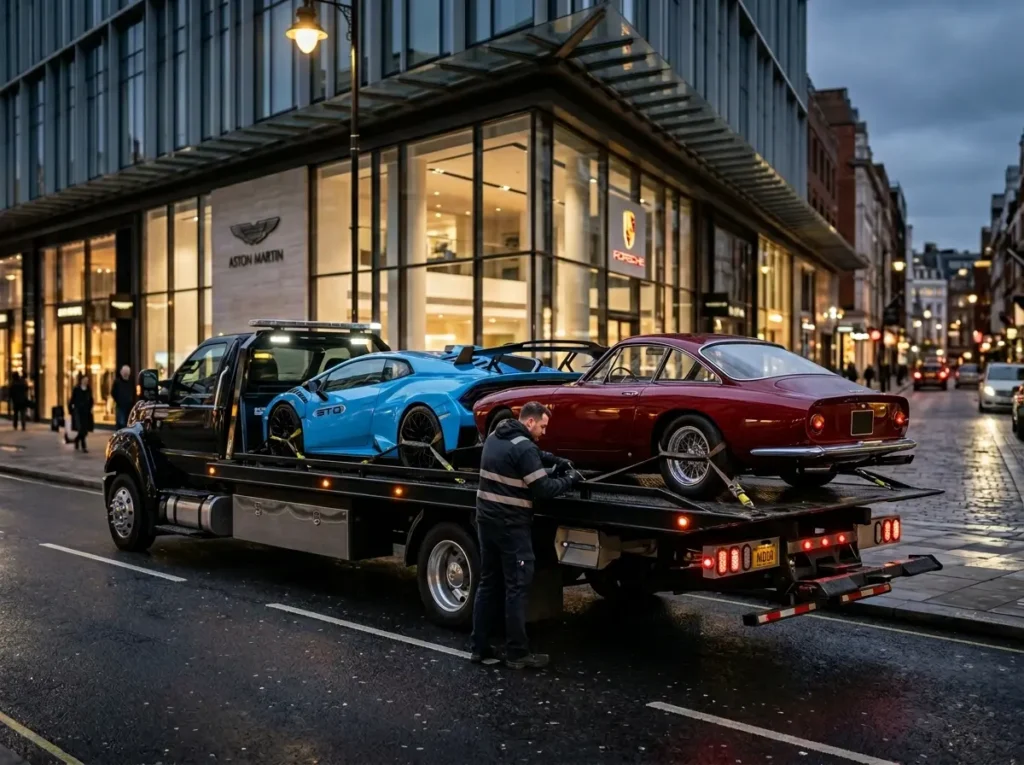
Exotic Car Towing
Exotic vehicles Ferrari, Lamborghini, McLaren, Bugatti, Koenigsegg, and similar marques represent the most demanding towing challenge in the industry.
These vehicles combine extreme low clearance (some as low as 3 to 4 inches), carbon fiber body components that shatter rather than bend, aerodynamic features that are structurally integral, and values that make any damage claim significant.
Exotic car towing in Milwaukee requires: an enclosed or covered transport option wherever possible, ramp extenders or bridge plates that bring the loading transition to an angle the vehicle can clear, wheel cradles rather than strap-based securing systems, and an operator with specific experience handling exotic vehicles.
The operator should be able to identify the vehicle’s jack points and structural towing points without consulting a manual, that level of familiarity signals genuine expertise.
Sports Car Towing
Performance sports cars Corvette, Porsche 911, Mustang GT500, Dodge Viper, Audi R8, and similar vehicles share many of the clearance and handling challenges of exotics at a more common ownership level.
Sports car towing requires flatbed transport, proper clearance management during loading, soft loop wheel straps, and care around splitters, diffusers, and wide-body bodywork that may extend beyond the standard flatbed width.
For AWD sports cars Audi R8, Nissan GT-R, Porsche 911 Turbo, and others all of the AWD drivetrain protection requirements from the previous section apply in addition to the sports car-specific handling considerations.
Classic Car Flatbed Transport
Classic and vintage vehicles present a unique set of challenges that differ from modern vehicle towing in important ways. Classic cars often have non-standard frame geometry that does not align with the jack points and tie-down positions a modern-trained operator might expect.
They may have soft or fragile bodywork from aging metal and original paint that cannot withstand contact with metal straps or tie-down hooks. And their mechanical systems drum brakes, non-synchronized transmissions, pre-emissions engines require different handling during loading.
Classic car flatbed transport in Milwaukee should involve: pre-loading consultation with the owner about specific handling requirements, soft wheel cradles or tire nets rather than hook straps, operator knowledge of where the frame rails and tie-down points are on vintage vehicles, and ideally transport in an enclosed carrier for long-distance moves of significant collector cars.
The collector car community is well aware of which towing operators treat classic vehicles with appropriate care and which do not. Before entrusting a valuable classic to any Milwaukee towing company, ask specifically about their experience with vintage vehicles and what tie-down system they use.
Hybrid and Electric Vehicle Towing
Hybrid and electric vehicles Tesla, Rivian, BMW i-series, Chevrolet Bolt, Toyota Prius, and others have towing requirements driven by their high-voltage electrical systems and regenerative braking systems.
Most EVs and hybrids should never be towed with any wheels on the ground because the rotating wheels generate current through the regenerative braking system that can overload and damage battery management electronics.
All hybrid and electric vehicles should be flatbed towed with all four wheels completely off the ground, and the vehicle should be placed in the manufacturer-specified transport mode before loading.
Tesla vehicles, for example, have a specific transport mode accessible through the screen that disables the parking brake and prepares the drivetrain for flatbed loading. Operators unfamiliar with EVs may attempt to load a Tesla the same way they would a conventional car — this is a warning sign of inexperience.
| EV and Hybrid Towing Warning: Never allow an electric or hybrid vehicle to be towed with any wheels on the road surface. The rotating wheels generate electrical current through the regenerative braking system. Without the battery management system actively regulating this current which only happens when the vehicle is powered on in the correct mode, this uncontrolled current can damage battery cells, inverters, and motor windings in ways that produce repair bills exceeding $10,000. Always insist on flatbed towing and confirm the driver knows your vehicle’s transport mode procedure. |
Flatbed vs. Wheel-Lift Towing Safety: A Direct Comparison
The debate between flatbed and wheel-lift towing is not really a debate when it comes to AWD, luxury, exotic, sports, or classic vehicles. But understanding exactly why flatbed towing is superior for these vehicle types and when wheel-lift is and is not acceptable, helps you advocate effectively for your vehicle.
| Safety Factor | Flatbed Towing | Wheel-Lift Towing |
| Wheels on road during transport | None – all four raised | Two wheels remain on road |
| Drivetrain stress | Zero – no components rotate | Significant – differential and transfer case rotate without lubrication |
| Safe for AWD/4WD vehicles | Yes – required method | No – causes drivetrain damage |
| Safe for EVs and hybrids | Yes – with transport mode | No – generates uncontrolled regen current |
| Low clearance vehicles | Yes – with ramp extenders | Often not possible – dragging risk |
| Risk of additional damage | Very low when done correctly | Moderate to high for sensitive vehicles |
| Body and paint contact risk | Low – no chain wrap needed | Higher – lift points contact vehicle |
| Appropriate for standard FWD/RWD | Yes – always the preferred option | Yes – acceptable for short local tows |
| Appropriate for luxury/exotic/classic | Yes – only acceptable method | No – never appropriate |
Towing Vehicle Safety Checklist: What to Verify Before Your Car Is Loaded
Whether you own an AWD crossover, a luxury sedan, an exotic sports car, or a treasured classic, this checklist gives you the exact questions and observations to make before any tow truck operator moves your vehicle. A professional operator will welcome these questions. An unprepared or unqualified operator may be unable to answer them clearly which is itself important information.
Before the Tow Truck Arrives
- Save the number of a Milwaukee towing company experienced with your vehicle type before you ever need a tow, do not search under pressure after a breakdown.
- Know your vehicle’s towing requirements from the owner’s manual, particularly whether it requires flatbed transport.
- Know whether your vehicle has an air suspension system and how to access the transport or jack mode if needed.
- Know where your vehicle’s designated tie-down points and jack points are located.
- Have your insurance or roadside plan information accessible know whether towing is covered and whether the plan specifies preferred providers.
When the Tow Truck Arrives
- Confirm the operator knows your vehicle type and its specific requirements before they begin
- Ask directly: will this be a flatbed tow? (For AWD, luxury, EV, exotic, and classic vehicles this must be yes)
- Ask where the tie-down straps will be placed confirm they will use soft loops at the wheels or designated frame points, not hooks over bumpers or body panels
- For EVs: confirm the operator knows the transport mode procedure for your specific vehicle
- For air suspension vehicles: confirm the operator will address suspension height before loading
- Request pre-tow photographs of the vehicle’s full exterior and undercarriage before any movement begins
During Loading
- Observe the ramp angle for low-clearance vehicles, confirm the angle is appropriate before the vehicle contacts the ramp transition.
- Watch for any contact between the vehicle’s chin spoiler, diffuser, running boards, or wheel arch extensions and the ramp, bed edge, or tie-down hardware.
- Confirm all four wheels are on the bed before the flatbed is raised, partial loading is not acceptable.
- Confirm all four tie-down points are secured and tensioned before the truck moves.
After Delivery
- Inspect the vehicle before the tow truck leaves, check all panels for scratches or contact marks, check the undercarriage for any damage visible from ground level.
- Document any new damage before the operator departs, do not allow them to leave without acknowledging any damage that occurred during the tow.
- Test the vehicle before accepting delivery for long-distance tows, turn on the engine, check for warning lights, and drive a short distance to confirm normal operation.
How to Choose a Towing Company in Milwaukee for AWD and Luxury Vehicles?
Not every tow truck service in Milwaukee is equipped and trained to handle the full range of vehicle types that require specialized care. Here is how to evaluate a towing company’s genuine capability before you need them.
Questions to Ask Any Towing Provider
- Do you have flatbed trucks available 24/7? (The answer must be yes for AWD, luxury, EV, and specialty vehicles)
- Do your operators have specific experience with AWD vehicles and the drivetrain protection requirements involved?
- How do you handle low-clearance vehicles do you have ramp extenders or loading ramps for sports cars?
- What tie-down system do you use for luxury and exotic vehicles, soft loops or hooks?
- Do you offer enclosed transport for extremely high-value vehicles?
- Are your operators trained on EV transport modes?
Red Flags to Watch For
- A tow truck arrives for an AWD vehicle and the operator proposes a wheel-lift tow without hesitation or discussion, this indicates they either do not know the requirement or are ignoring it.
- The operator is unfamiliar with your specific vehicle type and has no visible preparation for its clearance, suspension, or drivetrain requirements.
- Hook straps are applied directly to bumpers, tow balls, or body panel contact points rather than wheel spokes or frame tie-down points.
- The operator skips the pre-tow condition documentation, no photographs, no condition acknowledgment.
- The operator cannot explain where they will attach the vehicle or which jack points they will use.
- The operator seems rushed, cuts corners in the setup process, or dismisses your questions about vehicle-specific requirements.
Why MG Towing & Recovery Is Milwaukee’s Trusted Choice for Specialty Vehicle Towing?
MG Towing & Recovery provides professional towing services across Milwaukee for all vehicle types, including AWD vehicles, luxury cars, sports cars, hybrids, and electric vehicles. Our fleet includes modern flatbed trucks equipped for vehicles of all clearance levels, and our operators are trained in the specific requirements of each vehicle category we service.
We understand that when you call for AWD towing in Milwaukee or luxury car towing in Milwaukee, you are trusting us with a significant investment. Our approach reflects that responsibility:
- Flatbed towing is our standard for all AWD, 4WD, luxury, EV, sports, and classic vehicles, no exceptions.
- Pre-tow condition documentation is performed on every specialty vehicle tow.
- Our operators know the drivetrain protection requirements for AWD vehicles and the transport mode procedures for major EV brands.
- Soft loop tie-down systems are used for luxury and exotic vehicles as standard practice.
- 24-hour towing in Milwaukee means we are available every time you need us 3 a.m. on a Sunday during a January ice storm or noon on a Tuesday.
- Transparent pricing, you know exactly what the service costs before we touch your vehicle.
FAQs: AWD and Luxury Vehicle Towing
My AWD SUV broke down on I-94 in Milwaukee. What should I tell the tow truck dispatcher?
Tell the dispatcher immediately that your vehicle is all-wheel drive and requires flatbed towing with all four wheels off the ground.
Confirm this before the truck is dispatched not after it arrives. If the dispatcher says a wheel-lift truck is what is available, ask them to send a flatbed or hold until one is available. The cost of waiting for the right equipment is far less than the cost of drivetrain repair from improper towing.
Can a luxury car with air suspension be towed safely on a flatbed?
Yes, but it requires a knowledgeable operator who understands the suspension system. Before loading, the suspension should be lowered to its minimum ride height through the vehicle’s air suspension control interface, or the transport or jack mode should be engaged if available.
This ensures the vehicle clears the ramp-to-bed transition cleanly and sits stably on the flatbed. An operator unfamiliar with air suspension systems may not know to take this step, asking them directly confirms their awareness.
My Tesla was in an accident. Can any tow truck handle it?
Not safely. Tesla and other electric vehicles require flatbed towing with all four wheels off the ground, and the vehicle should be placed in transport mode before loading to disable the parking brake and prepare the drivetrain. Tesla’s transport mode is accessed through the touchscreen under Controls.
An operator unfamiliar with Tesla’s specific procedures may attempt to tow it the same way as a conventional vehicle, which risks damage to the electric drivetrain. MG Towing & Recovery’s operators are trained on EV transport procedures including Tesla transport mode.
How do I know if towing damaged my AWD transmission or transfer case?
Symptoms of AWD drivetrain damage from improper towing may include unusual vibration or noise when accelerating, difficulty engaging or disengaging four-wheel-drive modes, fluid leaks under the vehicle, warning lights related to the AWD or traction control system, or noticeable pulling to one side.
If you notice any of these symptoms after your vehicle has been towed, have it inspected by a qualified drivetrain technician immediately. The longer damaged components operate, the more extensive the secondary damage becomes.
Is enclosed transport available for extremely valuable vehicles in Milwaukee?
Yes. For collector cars, exotic vehicles, or any situation where open flatbed transport is not adequate protection, MG Towing & Recovery can arrange enclosed transport. Enclosed transport provides complete protection from road debris, weather exposure, and visibility to other road users.
It is the preferred choice for concours-condition vehicles, irreplaceable classics, and exotics with carbon fiber bodywork that cannot be allowed any debris contact. Contact us directly to discuss enclosed transport options and pricing for your specific vehicle.
Your Vehicle Deserves the Right Tow – Every Time
The towing method used for your vehicle is not a minor operational detail. For AWD and 4WD vehicles, it determines whether your drivetrain arrives at the shop intact or damaged.
For luxury cars, it determines whether your air suspension, sensors, and paintwork are handled with the care they require. For EVs and hybrids, it determines whether your battery system is protected.
For classics and exotics, it determines whether an irreplaceable vehicle is treated with the respect it deserves.
Every driver of an AWD vehicle, a luxury car, an electric vehicle, a sports car, or a classic should know the key principle before they ever need a tow: flatbed transport with all four wheels off the ground is the correct method, soft-loop tie-down systems protect the vehicle during transport, pre-tow documentation is non-negotiable, and a professional operator should be able to answer your vehicle-specific questions without hesitation.
MG Towing & Recovery provides professional towing services for all vehicle types across Milwaukee and the surrounding Wisconsin area, available 24 hours a day, 365 days a year.
When you need AWD towing in Milwaukee, luxury car towing, EV transport, or specialty vehicle recovery, our trained operators and properly equipped flatbed fleet are ready to handle your vehicle with the care and expertise it requires. One call, the right equipment, every time.