

Picture this. It’s 11 p.m. on a Tuesday in winter. A driver pulls over on a quiet stretch of interstate with a dead battery, two kids in the back seat, and 35 miles to the nearest town. They open Google, type “roadside assistance near me,” and call the first local number that picks up. Twenty minutes later, someone shows up, jumps the car, and charges $95 for ten minutes of work.
That driver just had one of the worst nights of their month. The person who showed up just made one of the easiest paychecks of theirs.
This is the everyday reality of the roadside assistance industry in the United States. It is one of the most overlooked yet consistently profitable service businesses you can start with relatively low capital. Cars break down 24 hours a day, every single day, in every zip code in the country. If you can show up reliably, you have a business.
This guide walks you through exactly how to start a roadside assistance business in the U.S, from the first license to your first hundred calls.
What Is a Roadside Assistance Business?
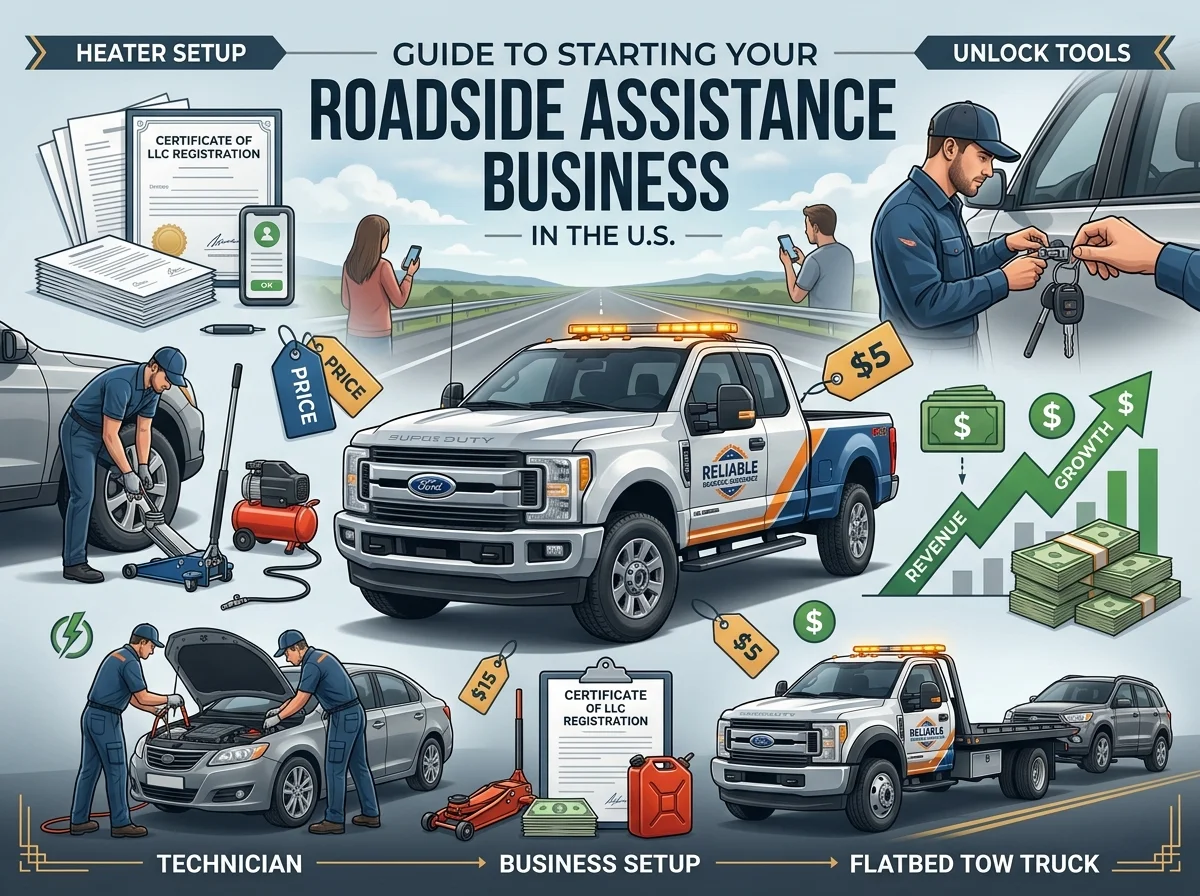
A roadside assistance business provides on-demand help to drivers who are stuck on the road. The most common services include:
- Battery jump starts
- Flat tire changes (using the customer’s spare)
- Lockout services
- Fuel delivery
- Light-duty towing
- Winching vehicles out of mud, snow, or ditches
Some operators stick strictly to “no-tow” services using a regular pickup truck. Others invest in a tow truck or flatbed and offer full towing as part of the package. Both models work. The difference is your startup cost and the type of contracts you can chase later.
Most successful operators run as independent contractors for digital dispatch networks (Agero, Urgently, Honk, Allstate Roadside) while also taking direct cash and card calls from local customers. That dual-channel model is what keeps trucks busy.
Also Read: How to Start a Tow Truck Business?
Market Demand and Industry Facts
The numbers behind this business are strong, and they are getting stronger.
The U.S. vehicle roadside assistance market was valued at roughly $2.4 billion in 2025 and is projected to grow at a CAGR of nearly 4.9% through 2034, according to Custom Market Insights. North America alone accounts for about 39% of the global market share, with revenue projected to hit $10.6 billion by 2030.
A few real-world drivers behind this growth:
- The U.S. car fleet is aging. The average car on American roads is now over 12 years old, which means more breakdowns, more dead batteries, and more flat tires.
- EV adoption is creating new service demand. Electric vehicles still get flat tires and need roadside help. Many roadside operators are now adding mobile EV charging as a premium service.
- Insurance bundling is booming. Companies like Allstate, GEICO, State Farm, and Progressive sub-contract calls to local operators. That is the bread and butter for thousands of small roadside businesses.
- Light vehicle sales hit nearly 15.5 million in 2023, growing the customer base every single year.
In short, demand is steady, recession-resistant, and not going away.
Step-by-Step Guide to Start a Roadside Assistance Business
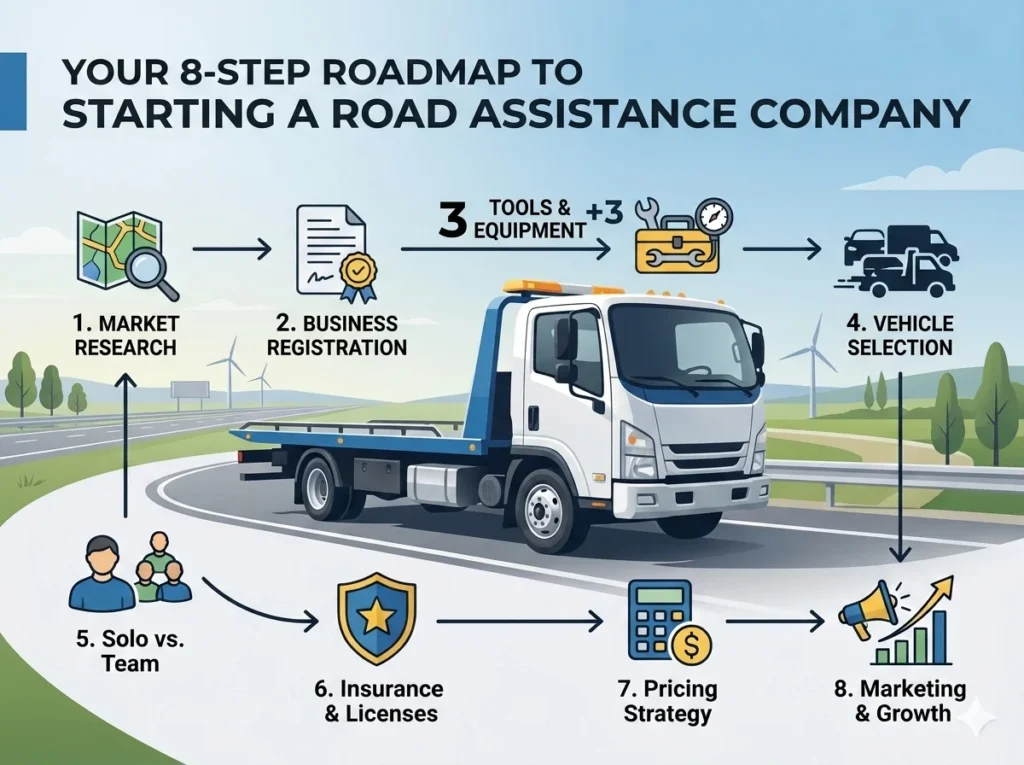
Step 1: Do Real Market Research
Before you spend a dollar, drive around your target service area for a week. Note:
- How many tow trucks and service vans you see actively running
- What the wait times look like when you call 3-4 local roadside companies pretending to be a customer
- Which areas have heavy commuter traffic, truck stops, or aging vehicle populations
Search Google for “roadside assistance + your city.” If only 4-5 listings show up and reviews are thin, you have a real opening. If 30 companies show up with thousands of reviews, you will need a sharper niche, like 24/7 service, motorcycle towing, or commercial fleet contracts.
Step 2: Register Your Business and Get Licensed
For most U.S. operators, the practical setup looks like this:
- Form an LLC in your state for liability protection (typically $50 to $500)
- Get an EIN from the IRS (free)
- Register for state and local business licenses
- If you offer towing, get a state towing permit or motor carrier authority. Requirements vary widely. California, Texas, Florida, and New York have their own specific tow operator rules.
- For interstate towing, you will need a USDOT number through the FMCSA
Skipping the licensing step is the fastest way to lose your first big insurance contract. Networks like Agero will not onboard you without proper paperwork.
Step 3: Get the Right Equipment and Tools
For a non-towing roadside operation, your basic kit looks like this:
- Heavy-duty jump starter pack (lithium, 2000+ amps)
- Floor jack and jack stands
- Lug wrenches and torque wrench
- Lockout tool kit (long-reach tool, wedge, slim jim alternatives)
- Portable fuel cans (DOT-approved)
- Air compressor and tire plug kit
- Heavy-duty flashlight, traffic cones, safety vest
- Tow strap, snatch strap, and recovery shackles
- First-aid kit and fire extinguisher
If you add light towing, you will need a wheel-lift truck or flatbed and proper recovery equipment.
Step 4: Pick the Right Vehicle
You have three realistic options:
- Used pickup truck (3/4 ton or 1 ton): Best entry point. Reliable, cheap to insure, easy to outfit. Costs $15,000 to $35,000 used.
- Service van (cargo van): Great for non-towing operations. Keeps tools dry and organized. $20,000 to $40,000 used.
- Used flatbed tow truck: Higher earning ceiling but bigger investment. Expect $35,000 to $80,000 for a decent used unit.
Start with what you can afford to keep running. A reliable $20,000 truck beats a flashy $60,000 truck that drains your cash flow in month two.
Step 5: Decide on Solo or Staffed
Almost every successful roadside business in the U.S. starts as a one-person operation. You drive, you dispatch, you invoice. Once you are doing 8 to 12 calls a day consistently, hire your first driver. Pay typically runs $18 to $25 an hour or 30 to 40 percent commission per call.
Step 6: Get the Right Insurance
This is non-negotiable. The minimum coverage you need:
- Commercial auto insurance: $1 million combined single limit is standard
- General liability insurance: $1 million per occurrence
- On-hook and garage keepers (if towing): protects vehicles in your custody
- Workers’ comp: Required in most states once you hire
Expect to spend $4,000 to $9,000 a year on insurance for a one-truck operation. Towing operators pay more.
Step 7: Build a Smart Pricing Strategy
Here is what works in the U.S. market in 2025-2026:
- Jump start: $75 to $125
- Tire change: $75 to $100
- Lockout: $65 to $100
- Fuel delivery: $65 to $90 (plus the cost of fuel)
- Light tow (first 5 miles): $95 to $150 hookup, then $4 to $7 per mile
Charge fairly, but never undercut yourself just to win calls. Roadside is a service of urgency. People will pay for fast, professional help.
Step 8: Market the Business the Right Way
This is where most new operators fail. They buy a truck and wait. Don’t wait. Here is the marketing stack that actually fills your schedule:
- Google Business Profile (GBP): Set this up day one. Add real photos of your truck, your gear, and yourself. Get reviews from every customer. GBP drives 60-80% of calls for local roadside operators.
- Local SEO: Build a simple website with city pages (“Roadside Assistance in [City]”) and write helpful content like “What to do if your battery dies in cold weather.”
- Google Local Service Ads: These show up above regular search results with the green “Google Guaranteed” badge. Pay-per-lead, very high conversion.
- Sign up with dispatch networks: Agero, Urgently, Honk, Allstate Roadside, and Quest Towing Services. They send you steady calls in exchange for a per-call fee or revenue split.
- Local partnerships: Visit auto repair shops, used car lots, apartment complexes, and trucking companies. Drop off business cards. Offer them a $10 referral fee per call. This pays for itself fast.
- Sticker your truck: A clean wrapped vehicle with your phone number is rolling advertising. Don’t skip this.
Also Read: Types of Tow Trucks Explained: Which Tow Truck Do You Need?
Startup Cost Breakdown
Here is a realistic startup budget for a single-operator roadside business in the U.S. (non-towing entry, 2025-2026):
| Expense Item | Low Estimate (USD) | High Estimate (USD) |
|---|---|---|
| Used pickup truck or service van | $15,000 | $35,000 |
| Tools and equipment kit | $2,500 | $5,000 |
| Business registration and licensing | $300 | $1,500 |
| Commercial insurance (1st year) | $4,000 | $9,000 |
| Vehicle wrap, signage, uniforms | $1,500 | $3,500 |
| Website, GBP setup, local SEO | $500 | $2,500 |
| Initial marketing (GLSA, ads) | $1,000 | $3,000 |
| Working capital (fuel, phone, misc) | $2,000 | $4,000 |
| Estimated Total Investment | $26,800 | $63,500 |
If you add a used flatbed tow truck, add another $20,000 to $50,000 to the high end.
Revenue Potential
Roadside is a high-margin service business once your truck is paid off and your name is known locally. Here is what realistic monthly numbers look like for a U.S. operator:
| Stage | Avg. Calls / Day | Avg. Price / Call | Monthly Revenue (Approx.) | Net Profit Margin |
|---|---|---|---|---|
| Solo startup (months 1-6) | 2 to 4 | $85 | $5,100 to $10,200 | 25% to 35% |
| Established solo operator | 5 to 8 | $90 | $13,500 to $21,600 | 35% to 45% |
| Two-truck small business | 10 to 14 | $95 | $28,500 to $40,000 | 30% to 40% |
| Growing fleet with insurance contracts | 18 to 25 | $100 | $54,000 to $75,000 | 25% to 35% |
Margins shrink slightly as you scale because of payroll and fleet maintenance, but absolute profit grows significantly. Many three-truck operators clear six figures in personal income.
Common Mistakes to Avoid
After watching dozens of new operators succeed and fail, the same mistakes show up over and over:
- Skipping insurance to save money. One accident wipes out the business. Don’t gamble.
- Saying yes to every call. Some calls (heavy-duty tows, accident scenes) are not worth it without the right gear and training. Know your limits.
- Not tracking your numbers. Operators who don’t know their cost per call, fuel per call, and average ticket size always run into cash flow trouble.
- Ignoring online reviews. A 4.7-star company will out-earn a 3.9-star company every single time, even with worse trucks.
- Pricing too low. Cheap pricing attracts cheap customers and creates burnout. Charge for the value you deliver.
- Burning out by working 24/7 alone. Set hours, take days off, or hire help once you can. This is a marathon.
How to Scale the Business?
Once your first truck is consistently busy, scaling is mostly about systems and contracts.
- Add trucks one at a time. Add a second truck only when your first is turning away calls or running 60+ hours a week.
- Sign up with more dispatch networks. Agero, Urgently, Honk, AAA contractor programs, and Quest Towing all feed local operators. Stack them.
- Pursue insurance company contracts directly. Once you have a clean 12-month track record, reach out to regional offices of insurance companies. Steady volume, predictable payment.
- Land fleet contracts. Local trucking companies, U-Haul dealers, car rental agencies, and corporate fleets all need preferred roadside vendors. One signed contract can equal 30 to 50 calls a month.
- Add specialty services. Mobile EV charging, motorcycle towing, semi-truck tire service, and heavy-duty recovery all command premium pricing and have less competition.
- Build a brand, not a side hustle. Uniforms, branded trucks, professional invoicing, and a clean website let you charge more and win contracts that solo operators never get.
Conclusion
Starting a roadside assistance business in the U.S. is one of the most realistic paths to owning a profitable service business with under $30,000 to start. The demand is real, the work is steady, and the playbook is well-tested. You don’t need a fancy degree, a perfect business plan, or venture capital. You need a reliable vehicle, the right insurance, professional service, and the discipline to show up when other people don’t want to.
Most operators who fail in this industry don’t fail because of competition. They fail because they treat it like a hobby. The ones who treat it like a real business, who answer the phone at 2 a.m., who keep their trucks clean, who follow up with customers, and who track every dollar, are the ones still on the road five years later, running fleets and signing contracts.
The next driver stranded in your city tonight is going to call somebody. The only question is whether they call you.
Get the truck. Get the license. Get the insurance. Then get to work.