

Breakdowns rarely happen at a good time. Whether you’ve slid off an icy back road, blown a transmission on the highway, or locked your keys in the car at a grocery store, the tow truck that shows up makes a real difference. Not every truck can handle every job, and picking the wrong one can cost you money, damage your vehicle, or leave you stranded longer than you need to be.
This guide walks through the main types of tow trucks you’ll encounter on the road, how each one works, what it’s good at, and where it falls short. By the end, you’ll know exactly what to ask for when you call a towing company, and you’ll understand why your neighbor’s Prius gets loaded differently than an 18-wheeler that jackknifed on the interstate.
Why Understanding Tow Truck Types Actually Matters?
Most people only think about tow trucks when something has already gone wrong. That’s usually the worst time to start learning. If you tell a dispatcher “just send a tow truck,” you might get one that’s technically able to move your car but isn’t the best fit for it. A front-wheel-drive sedan hooked up the old-fashioned way can pick up thousands of dollars in damage. An all-wheel-drive SUV towed on two wheels can wreck its drivetrain.
Knowing the tow truck types and uses helps you in three big ways:
- You can request the right equipment the first time.
- You can avoid towing methods that damage modern vehicles.
- You can get a more accurate price quote before the truck shows up.
Towing operators have been refining this equipment for over a century. The earliest recognizable tow truck was built in 1916 by Ernest Holmes Sr. in Chattanooga, Tennessee, using a Cadillac, some pulleys, and a lot of patience. Today’s trucks are far more specialized, and that specialization is exactly why there are so many kinds.
The Main Types of Tow Trucks
There are six tow truck designs you’ll run into most often. Some overlap a bit in what they can do, but each one has a job it does best.
1. Flatbed Tow Truck
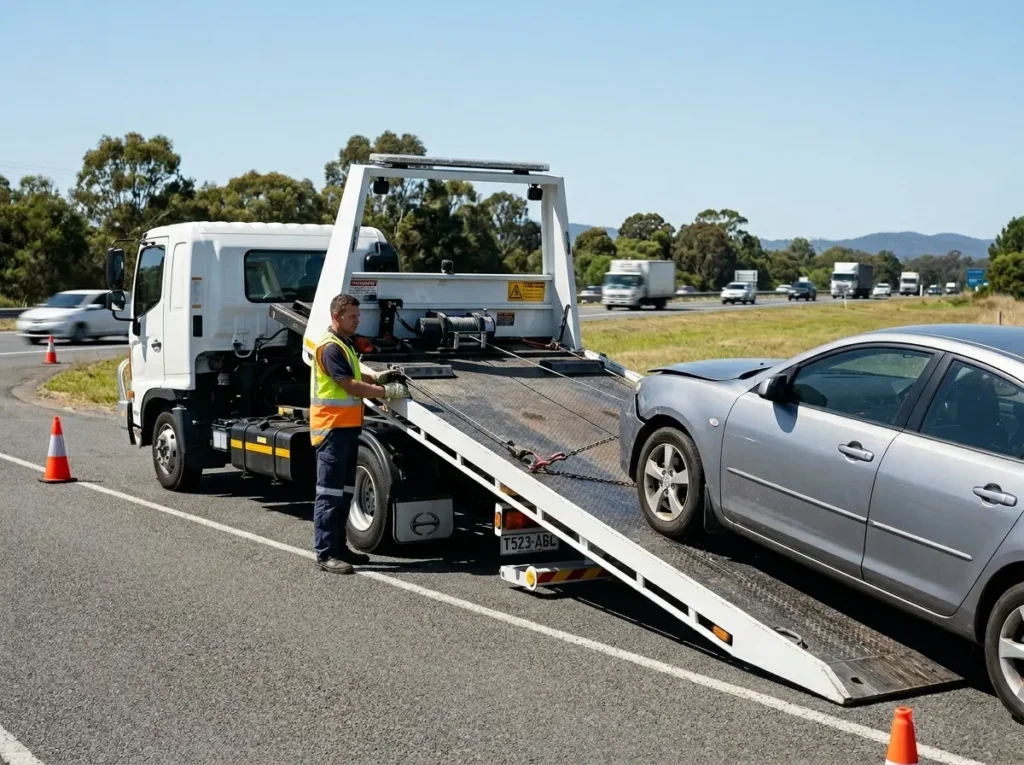
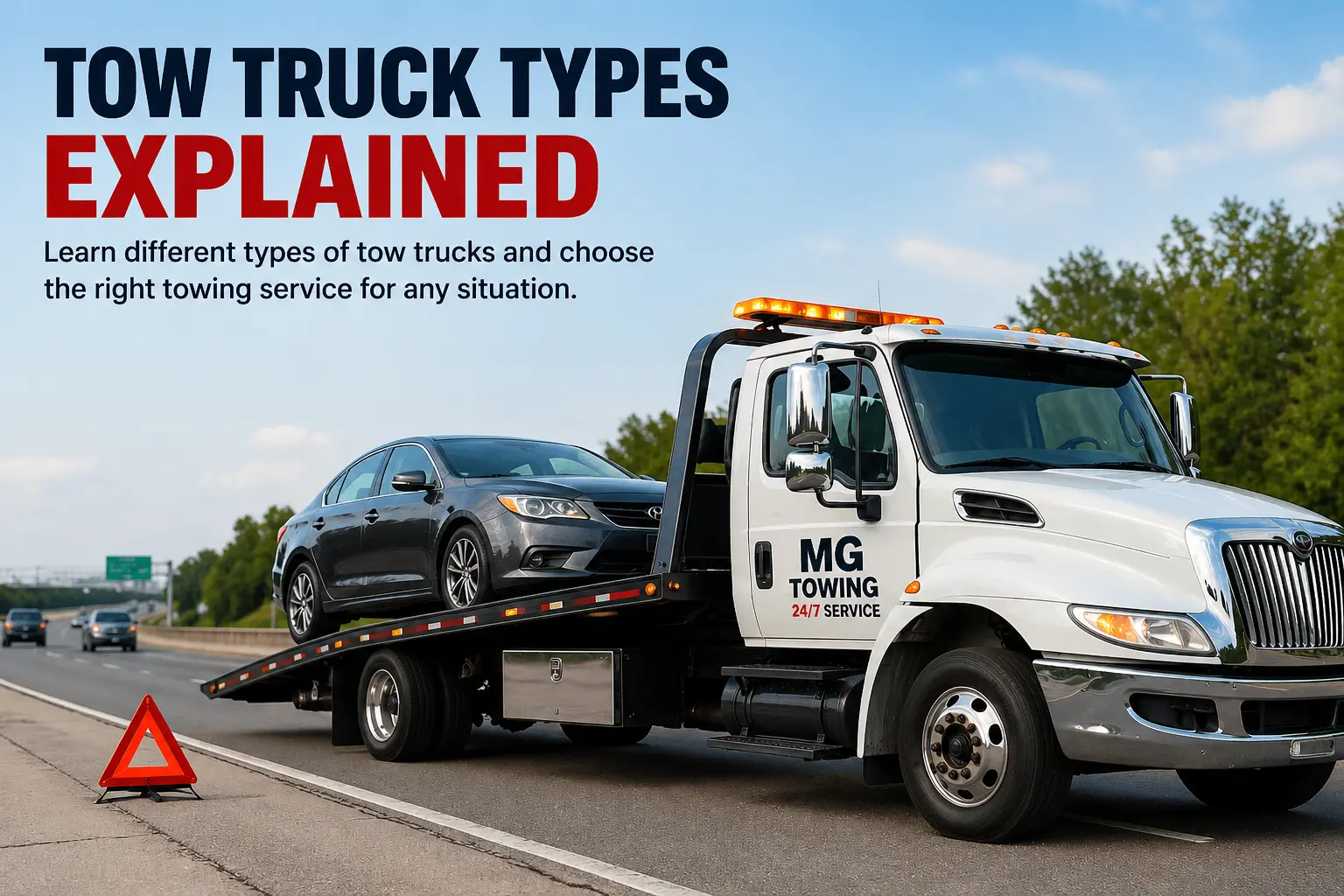
The flatbed tow truck is probably the one you picture when you hear the word “tow truck” today. It has a long, flat platform behind the cab that tilts and slides backward to ground level. The disabled vehicle is winched up onto the bed, secured with straps or chains, and then the bed levels out for transport.
How it works: Hydraulics tilt the bed down and extend it. A winch pulls the vehicle onto the platform. Once loaded, the bed returns to its horizontal position and the vehicle rides completely off the ground.
When it’s used:
- All-wheel-drive and four-wheel-drive vehicles (towing on the wheels can damage the drivetrain).
- Luxury cars, exotics, and classic cars where ground clearance or paint is a concern.
- Vehicles with major damage, flat tires, or seized wheels.
- Long-distance transport.
- Motorcycles and small equipment.
Pros: Safest option for most modern vehicles. No stress on transmissions, suspensions, or tires. Can carry almost anything that fits on the bed.
Cons: Higher hourly rate than some alternatives. The truck itself is longer and less nimble in tight spots like crowded parking garages.
Real-world use case: You hit a curb hard in your AWD Subaru and the front wheel is bent inward. A flatbed is the only sensible way to move that car without risking thousands of dollars in additional damage.
Need a safe flatbed tow or roadside assistance? MG Towing & Recovery specializes in damage-free towing for all vehicle types including AWD, luxury, and accident recovery vehicles. Call now for professional help you can trust. Call: 414-973-1902
2. Rollback Tow Truck
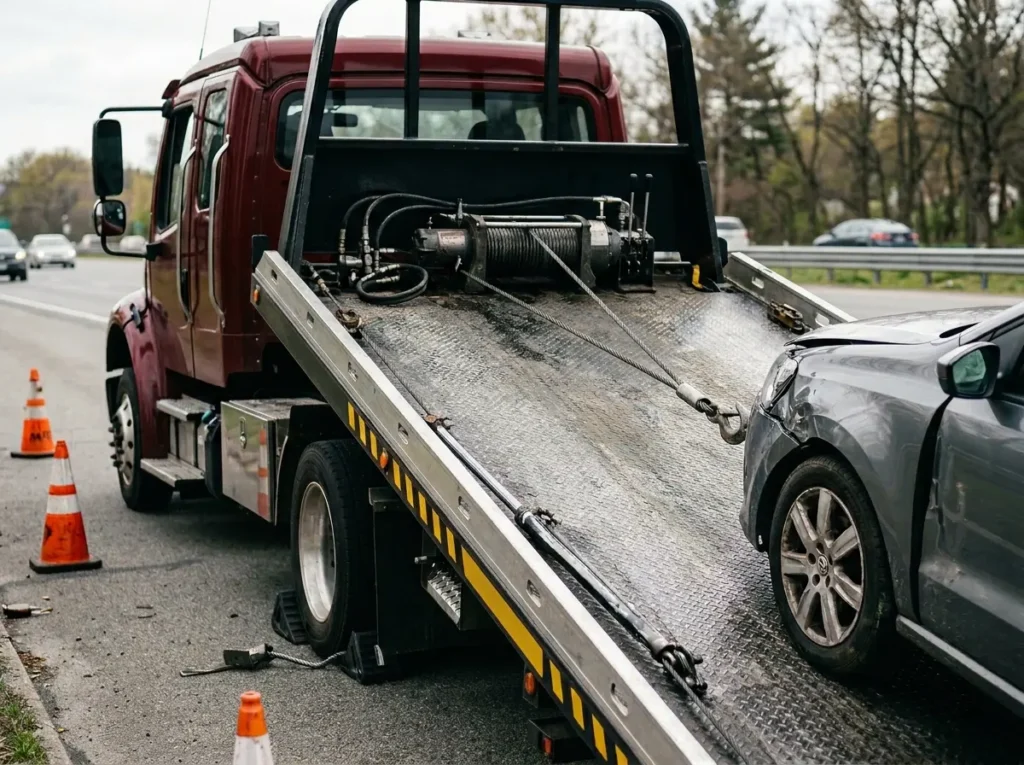
Here’s where things get a little confusing. A lot of people use “flatbed” and “rollback” interchangeably, and in casual conversation that’s fine. Technically, a rollback tow truck is a specific kind of flatbed where the entire bed slides back and tilts, letting a vehicle roll on smoothly rather than being winched up a steep incline.
How it works: The bed moves backward on a track before it tilts, which lowers the loading angle. That gentler angle is crucial for cars with low ground clearance or front splitters.
When it’s used:
- Lowered or sports cars that would scrape on a steeper ramp.
- Exotic and collector vehicles.
- Situations where the vehicle is on soft ground and can’t be dragged far.
Pros: Easier loading angle, gentler on vehicles, reduces risk of front bumper or undercarriage damage.
Cons: Slightly more expensive than a standard flatbed in some markets. Requires more space to load because the bed extends further back.
Quick clarification: Every rollback is a flatbed, but not every flatbed is a rollback. If you drive something low or valuable, ask specifically for a rollback.
3. Hook and Chain Tow Truck
The hook and chain tow truck is the old-school design that dominated the industry for most of the 20th century. It uses a heavy chain wrapped around the vehicle’s frame or axle, connected to a boom that lifts one end of the car off the ground. The other two wheels stay on the pavement.
How it works: The operator loops chains around a structural part of the vehicle, then the boom lifts that end. The vehicle is towed on its remaining two wheels.
When it’s used today:
- Vehicles that are already wrecked beyond repair (junk yards, totaled cars).
- Trucks with missing wheels or collapsed suspensions.
- Moving heavy equipment or machinery short distances.
Pros: Simple, rugged, inexpensive to operate.
Cons: Can seriously damage modern vehicles. The chains scratch paint, bend bumpers, and stress body panels. Most reputable companies no longer use hook and chain trucks on operational cars.
Real-world use case: A scrapyard needs to move rows of wrecked cars. A hook and chain rig is cheap and fast because cosmetic damage doesn’t matter anymore.
4. Wheel Lift Tow Truck
The wheel lift tow truck is the modern evolution of the hook and chain. Instead of chains, it uses a metal yoke that slides under the drive wheels and lifts them off the ground. The other two wheels roll along behind.
How it works: A hydraulic arm extends from the back of the truck with a bracket that cradles two of the vehicle’s tires. The bracket lifts, and the car is towed with only two wheels touching the road.
When it’s used:
- Parking enforcement and repossession.
- Short-distance tows in urban areas.
- Front-wheel-drive or rear-wheel-drive cars (lift the drive wheels off the ground).
- Tight spaces like underground parking garages.
Pros: Fast to hook up, maneuverable, cheaper than a flatbed for quick jobs. Much less damaging than hook and chain.
Cons: Not ideal for AWD or 4WD vehicles. Long-distance towing this way is hard on tires and suspension. Some exotic and low-clearance cars can’t be lifted safely.
Real-world use case: A car is parked illegally in a loading zone downtown. A wheel lift truck can be in and out in under two minutes, which is exactly why cities rely on them.
5. Integrated Tow Truck
The integrated tow truck (sometimes called a “self-loader” or “repo truck” in its lighter form, and “integrated heavy” in its bigger version) combines the boom and wheel lift into a single built-in unit. Controls are often operated from inside the cab.
How it works: The lifting arm is built into the chassis rather than bolted on as a separate piece. Heavy-duty integrated trucks have more lifting capacity and are engineered for rigs that would overwhelm a standard wrecker.
When it’s used:
- Buses, semis, and commercial trucks.
- Repossession work (the cab-operated lift lets the driver hook up and leave quickly).
- Situations where strength and speed both matter.
Pros: Very strong, quick hookup, operator stays safe inside the cab.
Cons: Expensive to buy and maintain. Usually overkill for everyday passenger car tows.
6. Heavy Duty Tow Truck
When a semi-truck rolls over, a bus breaks down on a mountain pass, or an RV dies on the shoulder, a regular wrecker can’t help. That’s where the heavy duty tow truck comes in. These rigs are purpose-built for moving vehicles that weigh anywhere from around 17,000 pounds up to well over 100,000 pounds.
How it works: Heavy duty wreckers have reinforced frames, massive booms, powerful winches (often rated at 50,000 pounds or more), and underlifts that can cradle commercial truck axles. Many are built on tandem-axle or tri-axle chassis for stability.
When it’s used:
- Semi-trucks, tractors, and trailers.
- Buses, motor homes, and large RVs.
- Construction and agricultural equipment.
- Recovery operations after serious crashes or rollovers.
Pros: The only realistic option for commercial-sized vehicles. Can handle recoveries that no other equipment can touch.
Cons: Expensive per hour, and response times can be longer because fewer companies own them.
Real-world use case: A loaded tractor-trailer jackknifes during a winter storm. The recovery job involves uprighting the cab, separating the trailer, and towing both pieces. This typically requires two heavy duty trucks working together, sometimes alongside a rotator (a specialized heavy-duty truck with a 360-degree rotating boom).
Also Read: Winch Out vs. Towing: What’s the Difference
Weight Capacity Comparison
Capacity ratings vary by manufacturer and configuration, but these are typical ranges you’ll see in the field. Gross Vehicle Weight Rating (GVWR) is how heavy the truck itself can legally be when loaded; towing capacity is how much it can actually pull or carry.
| Category | Typical GVWR | Approximate Towing Capacity | Class |
|---|---|---|---|
| Light duty (wheel lift, small flatbed) | Up to 14,000 lbs | Up to 10,000 lbs | Class 1-4 |
| Medium duty (standard flatbed, rollback) | 14,001 to 26,000 lbs | Up to 17,000 lbs | Class 5-6 |
| Heavy duty | 26,001 lbs and up | 25,000 to 50,000+ lbs | Class 7-8 |
| Rotator / super-heavy | 60,000+ lbs | 50,000 to 100,000+ lbs | Class 8 |
Typical Cost Estimates
Towing prices vary by region, time of day, distance, and how complicated the recovery is. The numbers below are ballpark figures for the United States as of the mid-2020s. Expect higher rates in major metro areas and lower rates in rural markets.
| Service | Hook-Up Fee | Per-Mile Rate | Notes |
|---|---|---|---|
| Local tow (under 5 miles) | $50 to $125 | Often included | Flat rate common for short distances |
| Standard flatbed / rollback | $75 to $150 | $3 to $7 per mile | Most common service call |
| Wheel lift | $50 to $100 | $2.50 to $5 per mile | Cheaper for short hauls |
| Long-distance tow (100+ miles) | Varies | $2 to $4 per mile | Better rates for longer trips |
| Heavy duty | $250 to $600 | $7 to $15+ per mile | Hourly rates also apply |
| Rotator / heavy recovery | $500 to $1,500+ | Hourly ($300 to $800/hr) | Complex recoveries billed per hour |
| After-hours / holiday | +$25 to $100 | Standard rate | Nights, weekends, storms cost extra |
Pro tip: If you have roadside assistance through your insurance, auto club, or credit card, check your coverage before calling. Many policies cover basic tows up to a set mileage, which can save you a couple hundred dollars.
How to Choose the Right Tow Truck for Your Situation?
You don’t need to memorize every truck design. You just need to answer a few questions when you call for help.
- What kind of vehicle do you drive? AWD, 4WD, luxury, exotic, or lowered vehicles should always go on a flatbed or rollback.
- Is the vehicle operable? If the wheels turn and the steering works, a wheel lift might be fine for a short hop. If anything is seized or broken, flatbed is safer.
- How far is the tow? Short distances under 10 miles can often use a wheel lift. Longer distances are better on a flatbed to avoid wearing out tires and bearings.
- How big is the vehicle? Anything heavier than a full-size pickup likely needs medium or heavy duty equipment.
- Is the vehicle in a difficult spot? Ditch, mud, snowbank, ravine? That’s a recovery job, which may need a winch-equipped truck or a rotator depending on the situation.
Also Read: Flatbed vs. Hook-and-Chain Towing: Key Difference
Common Myths About Tow Trucks
Myth 1: “All tow trucks can safely tow my car.” Not true. Towing an AWD vehicle on two wheels can destroy the transfer case and cost thousands to repair.
Myth 2: “Flatbeds are only for fancy cars.” Flatbeds are actually the default recommendation for almost any modern vehicle. The reason you see wheel lifts more often in cities is speed and cost, not suitability.
Myth 3: “The hook and chain method is fine for short tows.” It’s fine only if you don’t care about paint, frame, or bumper damage. Most reputable operators stopped using it on functional vehicles decades ago.
Myth 4: “Towing prices are standard across companies.” Rates can vary by a factor of two or three between operators in the same city. Always ask for a quote before the truck is dispatched.
Signs You’re Dealing with a Professional Tow Operator
- They ask what kind of vehicle you have before agreeing to send a truck.
- They give you a written or verbal quote with the hook-up fee and per-mile rate.
- The truck arrives clearly marked with the company name and DOT number.
- The operator walks around your vehicle and documents its condition before loading.
- They use soft straps rather than chains on modern vehicles.
If a tow operator shows up and none of those things happen, you have every right to ask questions or request a different company. Predatory towing is unfortunately a real issue, especially after accidents and in unfamiliar cities.
Don’t wait for a breakdown to turn into a bigger problem. Save MG Towing & Recovery now for 24/7 reliable towing and roadside assistance anywhere in Milwaukee, Racine, and surrounding Wisconsin areas. Number: 414-973-1902
Conclusion
The world of towing is more specialized than most people realize. From the old-school hook and chain rigs still hauling wrecks to scrapyards, to the massive rotators pulling semi-trucks back onto highways, each design exists because someone needed to solve a specific problem. For the average driver, the takeaway is simple: a flatbed or rollback is almost always the safest bet, a wheel lift is fine for quick local moves, and anything bigger than a pickup probably needs medium or heavy duty equipment.
Next time you call for a tow, you won’t just be asking for “a truck.” You’ll be asking for the right truck. That small piece of knowledge can save your vehicle, your wallet, and a lot of stress on what’s already a bad day.
Frequently Asked Questions
Q. What is the most common type of tow truck?
The flatbed (often called a rollback) is the most common type of tow truck used today for passenger vehicles. It’s the safest option for modern cars because all four wheels are off the ground during transport.
Q. Can any tow truck tow an all-wheel-drive vehicle?
No. AWD and 4WD vehicles should only be towed on a flatbed or rollback. Towing them with a wheel lift or hook and chain can damage the transfer case, transmission, and differentials.
Q. Why don’t tow companies use hook and chain trucks anymore?
Hook and chain trucks damage modern vehicles. The chains scratch paint, bend bumpers, and put stress on body panels that weren’t designed for it. They’re still used in salvage yards where cosmetic damage doesn’t matter.
Q. How much does a tow truck cost per mile?
Standard tows usually run between $3 and $7 per mile after the hook-up fee, which typically ranges from $50 to $150. Heavy duty tows cost significantly more, often $7 to $15 or more per mile plus hourly recovery rates.
Q. What type of tow truck do I need for a motorcycle?
A flatbed or rollback is the best choice for motorcycles. Specialized motorcycle tow trucks exist and use wheel chocks and soft straps to secure the bike without damaging it.
Q. What kind of tow truck is used for semi-trucks?
Semi-trucks require heavy duty tow trucks, and in the case of accidents or rollovers, often a rotator. These trucks have winches capable of pulling 50,000 pounds or more and booms that can rotate 360 degrees.
Q. How long does it take for a tow truck to arrive?
Response times vary by location and time of day. In urban areas, expect 30 to 60 minutes on average. Rural areas and bad weather can push wait times past two hours. Heavy duty and specialty trucks often take longer because fewer are available.