

The Complete Milwaukee Driver’s Guide to Flat Tire Safety, Service & Prevention
Few things are more disorienting than the sudden thud and pull of a tire blowout at highway speed or the slow, creeping realization that your car is riding lower on one side than it should be. Flat tires happen to experienced drivers just as often as to new ones.
They do not discriminate by time of day, weather, or how carefully you drive. And in Milwaukee, with its notorious pothole season, heavy road salt, and long winters that wreak havoc on tire pressure and rubber, flat tires are an especially common reality.
What separates a minor inconvenience from a dangerous roadside situation is how you respond. Drivers who know exactly what to do in the first thirty seconds after a flat tire occurs are far less likely to be involved in a secondary accident, cause damage to their vehicle, or find themselves stranded in an unsafe location.
This guide walks you through every step of handling a flat tire on the road from the moment you first feel or hear the problem, through the decision of whether to change it yourself or call for professional flat tire roadside assistance, to the costs involved and how to prevent it from happening again.
Whether you are on I-94 through downtown Milwaukee, a quiet residential street, or a rural Wisconsin highway, this guide applies to you.
Related Article: Locked Out of Your Car? Step-by-Step Guide for Milwaukee Drivers
Recognizing a Flat Tire While Driving

What a Flat Tire Feels and Sounds Like?
Not all flat tires announce themselves the same way. Knowing the different warning signs helps you react appropriately without panicking or making the situation worse.
- Blowout: A sudden, loud bang followed by violent pulling to one side and a rapid loss of vehicle stability. This is the most dramatic and dangerous type of flat tire event and requires immediate, controlled response.
- Rapid deflation: A strong vibration and increasingly heavy pulling to one side, usually accompanied by a flapping or thumping sound as the deflated tire contacts the road. Less sudden than a blowout but still urgent.
- Slow leak: The vehicle gradually pulls to one side over miles, or you notice the ride quality becoming rough and the steering feeling heavier than usual. Often only noticed when stopping or when the TPMS warning light activates.
- TPMS warning light: Modern vehicles have a Tire Pressure Monitoring System that illuminates a dashboard warning when any tire drops below safe pressure. Never ignore this light pull over at the nearest safe opportunity and inspect your tires.
The Single Most Important Rule: Do Not Panic-Brake or Jerk the Wheel
When a tire blows out or deflates rapidly at speed, the instinctive response for most drivers is to brake hard and steer away from the pull. This is exactly the wrong thing to do. Sudden heavy braking or sharp steering input during a blowout can cause you to spin out, roll over, or lose control entirely.
The correct response is counterintuitive but critical: maintain a firm grip on the wheel, ease off the accelerator gradually, and allow the vehicle to slow naturally while steering gently to correct the pull.
Do not apply the brakes hard until your speed has dropped significantly, below 30 mph is a reasonable threshold. This technique keeps the vehicle stable and gives you time to steer toward safety.
| Critical Safety Rule: When a tire blows out at highway speed, do NOT slam on the brakes. Maintain steering control, ease off the gas gradually, and let the vehicle slow naturally. Apply brakes only gently once you are below 30 mph and steering toward the shoulder. Panic braking during a blowout is a leading cause of blowout-related fatalities. |
Step-by-Step: What to Do Immediately After a Flat Tire?
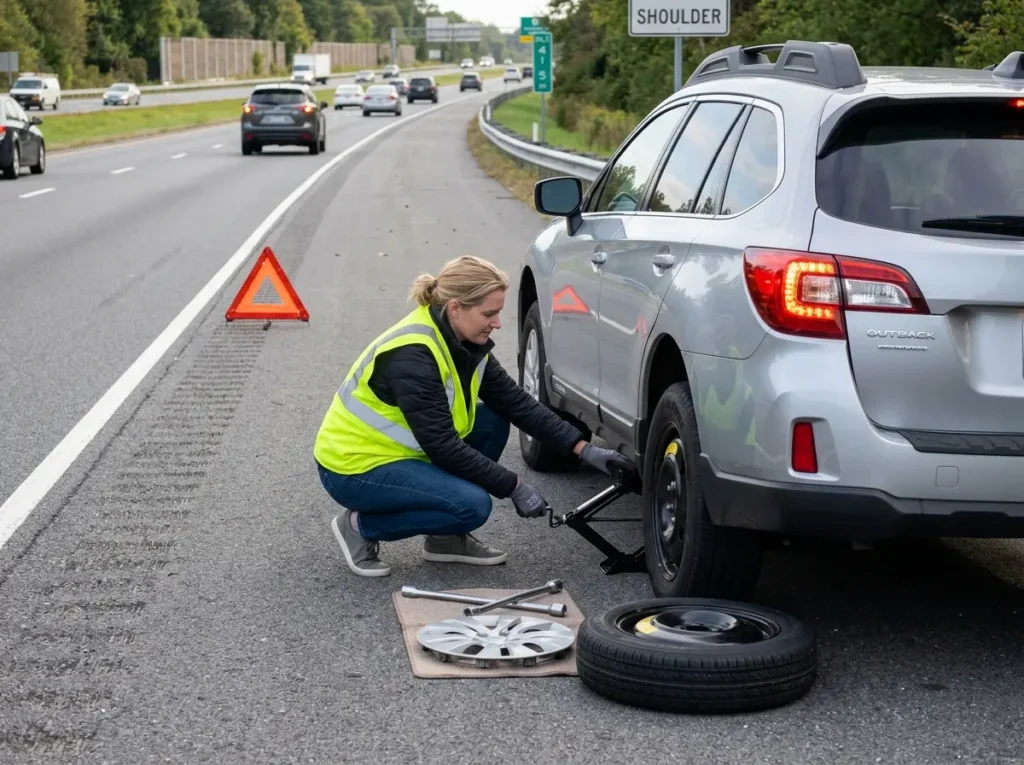
Whether your flat tire happens in a sudden blowout or as a gradual deflation, the following steps apply every time. Follow them in order.
- Grip the steering wheel firmly with both hands and stay calm. Do not make any sudden movements.
- Ease off the accelerator gradually do not hit the brakes immediately.
- Allow the vehicle to slow down naturally while maintaining a straight line or gentle correction toward the right shoulder.
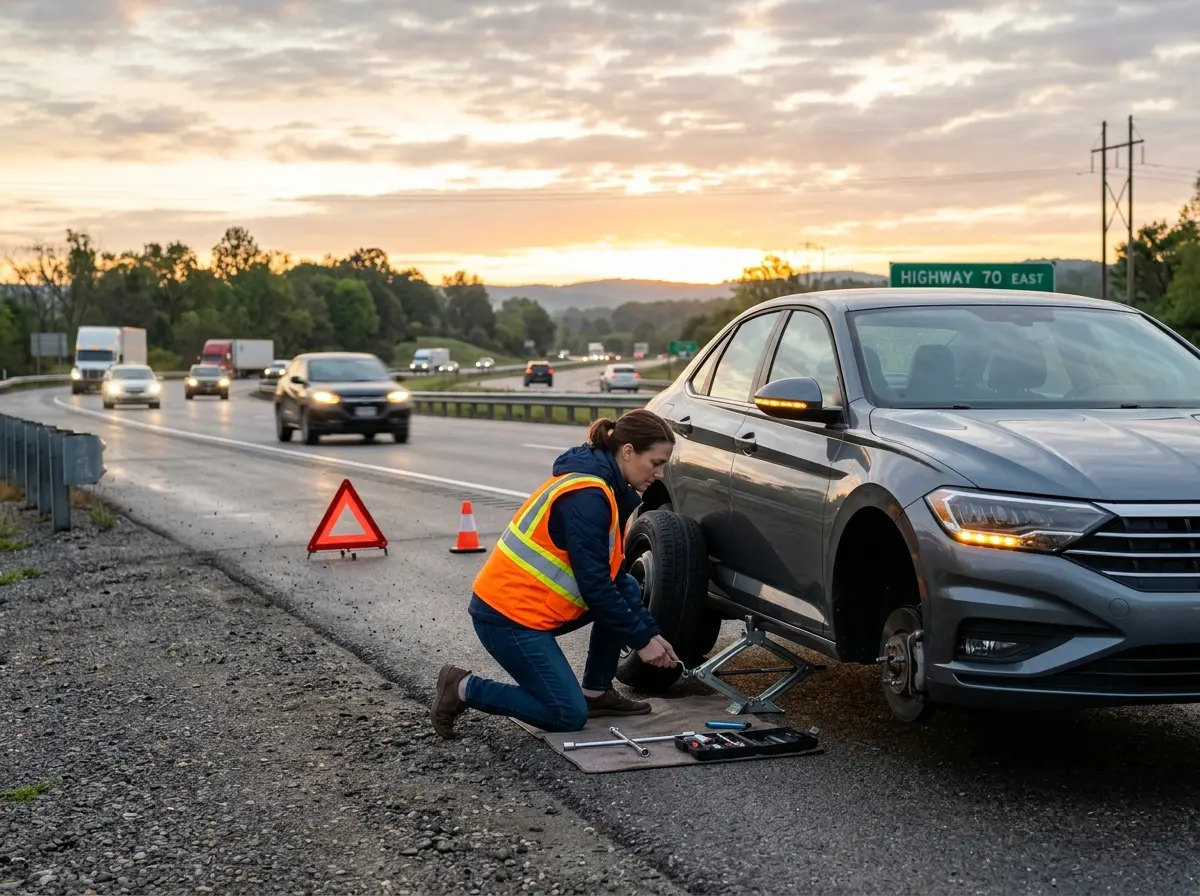
- Activate your hazard lights as soon as you have stabilized the vehicle.
- Steer toward the right shoulder or the nearest safe pullout, parking lot, or side street. Avoid stopping in a live traffic lane at all costs.
- Once stopped safely off the road, apply the parking brake.
- If you are on a highway, stay in the vehicle with your seatbelt on do not stand behind or beside your vehicle in traffic.
- Assess your surroundings: Is it safe to change the tire here? Do you have a usable spare? If not, call for flat tire roadside assistance.
- Place warning triangles or flares behind your vehicle if you have them, at intervals of 50 to 100 feet.
- Call for help if needed, MG Towing & Recovery provides 24/7 flat tire service in Milwaukee and the surrounding area.
| Location Matters: Where you stop after a flat tire is as important as how you stop. A well-lit parking lot or wide shoulder is far safer than a narrow highway shoulder or a dark, isolated stretch of road. If you can safely drive a short distance further to reach a safer stopping point even on a flat tire it is often worth doing. Driving slowly on a flat for a very short distance causes tire damage but is sometimes the safer choice compared to stopping on a dangerous stretch of road. |
Should You Change the Tire Yourself or Call for Help?
This is the question most drivers face after a flat tire, and the honest answer depends on several factors: your physical ability, the location, the conditions, whether you have the right equipment, and whether you actually know how to change a tire correctly. Let us break down both options.
When to Change the Tire Yourself?
Changing a flat tire yourself is a reasonable option when all of the following conditions are true:
- You are in a safe, well-lit location with firm, level ground, a parking lot or wide shoulder, not a highway shoulder or soft shoulder
- You have a full-size or temporary spare tire that is properly inflated
- You have a functioning jack and lug wrench in the vehicle
- You are physically capable of safely performing the task
- Weather conditions are acceptable not a blizzard, heavy rain, or extreme cold
- You have changed a tire before and are confident in the process
If all of these conditions apply, changing a flat tire yourself can get you moving faster than waiting for roadside assistance. The step-by-step process is covered in the next section.
When to Call for Emergency Tire Change Service?
Call for professional flat tire help in any of these situations:
- You are stopped on a highway shoulder, particularly at night or in low-visibility conditions, roadside tire changes on busy highways are extremely dangerous
- You do not have a spare tire, or the spare is also flat or damaged
- The lug nuts are corroded or stuck and cannot be loosened with standard tools
- Weather conditions are dangerous ice, heavy snow, or a severe storm
- You are physically unable to safely change the tire
- You are in an area that feels unsafe
- The damaged tire is on the traffic-side of the vehicle
- You have run-flat tires that require specialized service
Professional emergency tire change service is not a sign of helplessness it is the smart, safe choice in many of the most common flat tire scenarios. A professional technician has the right equipment, works safely, and gets the job done correctly every time.
| Milwaukee Highway Tip: If your flat tire occurs on I-43, I-94, I-894, or any other Milwaukee-area highway, the safest choice is almost always to call for roadside assistance rather than attempting a shoulder tire change. Wisconsin DOT Highway Helpers patrol major Milwaukee highways and can assist, but MG Towing & Recovery’s 24/7 flat tire service in Milwaukee guarantees a trained technician reaches you fast regardless of the time or location. |
Flat Tire in Milwaukee? Help Is One Call Away. MG Towing & Recovery – 24/7 Flat Tire Service & Emergency Roadside Assistance. Call Now: 414-973-1902
How to Change a Flat Tire: Step-by-Step Guide
If conditions are safe and you have decided to change the tire yourself, follow these steps carefully. Do not rush a rushed tire change that goes wrong is far more costly than a slow, careful one.
What You Will Need
- Spare tire (full-size or temporary/donut spare)
- Car jack (scissor jack or hydraulic floor jack)
- Lug wrench
- Vehicle owner’s manual (for jack placement points)
- Wheel wedges or large rocks to block the opposite tires
- Flashlight if it is dark
- Reflective triangles or road flares
- Gloves – lug nuts and tires are dirty and often greasy
The Tire Change Process
- Apply the parking brake fully before doing anything else.
- Place wheel wedges or rocks against the tires diagonally opposite the flat to prevent rolling.
- Remove the spare tire, jack, and lug wrench from your trunk or undercarriage storage.
- Loosen the lug nuts on the flat tire slightly, do this before jacking the car up, while the tire still has ground contact providing resistance. Turn counterclockwise. Do not remove them yet — just break them loose.
- Consult your owner’s manual to locate the correct jack placement points on your vehicle’s frame. Using the wrong jack point can damage the vehicle or cause the jack to slip catastrophically.
- Position the jack at the correct point and raise the vehicle until the flat tire is about six inches off the ground.
- Remove the lug nuts completely and keep them somewhere safe, a pocket or cup holder works well.
- Remove the flat tire and set it aside flat on the ground.
- Mount the spare tire, aligning the holes with the wheel bolts.
- Hand-tighten the lug nuts in a star pattern not a circular pattern to ensure even seating.
- Lower the vehicle until the spare tire just contacts the ground, then tighten the lug nuts fully in the same star pattern using the lug wrench. Apply firm body weight — they need to be tight.
- Lower the vehicle completely and remove the jack.
- Check the spare tire’s pressure if possible, and drive cautiously to the nearest tire shop for a proper repair or replacement.
| Temporary Spare Speed and Distance Limits: If you are using a compact temporary spare (donut spare), observe its limitations strictly. Most are rated for a maximum of 50 mph and no more than 50 to 70 miles of driving. They are not designed for highway speeds or long-distance travel. Drive directly to a tire shop do not take the highway, and do not put off getting the full tire repaired or replaced. |
Flat Tire Issues in Milwaukee Winter: What Every Driver Must Know
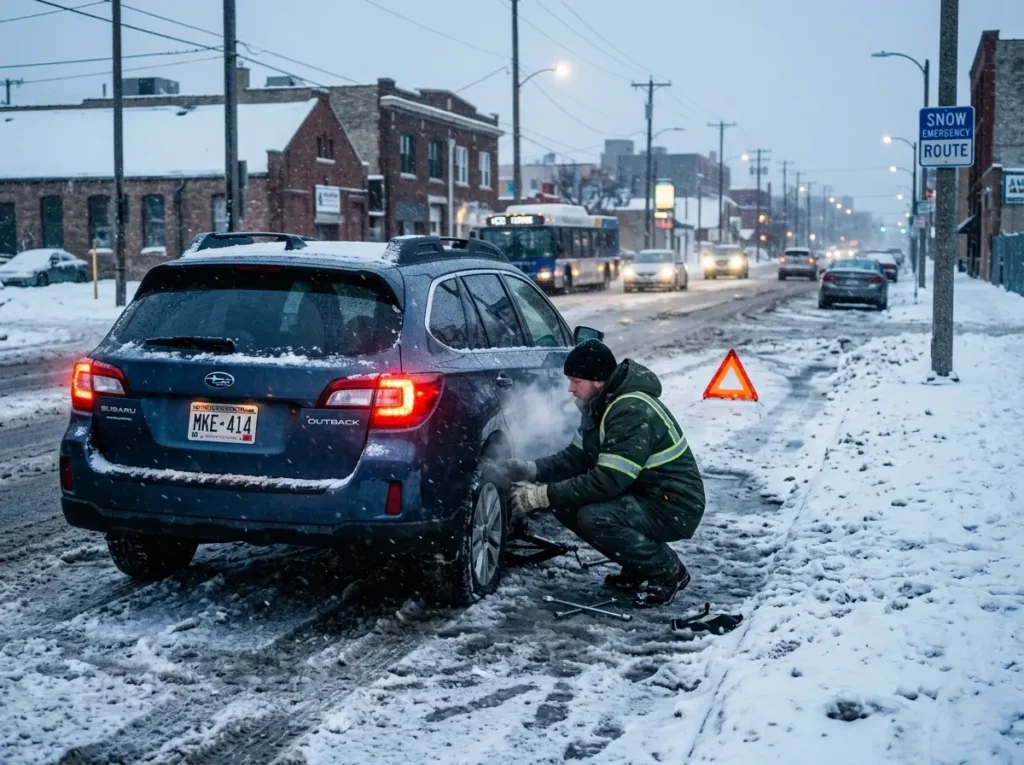
Flat tires in Milwaukee’s winter months come with a unique set of complications. Cold weather tire issues are among the most common complaints from Wisconsin drivers between November and March, and understanding them helps you stay ahead of potential problems.
1. Cold Weather Tire Pressure Issues
Tire pressure drops significantly in cold temperatures. For every 10-degree Fahrenheit drop in temperature, tire pressure decreases by approximately 1 PSI. During a typical Milwaukee winter, when temperatures can swing from the low 20s at night to the upper 30s during the day, this means your tires can be losing and gaining a pound of pressure every single day.
Underinflated tires are more susceptible to damage from potholes and road debris, wear unevenly, and handle poorly particularly on snow and ice. Check your tire pressure at least once a month during winter, always when the tires are cold (before you have driven more than a mile), and inflate to the manufacturer’s recommended PSI listed on the driver’s door jamb sticker.
Do not inflate to the maximum PSI printed on the tire sidewall that number is the tire’s maximum capacity, not the recommended operating pressure for your specific vehicle.
2. Driving with a Flat Tire in Snow and Ice
A flat tire in winter conditions is significantly more dangerous than a summer flat. Snow and ice on the road surface mean less traction for your remaining three tires as you attempt to slow and steer after a flat occurs. Your stopping distance increases, and the pull from the flat tire feels more pronounced on slippery surfaces.
If your tire deflates while driving on a snowy or icy Milwaukee road, reduce speed even more gradually than you would in dry conditions. Steer with minimal inputs, avoid any braking that is not absolutely necessary, and find the nearest safe stopping point even if it means driving further on the flat tire than you otherwise would. The tire damage is worth it compared to the risk of a winter-road loss of control.
3. Winter Tire Safety Tips for Milwaukee Drivers
- Inspect all four tires before winter arrives, look for sidewall cracks, tread depth below 4/32 inch, and uneven wear patterns that suggest alignment or pressure problems
- Consider winter or all-season tires if you drive frequently in snow, summer performance tires lose significant grip below 45 degrees Fahrenheit
- Keep your spare tire properly inflated year-round, a flat spare discovered in a blizzard is a serious problem
- Carry a portable tire pressure gauge and a 12-volt tire inflator in your vehicle during winter months
- Check tire pressure on the same day each week during cold months consistency helps you catch slow leaks before they become roadside emergencies
4. Milwaukee’s Pothole Problem and Your Tires
Milwaukee’s pothole season which runs roughly from late February through May as freeze-thaw cycles fracture road surfaces is one of the worst in any major U.S. city.
Deep, sharp-edged potholes are a leading cause of tire damage including sidewall bulges, rim bends, and immediate deflation from impact punctures.
Sidewall damage from pothole impacts is generally not repairable — if your tire has a visible bulge, bubble, or crack on the sidewall after hitting a pothole, it needs to be replaced immediately. A sidewall bulge indicates internal structural damage, and the tire can fail catastrophically without further warning.
| Milwaukee Pothole Damage: If a Milwaukee pothole damages your tire, wheel, or suspension, you may be eligible for compensation through the City of Milwaukee’s claims process. Document the pothole location, take photos of the damage, and file a claim with the City of Milwaukee’s Department of Public Works. Claims must typically be filed within 120 days of the incident. |
Flat Tire Repair and Replacement Cost in Milwaukee
Understanding the realistic cost of flat tire service in Milwaukee helps you make informed decisions about repair versus replacement and avoid being overcharged in a stressful moment.
| Service | Typical Cost Range | Notes |
| Roadside tire change (professional) | $50 – $100 | Mounts your spare on-site |
| Plug repair (minor puncture) | $15 – $30 | Quick fix at a tire shop |
| Patch repair (internal) | $25 – $50 | More durable than plug alone |
| Tire replacement (standard) | $80 – $200+ per tire | Varies by tire brand/size |
| Tire replacement (premium/performance) | $150 – $400+ per tire | Luxury and performance vehicles |
| Rim/wheel damage repair | $75 – $300+ | Bent or cracked from pothole |
| Emergency roadside flat tire service (after hours) | $75 – $150 | Night/weekend surcharge applies |
| Tow to nearest tire shop (if no spare) | $75 – $175 | Standard local tow distance |
When Is a Flat Tire Repairable vs. When Does It Need Replacement?
Not every flat tire requires a full replacement. Here is a straightforward guide to when a repair is appropriate and when replacement is the only safe option:
- Repairable: A clean nail or screw puncture in the center tread area, no wider than 1/4 inch in diameter, with no sidewall involvement a proper patch-plug repair from the inside is safe and durable
- Not repairable: Any puncture in or near the sidewall, sidewall repairs are not considered safe by tire industry standards
- Not repairable: A puncture larger than 1/4 inch in diameter in the tread area
- Not repairable: A tire that has been driven on while flat even a short distance can damage the internal structure beyond repair
- Not repairable: Visible sidewall bulge, bubble, or cracking these indicate internal structural failure
- Not repairable: A blowout where significant tread separation has occurred
Does Insurance Cover Flat Tire Costs?
Roadside assistance coverage whether through your auto insurer, AAA, or a credit card benefit typically covers the cost of having a technician change your flat tire on the roadside. The cost of the replacement tire itself is generally not covered by standard roadside assistance plans.
Comprehensive auto insurance covers tire damage from incidents like theft, fire, or certain natural events, but not standard road hazard damage. Some tire retailers and dealers sell road hazard protection plans that cover replacement costs for damage from potholes and road debris, these can be worth the investment in Milwaukee, where pothole damage is unusually common.
Flat Tire Prevention: How to Reduce Your Risk on Milwaukee Roads?
No flat tire prevention strategy is foolproof, road debris and potholes are beyond your control. But the following habits and practices significantly reduce your risk of a flat tire emergency on Milwaukee roads.
Regular Tire Maintenance Habits
- Check tire pressure monthly and before long trips always when tires are cold
- Rotate your tires every 5,000 to 7,500 miles to promote even wear
- Check tread depth with a penny, if Lincoln’s head is fully visible when inserted into the tread, your tires are below safe depth and need replacement
- Inspect tires visually before driving look for visible nails, screws, or objects embedded in the tread
- Ensure your spare tire is always properly inflated, check it every time you check your main tires
- Have wheel alignment and balance checked annually and after any significant pothole impact
Build Your Roadside Emergency Kit for Tire Emergencies
- Properly inflated spare tire (full-size preferred; a compact spare if that is what your vehicle came with)
- Car jack and lug wrench rated for your vehicle
- Portable 12-volt tire inflator for slow leaks
- Tire plug kit for temporary repairs
- Reflective warning triangles or road flares
- Work gloves
- Flashlight or headlamp with fresh batteries
- Roadside assistance contact numbers, including MG Towing & Recovery for Milwaukee area coverage
Frequently Asked Questions: Flat Tires on Milwaukee Roads
Can I drive on a flat tire to reach a safer location?
You can drive very slowly on a flat tire for a very short distance if doing so moves you to a significantly safer stopping location for example, off a highway and into a parking lot.
Keep your speed under 15 mph and minimize the distance. Understand that driving on a flat will almost certainly destroy the tire and may damage the wheel rim, but that damage is sometimes worth accepting in exchange for a safer stopping point.
What is the fastest way to get flat tire help in Milwaukee?
Calling a local Milwaukee roadside assistance provider directly is almost always faster than going through a national insurance dispatch center. MG Towing & Recovery provides 24/7 flat tire service in Milwaukee with local dispatch, meaning a technician is sent from the area rather than routed from a distant contractor. For most Milwaukee locations, expect a response within 30 to 45 minutes.
My TPMS light came on but my tires look fine. Do I have a flat?
Not necessarily a flat, but you do have low pressure in at least one tire. The TPMS light activates when pressure drops 25 percent or more below the recommended level which can happen gradually from a slow leak or simply from cold temperatures.
Stop as soon as safely possible, visually inspect all four tires, and check pressure with a gauge. Add air if needed, and monitor the situation. If the light comes back on after inflating, you likely have a slow leak that needs professional inspection.
How do I know if my spare tire is still good?
Check your spare tire’s pressure every time you check your main tires most spare tires lose pressure over time even without a puncture. Also inspect the spare visually for cracks, dry rot, or sidewall damage, especially if it is several years old. Tires degrade with age even if unused, and many manufacturers recommend replacing spare tires after six years regardless of apparent condition.
Is a nail in my tire always an emergency?
Not always. If the nail is in the center tread area and the tire is still holding pressure reasonably well, you have a slow leak rather than an immediate flat.
Avoid highway speeds, check the pressure every few miles if possible, and head directly to a tire shop for a proper patch-plug repair. Do not leave a nail in your tire indefinitely it will eventually work its way deeper and cause a full flat.
Final Word: Stay Prepared, Stay Safe on Milwaukee Roads
A flat tire is one of the most common roadside emergencies Milwaukee drivers face and in a city with harsh winters, heavy road salt, and seasonal pothole craters, it is something every driver should be genuinely prepared to handle.
The difference between a flat tire that costs you thirty minutes and one that costs you a towed vehicle, a damaged rim, or worse, comes down to two things: knowing what to do in the first critical moments, and having the resources in place before the emergency happens.
That means a properly maintained spare, a basic emergency kit, and a trusted roadside assistance provider’s number already saved in your phone.
MG Towing & Recovery provides professional flat tire roadside assistance across Milwaukee 24 hours a day, seven days a week. Whether you need an emergency tire change on the side of a Milwaukee road, a tow to the nearest tire shop because you have no spare, or any other roadside assistance service, our local team is ready to respond fast. We know Milwaukee roads, we know Wisconsin winters, and we are here every time you need us.