



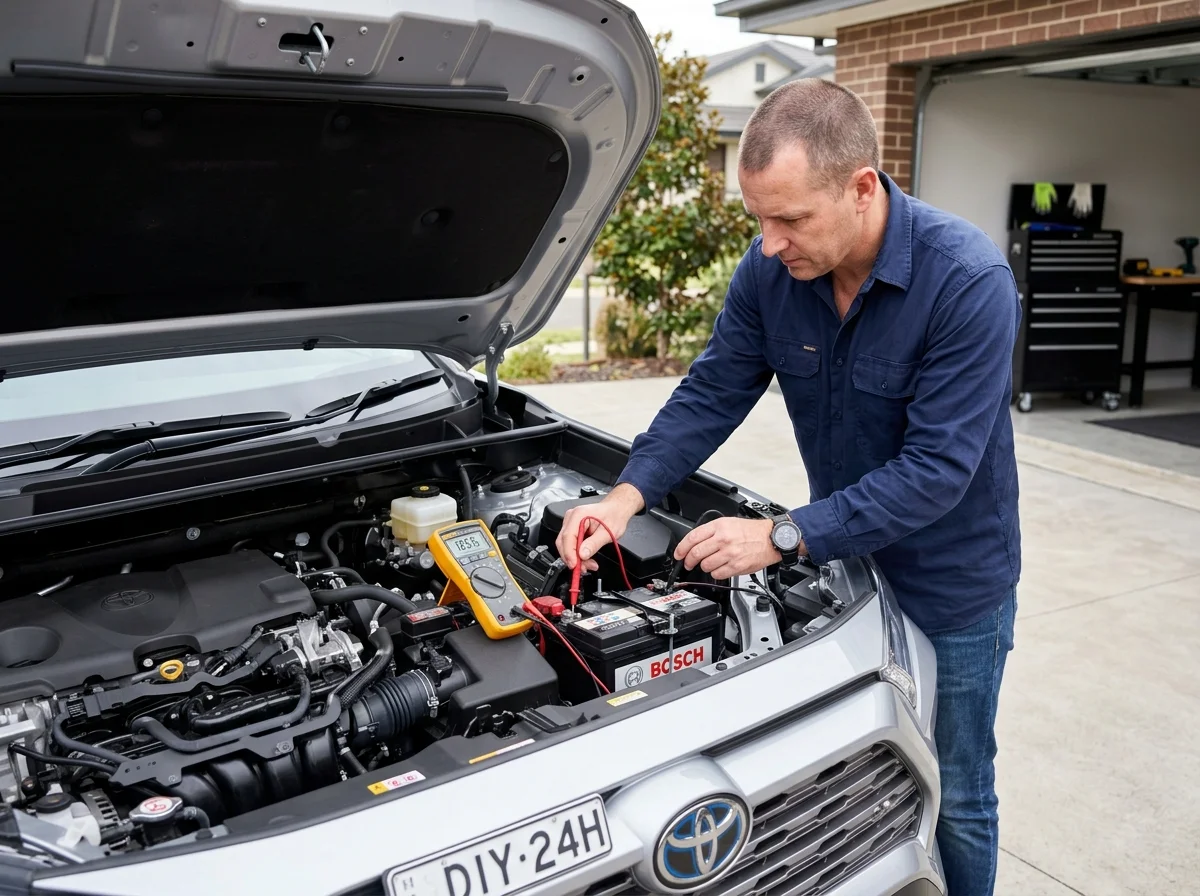
If your car cranks slowly or refuses to start, your battery is usually the first suspect. The good news? You can check it yourself in under five minutes with basic tools you probably already own.
Quick Answer: How Do You Test a Car Battery at Home?
To test a car battery at home, turn off the engine and all accessories, set a digital multimeter to 20 volts DC, then touch the red probe to the positive terminal and the black probe to the negative terminal. A healthy battery reads 12.6 volts or higher when fully charged. Anything below 12.4 volts means it needs charging, and below 12.0 volts suggests the battery is failing.
What You Need to Test a Car Battery?
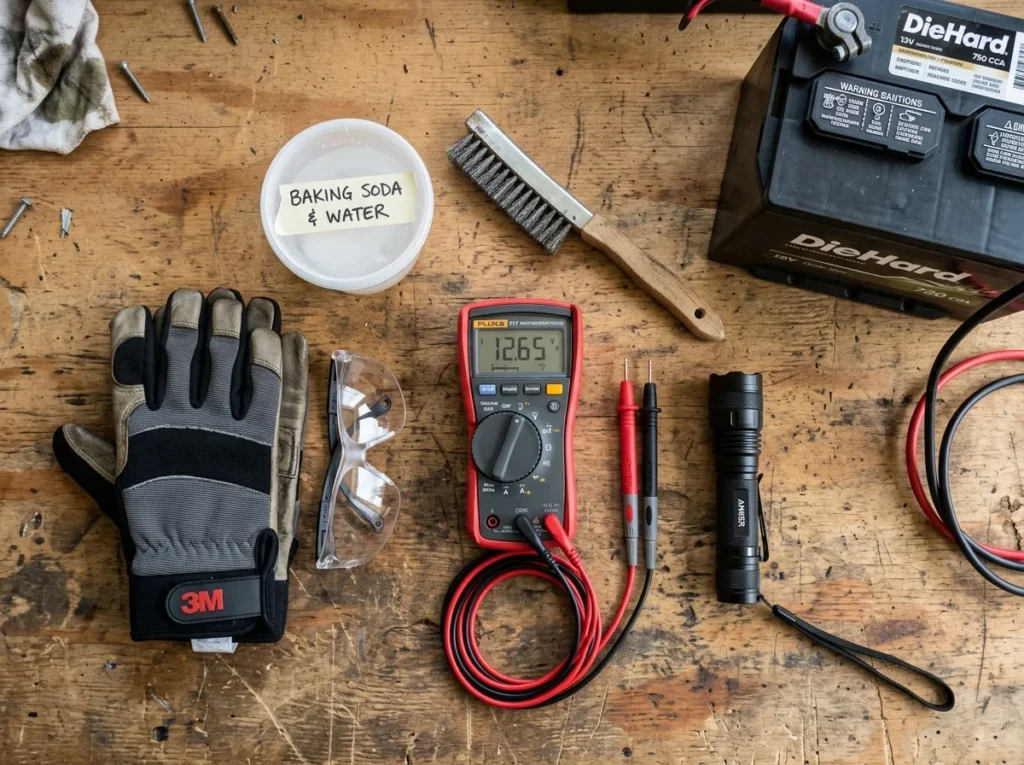
Before you start, gather a few simple items. Most of these cost less than a tank of gas.
- Digital multimeter (preferred over analog for accuracy)
- Safety gloves and glasses
- Wire brush for cleaning corroded terminals
- Baking soda and water to neutralize acid residue
- A flashlight if working in low light
A basic multimeter is enough for most home checks. You do not need an expensive load tester unless you plan to do this often.
How to Test a Car Battery with a Multimeter?
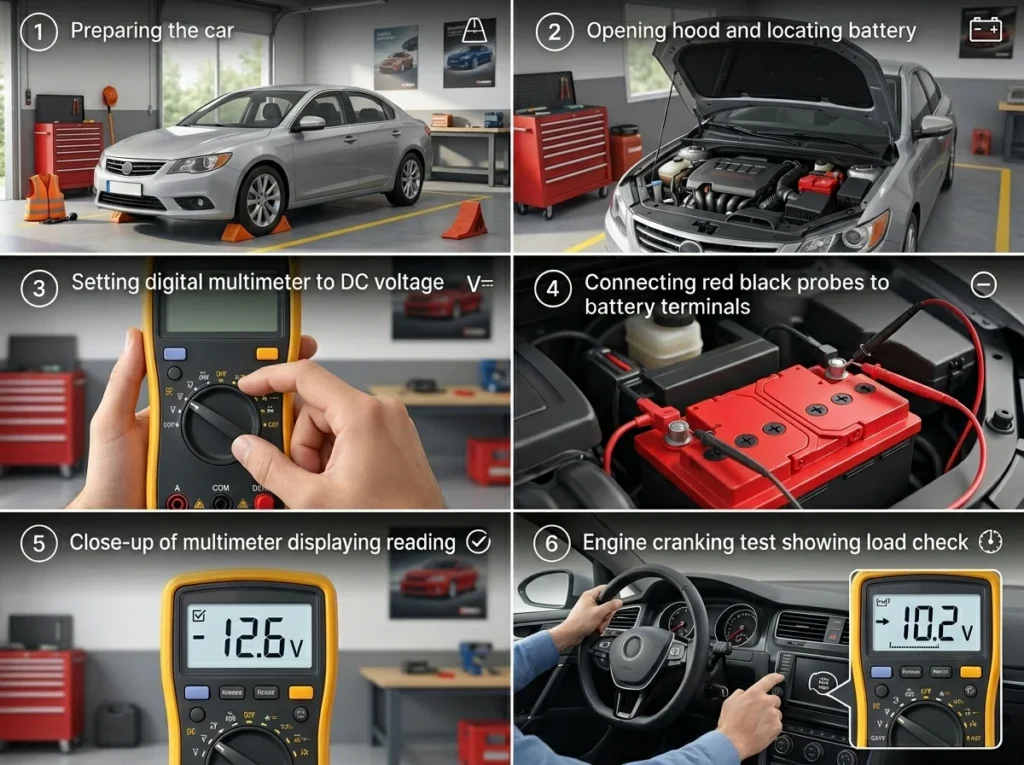
This is the most reliable method for performing a car battery test at home. Follow these steps carefully.
Step 1: Prepare the Car
Park on level ground. Turn off the engine, headlights, radio, and air conditioning. Let the car sit for at least one hour. This gives you a true resting voltage reading.
Step 2: Open the Hood and Locate the Battery
Find the positive (+) and negative (-) terminals. Clean off any white or green corrosion with a wire brush.
Step 3: Set Your Multimeter
Turn the dial to DC voltage (often marked V with a straight line). Choose the 20V range.
Step 4: Connect the Probes
Touch the red probe to the positive terminal and the black probe to the negative terminal. Hold them steady for a few seconds.
Step 5: Read the Voltage
Note the number on the screen. Compare it to the voltage chart below.
Step 6: Test Under Load (Cranking Test)
Have a helper start the car while you watch the meter. The voltage should not drop below 9.6 volts during cranking. A sharper drop signals a weak battery.
Also Explore: How to Charge a Car Battery Without a Charger?
How to Test a Car Battery Without a Multimeter?
No tools? You can still do basic testing a car battery without tools by observing how your car behaves.
The Headlight Test
- Turn on the headlights without starting the engine.
- Leave them on for 10 to 15 minutes.
- Start the engine while watching the lights.
If the headlights dim significantly when you crank the engine, the battery is likely weak.
The Crank Test
Listen when you turn the key. A healthy battery produces a strong, quick crank. Slow, labored cranking or rapid clicking points to a battery problem.
The Visual Check
Look for swollen battery sides, leaking fluid, or heavy corrosion. Any of these mean it is time for a replacement.
Also Read: How to Clean Car Battery Terminals?
Normal Car Battery Voltage Explained
A standard 12-volt car battery is not really 12 volts. When fully charged and rested, it should read between 12.6 and 12.8 volts. With the engine running, the alternator pushes that number up to 13.7 to 14.7 volts.
Anything outside these ranges suggests a charging or battery issue worth investigating.
Car Battery Voltage Chart
Use this chart to interpret your reading and check how to check car battery health at a glance.
| Voltage Reading | Charge Level | What It Means |
|---|---|---|
| 12.6V – 12.8V | 100% | Healthy, fully charged |
| 12.4V – 12.5V | 75% | Good, slight charge needed |
| 12.2V – 12.3V | 50% | Weak, recharge soon |
| 12.0V – 12.1V | 25% | Discharged, likely failing |
| Below 12.0V | 0% | Dead or sulfated battery |
Signs Your Car Battery Is Bad
Recognizing the signs of bad car battery early can save you from being stranded.
| Symptom | Possible Cause |
|---|---|
| Slow engine crank | Low battery charge or aging cells |
| Dim headlights at idle | Weak battery or failing alternator |
| Clicking sound when starting | Insufficient cranking amps |
| Swollen battery case | Overcharging or heat damage |
| Corroded terminals | Acid leakage or poor connection |
| Dashboard battery warning light | Charging system fault |
| Frequent jump starts needed | End of battery life |
Bad Battery vs Bad Alternator
These two issues often get confused. Here is how to tell them apart.
A bad battery struggles to start the car, but once running, everything works fine. A bad alternator lets the car start, but the engine dies shortly after or the electrical accessories fade while driving.
Quick test: Start the car, then disconnect the negative terminal briefly (older vehicles only). If the engine dies immediately, the alternator is not charging properly. On modern cars, skip this and use a voltmeter instead, with the engine running it should read between 13.7V and 14.7V.
How Long Car Batteries Last?
So, how long do car batteries last? On average, a typical lead-acid car battery lasts three to five years. AGM batteries can last up to seven years with proper care.
| Factor | Effect on Battery Life |
|---|---|
| Extreme heat | Speeds up internal corrosion |
| Short trips only | Prevents full recharge |
| Long storage | Causes deep discharge |
| Loose terminals | Creates voltage drops and arcing |
| Heavy electronics use | Increases parasitic drain |
| Regular highway driving | Extends battery life |
According to AAA, batteries in hot climates often fail within three years, while those in moderate climates can last five or more.
Common Mistakes When Testing a Battery
After years of working under the hood, these are the slip-ups I see most often:
- Testing immediately after driving (gives a falsely high reading)
- Touching probes together by accident
- Skipping terminal cleaning before testing
- Ignoring the load test and trusting voltage alone
- Using a cheap analog meter with poor accuracy
A surface charge can mask a weak battery. Always let the car rest before testing.
When You Should Replace the Battery?
Replace your battery when:
- Voltage stays below 12.4V even after charging
- It fails the cranking test (drops below 9.6V)
- It is over four years old and showing weak performance
- You see physical damage like swelling or leaks
- You need jump starts more than once a month
A new quality battery costs less than one tow truck call.
Safety Tips Before Testing
Car batteries contain sulfuric acid and produce hydrogen gas. Take these precautions seriously.
- Wear gloves and safety glasses at all times.
- Never smoke or use open flames nearby.
- Remove metal jewelry to prevent accidental shorts.
- Connect the red (positive) lead first, then the black.
- Keep baking soda and water close in case of acid spills.
- If the battery is hot, cracked, or hissing, stop and call a professional.
Frequently Asked Questions
Can I test a car battery with my phone?
There is no reliable way to test battery voltage with a smartphone alone. Some Bluetooth battery monitors connect to apps and provide real-time data, but they must be physically attached to the battery first.
What voltage is too low for a car battery?
Anything below 12.4 volts at rest means the battery needs charging. Below 12.0 volts, the battery is considered discharged and may be permanently damaged.
Can a car battery be bad even if it shows 12 volts?
Yes. Voltage alone does not measure cranking amps. A battery can show 12V but fail under load. That is why a cranking test matters.
How often should I test my car battery?
Test it every three to six months, and always before long road trips or winter. Hot summers and cold winters are the hardest on batteries.
Is it safe to test a battery while the engine is running?
Yes, and you should. With the engine running, you measure the alternator output, which should read between 13.7V and 14.7V.
Can a completely dead battery be revived?
Sometimes. A slow trickle charge over 24 hours can recover a deeply discharged battery, but if it cannot hold a charge afterward, replacement is the only fix.
Final Thoughts
Testing your car battery at home is one of the simplest and most rewarding maintenance habits you can build. It takes minutes, costs almost nothing, and can prevent the frustration of a no-start morning.
That said, home testing has its limits. A multimeter checks voltage, but it cannot fully measure internal resistance, cold cranking amps, or hidden electrical drains. If your readings seem off or your car still struggles after a charge, visit a trusted mechanic or stop by an auto parts store like AutoZone or Advance Auto Parts. Many offer free professional battery testing.
Disclaimer: Home battery testing can identify common issues but may not detect all electrical system problems.
Stay safe, stay charged, and when in doubt, let a professional confirm the diagnosis before replacing parts.


One thought on “How to Test a Car Battery at Home: Complete DIY Guide”