



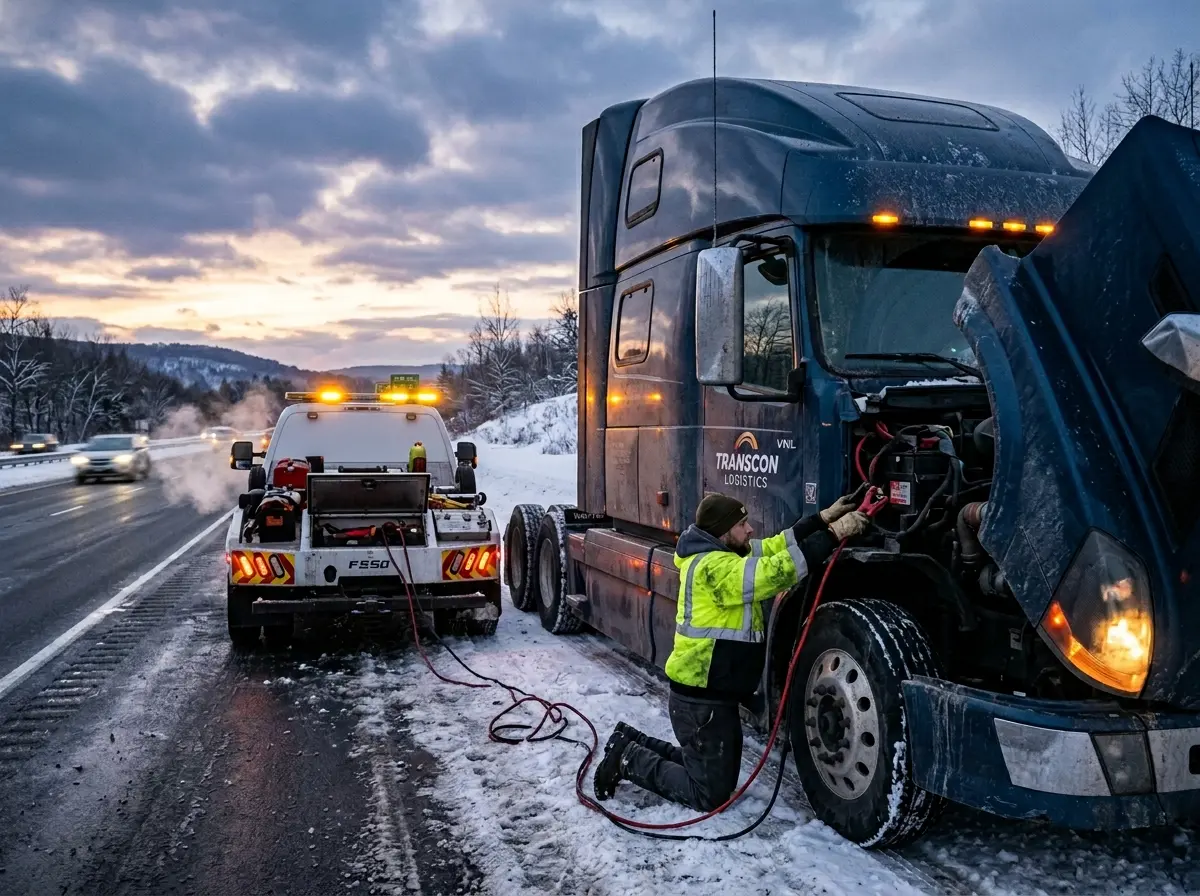
Jump starting a diesel truck is not the same as jumping a car. Diesel engines run higher compression, draw more cranking amps, and almost always use a dual-battery setup. Get the procedure wrong and you can fry an alternator, melt cables, or in rare cases cause a battery to rupture.
I have spent years around heavy duty trucks, from one-ton work pickups to Class 8 rigs sitting cold on a Wyoming morning. This guide walks you through exactly how to jump start a diesel truck the right way, what to check before you connect a single cable, and what to do when the engine still refuses to turn over.
Need Emergency Diesel Jump Start Assistance? Call Now for Fast Roadside Help 414-973-1902
Quick Answer: How to Jump Start a Diesel Truck?
To jump start a diesel truck, connect heavy gauge jumper cables (4 AWG or thicker) from a fully charged 12V donor vehicle to both batteries on the dead truck if it has a dual-battery setup. Attach positive to positive, then negative on the donor to a clean ground on the dead truck’s frame. Let the donor vehicle run for 5 to 10 minutes to charge the dead batteries before attempting to start the diesel engine.
That is the short version. The full process matters, especially for trucks with 24V starting systems or trucks that have been sitting in cold weather.
Diesel vs Gasoline Jump Start: Why the Difference Matters
Most drivers assume a jump is a jump. It is not. Diesel engines need significantly more cranking power to overcome compression, which is why nearly every diesel truck on the road in the USA uses two batteries wired in parallel.
| Factor | Gasoline Vehicle | Diesel Truck |
|---|---|---|
| Cranking amps required | 400 to 600 CCA | 700 to 1,500+ CCA |
| Battery configuration | Single 12V battery | Dual 12V batteries in parallel (sometimes 24V) |
| Compression ratio | 8:1 to 11:1 | 15:1 to 22:1 |
| Recommended cable gauge | 6 to 8 AWG | 2 to 4 AWG |
| Donor charging time before start | 2 to 3 minutes | 5 to 10 minutes |
| Risk of failed jump | Low | High if undersized cables are used |
This is the core reason a standard set of consumer jumper cables from a passenger car often will not crank a 6.7L Cummins or a 7.3L Power Stroke. The cables simply cannot carry the current.
Safety First: What to Check Before You Connect Anything
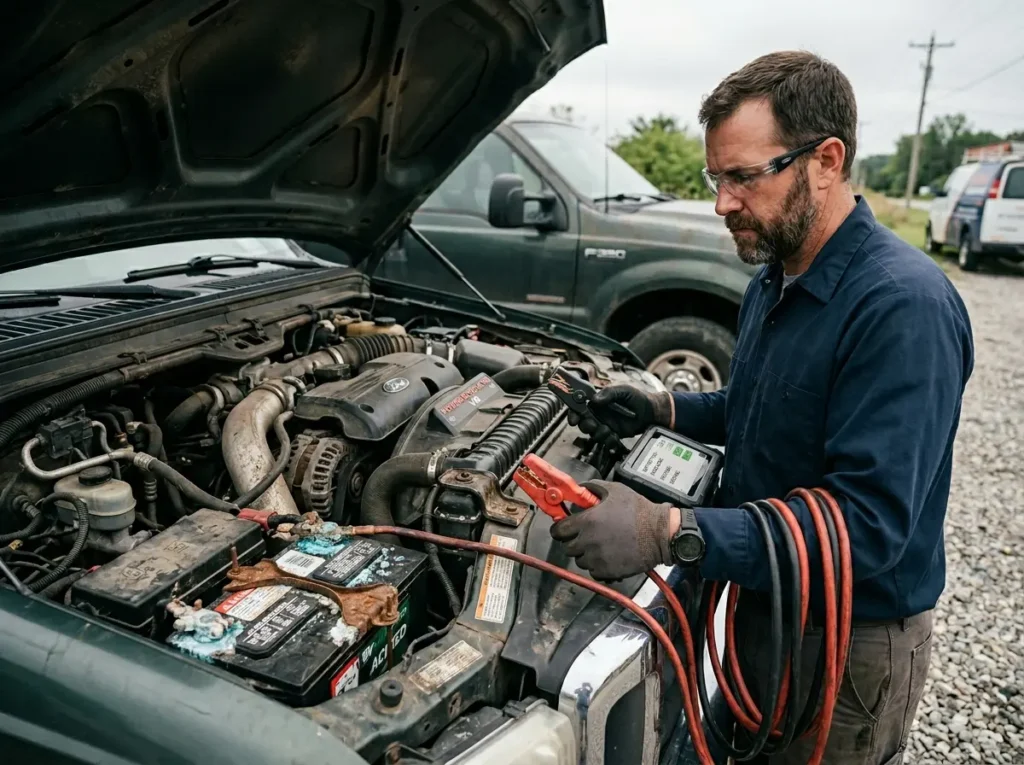
Before any cable touches any terminal, walk through this checklist. I have seen mechanics with 20 years of experience skip a step and pay for it with a destroyed ECM.
Inspect both batteries on the dead truck. Look for cracked cases, leaking acid, frozen electrolyte (you will see a bulged or distorted case), or heavy corrosion around the terminals. A frozen or visibly damaged battery should never be jumped. It can rupture or explode under load.
Confirm the system voltage. Most light and medium duty diesel trucks in the USA, including Ford Power Stroke, GM Duramax, and Ram Cummins, use a 12V system with two batteries in parallel. Some older heavy duty and military trucks use 24V systems. Never jump a 24V truck with a 12V donor unless you have a 24V boost pack rated for it.
Turn off everything. Headlights, HVAC, radio, heated seats, phone chargers. On the donor vehicle too. Any active load increases the risk of a voltage spike when you disconnect.
Wear eye protection. Battery acid and hydrogen gas are real hazards. A pair of safety glasses costs less than an ER visit.
Keep ignition sources away. No smoking, no open flames. Hydrogen gas vents from lead-acid batteries during charging and is flammable in small concentrations.
Make sure both vehicles are in park or neutral with the parking brake set.
Required Tools and Specifications
Use the right equipment. Underpowered cables are the single most common reason a diesel jump fails.
| Tool | Specification | Why It Matters |
|---|---|---|
| Jumper cables | 2 or 4 AWG, 20 to 25 feet, copper core | Heavy gauge carries the current a diesel needs without overheating |
| Jump pack (alternative) | 1,500 to 3,000 peak amps, 12V | Portable lithium or AGM packs designed for diesel applications |
| Safety glasses | ANSI Z87.1 rated | Protects against acid splash and arc flash |
| Nitrile gloves | Chemical resistant | Battery acid burns skin on contact |
| Wire brush or terminal cleaner | Brass bristles | Removes corrosion for solid electrical contact |
| Multimeter | 0 to 20V DC range | Confirms battery voltage and charging status |
If you are a fleet operator or owner-operator, a quality jump pack rated for diesel is worth every dollar. Brands like NOCO, Schumacher, and Clore Automotive make units that will start a Class 8 truck in winter.
Battery Voltage and Amperage Guidelines
Knowing what a healthy battery should read helps you diagnose whether a jump will even work.
| Battery State | Voltage (12V System) | Action |
|---|---|---|
| Fully charged, rested | 12.6 to 12.8V | No jump needed |
| Partially discharged | 12.2 to 12.5V | May start in warm weather, slow crank likely |
| Significantly discharged | 11.8 to 12.1V | Jump start required |
| Deeply discharged | Below 11.5V | Jump may work, but battery likely damaged |
| Failed or sulfated | Below 10.5V under load | Replace battery, jump start unlikely to hold |
A diesel truck with batteries reading below 10V on both units almost always needs a slow recharge with a proper charger, not a jump. Forcing a heavily depleted battery to crank a high compression engine can warp plates and shorten its remaining life.
Step-by-Step: How to Jump Start a Diesel Truck?
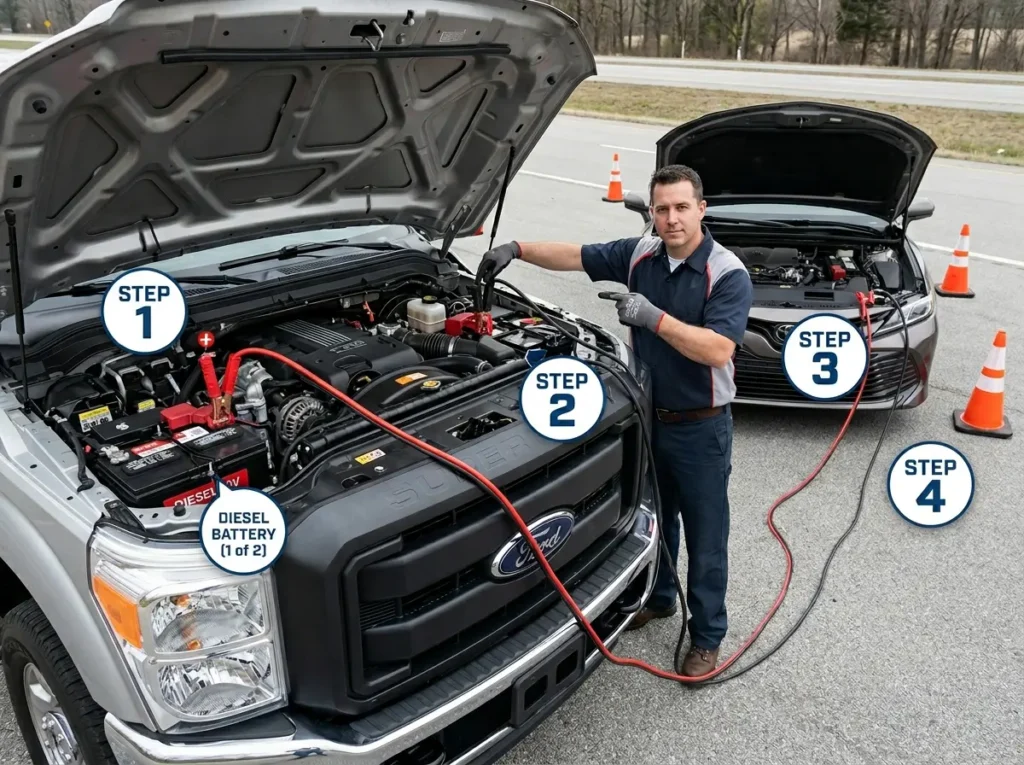
Follow this sequence exactly. The order of connection matters for safety.
Step 1: Position the Donor Vehicle
Park the donor vehicle close enough that your cables reach both batteries comfortably, but do not let the two vehicles touch. Shut off the donor’s engine before connecting cables.
Step 2: Identify Both Batteries
Open the hood on the dead diesel truck. Locate both batteries. On most domestic diesel pickups, they sit on either side of the engine bay. Identify the positive terminal (marked with a + and usually a red cover) and the negative terminal (marked with a – and usually black).
Step 3: Clean the Terminals if Needed
If you see white, green, or blue powdery corrosion on the terminals, brush it off before connecting. Corrosion blocks current flow and can prevent a successful jump even with good cables.
Step 4: Connect the Cables in This Order
- Red (positive) clamp to the positive terminal of the dead truck’s battery. If the truck has two batteries, connect to the battery closest to the starter or the one with the main positive cable running to the starter.
- Other red (positive) clamp to the positive terminal of the donor vehicle’s battery.
- Black (negative) clamp to the negative terminal of the donor vehicle’s battery.
- Final black (negative) clamp to a clean, unpainted metal ground on the dead truck’s engine block or frame. Do not connect this to the dead battery’s negative terminal. This reduces the chance of a spark near hydrogen gas.
Step 5: Start the Donor Vehicle and Wait
Start the donor’s engine and let it idle for 5 to 10 minutes. This is the step most people skip. A diesel needs a charged battery, not just a momentary boost. Rev the donor gently to about 1,500 RPM for the last 2 minutes to push more current into the dead batteries.
Step 6: Cycle the Glow Plugs
Turn the dead diesel truck’s key to the run position (not start) and wait for the glow plug or wait-to-start light to go off. In cold weather, cycle it twice. Cold diesel will not ignite without preheating.
Step 7: Start the Diesel Truck
Crank the engine for no more than 10 seconds at a time. If it does not catch, wait 30 seconds and try again. Long continuous cranking overheats the starter motor.
Step 8: Disconnect Cables in Reverse Order
Once the diesel is running smoothly:
- Remove the negative clamp from the truck’s ground point.
- Remove the negative clamp from the donor battery.
- Remove the positive clamp from the donor battery.
- Remove the positive clamp from the dead truck’s battery.
Step 9: Let the Truck Run
Keep the diesel running for at least 20 to 30 minutes to let the alternator recharge the batteries. Better yet, drive it. Idling charges slower than driving under load.
Related Articles:
How to Jump Start a Hybrid Car?
How to Jump Start a Motorcycle?
How to Start a Dead Diesel Battery When Both Are Drained?
If both batteries in a dual-battery setup are flat, connect your jumper cables to the battery that has the main positive cable feeding the starter. This is usually the driver’s side battery on Ford and Ram, and the passenger side on GM, but always verify on your specific truck. Because both batteries are wired in parallel, charging one charges both.
For trucks that have been sitting for weeks or months, a battery boost alone may not be enough. A trickle charger or a proper bench charge for 4 to 8 hours is the right move before attempting to start.
Heavy Duty Truck Jump Start: Class 7 and Class 8 Considerations
Commercial heavy duty trucks raise the stakes. Many over-the-road tractors use four batteries wired in parallel, providing 12V at 2,500 to 3,500 CCA combined. Jumping these with a passenger vehicle is rarely effective.
For a commercial truck jump start procedure, use either:
- A second heavy duty truck with the engine running, using 1/0 AWG welding-grade cables
- A commercial jump pack rated for Class 8 applications (3,000+ peak amps)
- A dedicated battery booster cart, common at truck stops and fleet yards
Never attempt to jump a commercial truck with a small SUV or sedan. The donor’s alternator and electrical system can be damaged trying to supply that much current.
What If the Truck Still Won’t Start?
If the engine cranks but does not catch, the issue is fuel or combustion, not electrical. Check these in order:
Fuel level. Diesel trucks that run completely dry often need the fuel system primed or bled of air before they will start.
Glow plugs or grid heater. A failed glow plug relay or burned out grid heater will prevent cold starts. Listen for the click of the relay when you turn the key to run.
Fuel filter. A clogged or water-saturated fuel filter starves the injection system. Trucks with a water-in-fuel sensor will often show a dash warning.
Cold weather gelling. Below about 15 degrees Fahrenheit, untreated diesel fuel can gel inside the fuel filter and lines. The truck will crank normally but never fire.
If the engine does not crank at all, even with cables connected:
- Check that the cable clamps have solid bite on clean metal, not corrosion or paint
- Verify the donor vehicle is actually running
- Test the dead truck’s batteries with a multimeter. If they read below 9V even with cables connected, one or both batteries may be internally shorted and need replacement
- Listen for a single loud click, which usually means the starter solenoid is engaging but the starter motor is dead
Common Mistakes During Diesel Truck Jump Starting
I see these mistakes constantly, even from experienced drivers.
Using thin consumer jumper cables. Cheap 10 AWG cables sold at gas stations cannot deliver the amperage a diesel needs. They get hot, lose voltage along their length, and often fail the jump entirely.
Not waiting long enough. People connect, crank immediately, and wonder why nothing happens. A depleted diesel battery needs minutes of charge before it can deliver starting current.
Connecting to the wrong battery. On dual-battery trucks, connecting to the wrong battery can work but is slower. Always look for the battery feeding the starter.
Reversing polarity. Connecting red to negative and black to positive will instantly blow fuses, damage the ECM, and can ignite hydrogen gas. Always double-check polarity before clamping down.
Disconnecting in the wrong order or letting clamps touch. A cable clamp touching the chassis while the other end is on a live battery creates a dead short. Sparks, melted clamps, and damaged batteries can follow.
Jumping a frozen battery. If the truck has been sitting in subzero weather and the battery case looks swollen or distorted, do not jump it. Let it thaw indoors and recharge slowly.
When to Skip the Jump and Call for Help?
Sometimes a jump is not the right answer. Call roadside assistance or a mobile mechanic if:
- Both batteries are below 10V and the truck has been sitting for over a month
- You smell sulfur or rotten eggs near the batteries, which indicates internal failure
- The truck has any visible electrical damage, melted insulation, or burn marks
- Your jumper cables are not heavy enough for diesel applications and no other donor is available
- The truck is a commercial vehicle with a 24V system and you only have 12V equipment
A professional service call costs less than a damaged ECM, a melted wiring harness, or a tow after a botched jump.
Maintaining Diesel Batteries So You Do Not Need a Jump
The best jump start is the one you never have to do. A few habits keep diesel batteries healthy through winter and beyond.
Test both batteries every fall before cold weather hits. Replace batteries in matched pairs, since mixing a new battery with an old one shortens the new one’s life. Keep terminals clean and protected with dielectric grease. If the truck sits for more than a week, connect a maintainer. And in cold climates, plug in the block heater overnight when temperatures drop below 20 degrees Fahrenheit. Easier starts mean less battery drain.
Final Thoughts From the Shop Floor
Jump starting a diesel truck is straightforward once you respect what makes a diesel different: high compression, high amperage demand, and usually two batteries doing the work. Use proper cables, follow the connection order, give the dead batteries time to absorb a charge, and you will get the truck running safely in nearly every situation.
The one principle worth remembering above all others: when in doubt, slow down. A jump start done patiently with the right gear almost always works. A jump start done in a hurry with the wrong cables almost always costs you more than a tow would have.
Stay safe out there, and keep a good set of cables or a quality jump pack in your truck before you need them.