



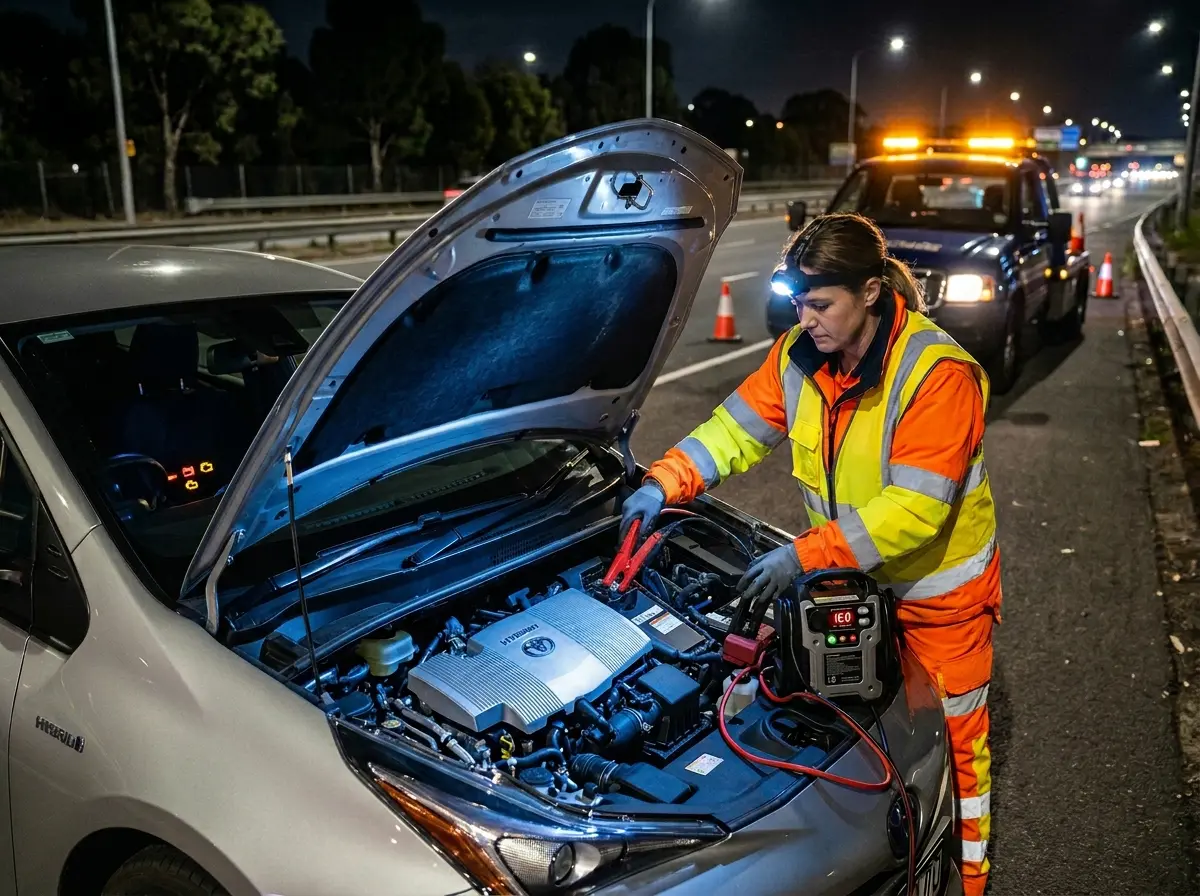
Jump starting a hybrid car is possible, but it requires a different approach than jumping a standard gasoline vehicle. If your hybrid won’t start, the issue is almost always with the smaller 12-volt auxiliary battery, not the large high-voltage hybrid battery. Using the wrong method can damage sensitive electronics, void your warranty, or in rare cases cause serious injury.
This guide walks you through the safe, manufacturer-approved process for jump starting a hybrid vehicle, what tools you need, and the critical mistakes to avoid.
Quick Answer: Can You Jump Start a Hybrid Car?
Yes, you can jump start a hybrid car, but only the 12-volt auxiliary battery, never the high-voltage hybrid battery. The procedure is similar to a regular car, with one key rule: you should not use your hybrid to jump start another vehicle, as this can damage the DC-to-DC converter.
Understanding Hybrid Car Batteries
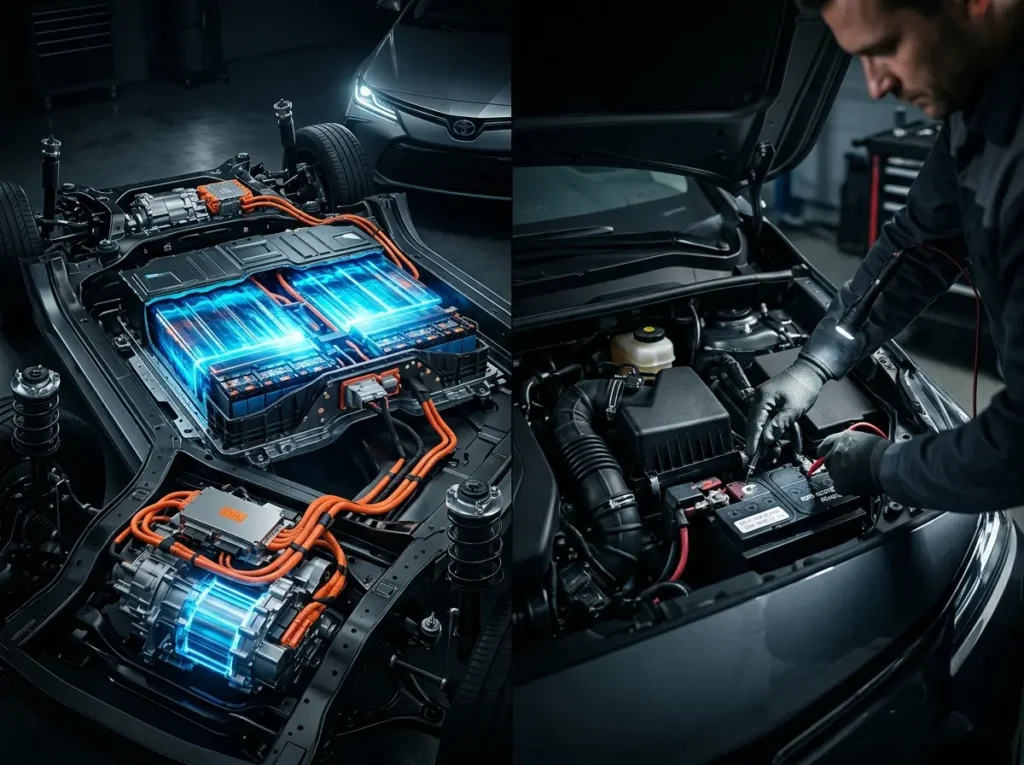
Before you connect any cables, it helps to understand what’s actually under the hood of a hybrid vehicle. Hybrids have two completely separate battery systems, and only one of them is involved in jump starting.
The 12-Volt Auxiliary Battery
This is the small lead-acid or AGM (Absorbent Glass Mat) battery that powers your headlights, infotainment system, computer modules, and door locks. It also tells the car to “wake up” and engage the high-voltage system. When your hybrid clicks but won’t start, this is the battery that’s drained.
In most hybrids like the Toyota Prius, Honda Insight, or Ford Escape Hybrid, the 12-volt battery is located in the trunk or under the rear seat, not under the hood. Manufacturers provide a dedicated positive (+) jump terminal under the hood for convenience.
The High-Voltage Hybrid Battery
This is the large traction battery, usually between 100 and 300 volts, that powers the electric motor. You should never attempt to jump start, open, or touch this battery. It is designed to be serviced only by certified technicians.
Hybrid Battery Comparison Table
| Battery Type | Voltage Range | Purpose | Can You Jump Start It? |
|---|---|---|---|
| 12V Auxiliary (Lead-Acid/AGM) | 12V | Powers electronics, starts the hybrid system | Yes |
| Nickel-Metal Hydride (NiMH) | 100V to 300V | Powers electric drive motor | No, never |
| Lithium-Ion (Li-ion) | 200V to 360V | Powers electric drive motor in newer hybrids | No, never |
| Plug-in Hybrid (PHEV) Pack | 300V to 400V | Extended electric driving range | No, never |
Hybrid vs Traditional Car: Key Jump-Start Differences
While the basic concept is the same, hybrids have unique considerations that gasoline vehicles do not.
| Factor | Traditional Gas Car | Hybrid Car |
|---|---|---|
| Battery being jumped | Main starter battery under hood | 12V auxiliary battery (often in trunk) |
| Jump terminal location | Directly on battery | Dedicated terminal under hood |
| Safe to jump-start another car? | Yes | No, can damage DC-DC converter |
| Risk of electronic damage | Low | Higher, sensitive hybrid control units |
| Recommended donor vehicle | Any 12V vehicle | Only a 12V gas vehicle, never another hybrid or EV |
| Use of jump-start box | Safe | Safer and recommended option |
Tools You Need to Jump Start a Hybrid
Having the right equipment matters more with a hybrid than a standard car. Cheap cables with thin gauges can cause voltage spikes that damage hybrid electronics.
| Tool | Purpose | Recommended Specs |
|---|---|---|
| Jumper cables | Connect donor vehicle to hybrid | 4 to 6 gauge, at least 10 feet long, insulated clamps |
| Portable jump starter | Self-contained power source (preferred) | 12V, minimum 400 to 600 peak amps |
| Safety gloves | Protect against sparks and battery acid | Insulated, dielectric rated |
| Safety glasses | Eye protection from sparks | ANSI Z87.1 certified |
| Owner’s manual | Locate jump terminals and follow specs | Vehicle-specific |
| Clean rag | Wipe terminals before connection | Lint-free |
A portable lithium jump starter is the safest option for hybrid owners. It eliminates the risk of connecting two vehicles incorrectly and is small enough to keep in the trunk.
How to Jump Start a Hybrid Car: Step-by-Step
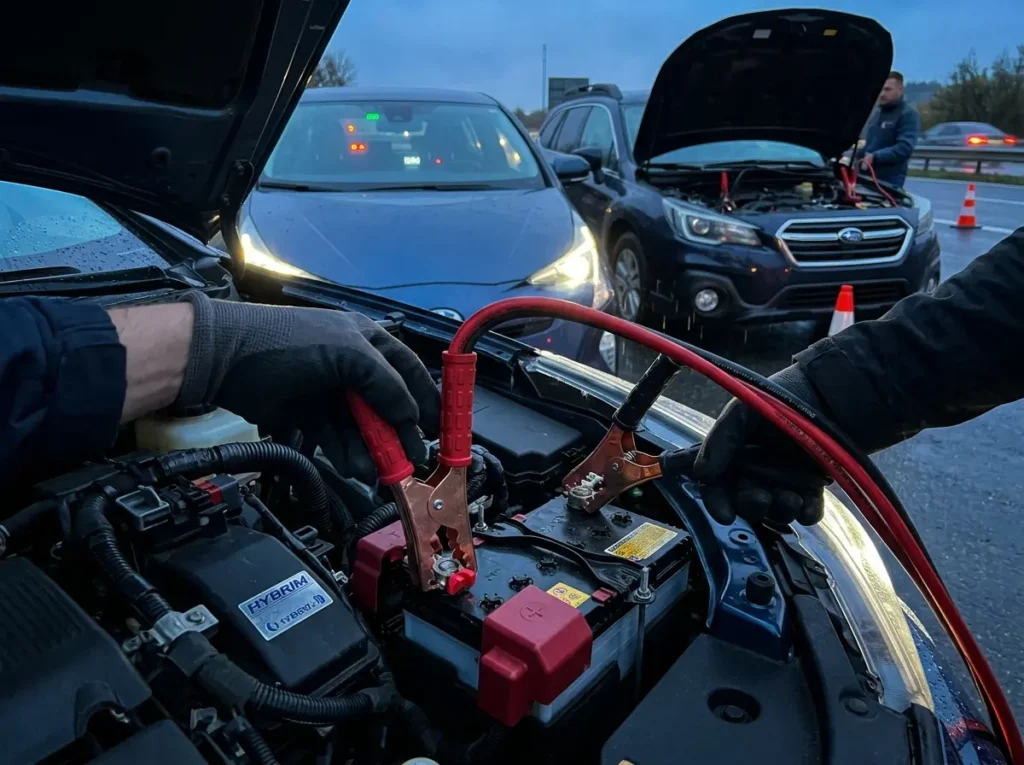
Follow this procedure carefully. The order of cable connections is critical for safety.
Step 1: Confirm the Problem Is the 12-Volt Battery
If your dashboard lights are dim, the car clicks when you press the power button, or nothing happens at all, the 12-volt battery is the likely culprit. If the “Ready” light comes on but the car won’t drive, the issue is with the hybrid system, and jumping will not help. Call roadside assistance instead.
Step 2: Locate the Jump Terminals
Open your owner’s manual or look under the hood for a red plastic cover marked with a “+” symbol. This is the positive jump terminal. There is also a designated chassis ground point, usually a metal bolt or bracket marked with a “-” symbol or a ground sticker.
Step 3: Position the Donor Vehicle
Park a standard 12-volt gasoline vehicle close to your hybrid, but do not let the two cars touch. Turn off the donor vehicle completely. Turn off all accessories in your hybrid, including headlights, climate control, and the radio.
Step 4: Connect the Jumper Cables in This Exact Order
- Connect the red (positive) clamp to the positive (+) jump terminal on your hybrid.
- Connect the other red (positive) clamp to the positive (+) terminal on the donor car’s battery.
- Connect the black (negative) clamp to the negative (-) terminal on the donor car’s battery.
- Connect the other black (negative) clamp to the designated ground point on your hybrid, not to the 12-volt battery itself. This prevents sparks near any potential hydrogen gas.
Step 5: Start the Donor Vehicle
Start the donor car’s engine and let it idle for two to three minutes. This allows a small charge to flow into your hybrid’s 12-volt battery.
Step 6: Start Your Hybrid
Press the “Power” or “Start” button in your hybrid. The “Ready” indicator should illuminate on the dashboard, meaning the hybrid system has booted up successfully. Note that hybrids do not “crank” like gas engines, the gasoline motor will only start if needed.
Step 7: Disconnect the Cables in Reverse Order
- Remove the black clamp from your hybrid’s ground point.
- Remove the black clamp from the donor car’s negative terminal.
- Remove the red clamp from the donor car’s positive terminal.
- Remove the red clamp from your hybrid’s positive jump terminal.
Step 8: Drive for at Least 30 Minutes
Keep your hybrid in “Ready” mode for at least 30 minutes so the DC-to-DC converter can recharge the 12-volt battery from the high-voltage system. Avoid shutting it off immediately, or you may need another jump.
Modern hybrid vehicles contain sensitive electrical systems that can be damaged by incorrect jump-start procedures. If your car still won’t start, MG Towing & Recovery offers professional jump starts, roadside diagnostics, battery assistance, and towing services 24/7 throughout the Milwaukee area. Get help fast before battery damage gets worse. 414-973-1902
Related Articles:
Car Won’t Start? Top Signs You Need a Jumpstart Service
How to Jump Start a Motorcycle?
Critical Safety Warnings: What NOT to Do
Hybrids contain delicate electronics that are expensive to replace. Avoid these common mistakes.
Never use your hybrid to jump start another vehicle. The DC-to-DC converter in a hybrid is not designed to handle the high current draw of cranking another engine. This is one of the most common ways owners accidentally damage their car.
Never connect cables to the high-voltage battery. It is orange-cabled and clearly marked. Touching it can result in fatal electric shock.
Never jump start a hybrid in the rain or standing water. Water increases conductivity and the risk of short circuits.
Do not push start or roll start a hybrid. Hybrids do not have a traditional starter mechanism, and this can damage the transmission or hybrid system.
Avoid cheap or damaged jumper cables. Voltage irregularities can fry the hybrid’s control modules, leading to repair bills of $1,000 or more.
Do not attempt jumping if you smell sulfur or see swelling on the 12-volt battery. A damaged battery can leak or rupture. Call a professional.
When to Call Roadside Assistance Instead?
There are situations where jumping your hybrid is not the right move. Call a professional if:
- Your hybrid is over 8 years old and has never had its 12-volt battery replaced
- The car has been sitting unused for more than 30 days
- You see warning lights related to the hybrid system, traction battery, or main computer
- The 12-volt battery is visibly damaged, corroded, or leaking
- You are not confident locating the correct jump terminals
- The vehicle is a plug-in hybrid (PHEV) and the issue may involve the charging system
Most hybrid manufacturers including Toyota, Honda, Ford, Hyundai, and Kia offer free roadside assistance for new vehicles. AAA also has technicians trained in hybrid-specific procedures.
How to Prevent 12-Volt Battery Failure in Hybrids?
Hybrid 12-volt batteries typically last 3 to 5 years, similar to standard car batteries. You can extend their life with these practices:
- Drive your hybrid at least once a week for 20 minutes or longer
- Avoid leaving accessories like dome lights or USB chargers on when the car is off
- Have the 12-volt battery load-tested annually after year three
- Replace the 12-volt battery with the same type (AGM or flooded) as the original
- If you store the vehicle, use a smart trickle charger designed for AGM batteries
Frequently Asked Questions
Q. Can you jump start a hybrid car with a regular car?
Yes, you can use a standard 12-volt gasoline vehicle to jump start a hybrid. Connect to the hybrid’s designated jump terminal under the hood, never directly to the high-voltage battery.
Q. Can a hybrid car jump start another car?
No. Using a hybrid to jump start another vehicle can damage the DC-to-DC converter and hybrid control electronics. Repairs typically cost between $1,000 and $3,000.
Q. Will jump starting a hybrid damage it?
When done correctly, jump starting will not damage your hybrid. Damage usually occurs from connecting cables incorrectly, using poor-quality cables, or attempting to jump the high-voltage battery.
Q. Why won’t my hybrid start even after a jump?
If your hybrid still won’t enter “Ready” mode after a jump, the issue may be a failing 12-volt battery that no longer holds a charge, a problem with the hybrid system itself, or a blown fuse. Call roadside assistance.
Q. Can I use a portable jump starter on a hybrid?
Yes, and this is often the safest method. A 12-volt lithium portable jump starter with at least 400 peak amps works well for most hybrids and eliminates the need for a second vehicle.
Q. Is the procedure different for plug-in hybrids (PHEVs)?
The 12-volt jump procedure is the same for PHEVs, but if your PHEV won’t start and the charging system is involved, contact roadside assistance rather than attempting a jump.
Final Thoughts
Jump starting a hybrid car is straightforward when you follow the right steps and respect the safety rules. The most important things to remember are: only jump the 12-volt battery, use the designated jump terminals, never use your hybrid to jump another vehicle, and drive for at least 30 minutes afterward to recharge the battery.
When in doubt, lean on professional help. Most modern hybrids include roadside assistance for the first several years of ownership, and a $100 service call is far cheaper than a $2,000 repair from a botched jump. Keeping a quality portable jump starter in your trunk is one of the smartest investments any hybrid owner can make.