


A run-flat tire is a specially engineered tire that lets you keep driving for a limited distance after a puncture or complete loss of air pressure, eliminating the immediate need for a spare tire or roadside tire change. Most run-flat tires let you drive up to 50 miles at speeds under 50 mph after a puncture, giving you time to reach a tire shop safely instead of changing a tire on the side of a highway.
Two main types exist: self-supporting run-flats (with reinforced sidewalls that hold up the vehicle when air pressure drops) and support-ring run-flats (which use an internal hard rubber ring around the wheel). Both require a Tire Pressure Monitoring System (TPMS) because the tire often looks normal even when flat.
As a roadside assistance and towing company serving Milwaukee and the surrounding areas, we respond to tire failures every week, including run-flat failures. The information below reflects what we actually see on the road, not just what tire brands say in their marketing.
What Is a Run-Flat Tire?
A run-flat tire is a tire built to keep functioning even after losing all of its air pressure. Standard tires collapse instantly when punctured because the air inside is what holds up the vehicle’s weight. Run-flats are reinforced so that the tire structure itself, not the air, supports the car long enough to reach safety.
Run-flat tires exist because more and more new vehicles ship without spare tires. Manufacturers remove the spare to save weight, free up trunk space, and improve fuel economy. That works fine until a tire goes flat. Run-flats solve that problem by giving drivers a built-in backup plan.
You may see run-flat tires referred to by several abbreviations, depending on the manufacturer:
- RFT — Run-Flat Tire (Bridgestone, general industry term)
- RSC — Runflat System Component (BMW)
- ZP — Zero Pressure (Michelin)
- SSR — Self-Supporting Runflat (Continental)
- EMT — Extended Mobility Tire (Goodyear)
- ROF — Run On Flat (Goodyear, Dunlop)
- DSST — Dunlop Self-Supporting Technology
Common Run-Flat Tire Markings on the Sidewall
Not sure if your vehicle has run-flats? Here’s how to check in under a minute.
Look at the sidewall of any tire on your car. Run-flat tires almost always carry one of the abbreviations above stamped near the tire size or brand name. If you see “RFT,” “RSC,” “ZP,” “SSR,” “ROF,” or the word “runflat” printed on the sidewall, you have run-flat tires.
If the sidewall doesn’t have any of those markings, check your owner’s manual under the “tires” or “wheels and tires” section. Vehicles equipped with run-flats from the factory will note it there, and they typically lack a spare tire and jack in the trunk, replaced instead by a tire repair kit or nothing at all.
MG Towing & Recovery provides 24/7 roadside tire assistance, flatbed towing, jump starts, and emergency towing throughout Milwaukee and nearby Wisconsin areas. If your run-flat tire fails completely or your TPMS warning comes on, our team can safely transport your vehicle to a trusted tire shop anytime day or night. Call now for fast roadside assistance 414-973-1902
How Do Run-Flat Tires Work?
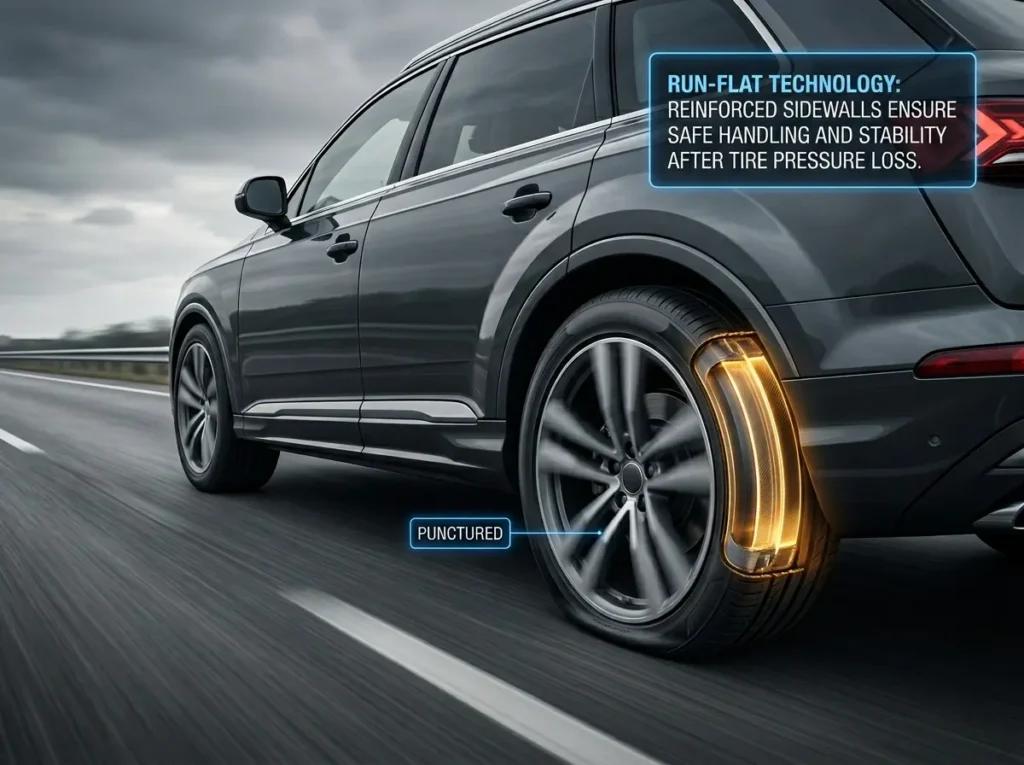
Run-flat tires use one of two engineering approaches to keep a vehicle moving after a puncture. Both work, but they work differently and have different trade-offs.
A. Self-Supporting Run-Flat Tires (Reinforced Sidewalls)
This is the most common type by far. Self-supporting run-flat tires have dramatically thicker, stiffer sidewalls than standard tires, roughly three-quarters of an inch thick compared to about an eighth of an inch on a regular tire. When the tire loses air, those reinforced sidewalls bear the weight of the vehicle instead.
Brands like Bridgestone DriveGuard, Michelin Zero Pressure, Continental SSR, and Pirelli Run Flat all use this self-supporting design. From the outside, a self-supporting run-flat looks almost identical to a standard tire, sometimes only a knowledgeable eye or the sidewall markings can tell them apart.
B. Support Ring Run-Flat Tires
Support ring systems take a different approach. Instead of reinforcing the sidewall, they place a ring of hard rubber or hard composite material around the wheel rim, inside the tire cavity. When the tire deflates, that internal ring holds up the vehicle and gives the tread something to roll on.
Support ring systems can typically handle more weight and rougher conditions than self-supporting tires, which is why they’re found on some military vehicles, armored cars, and a small number of luxury or specialty consumer vehicles. The downside is that they require specialized wheels designed to seat the support ring, making them less common on passenger cars.
The Role of TPMS (Why Run-Flats Require It)
Here’s something many drivers don’t realize: a flat run-flat tire often looks completely normal. The thick sidewalls or internal support ring keep the tire’s shape even with zero air pressure. You can walk around your car, check all four tires visually, and have no idea one of them is flat.
This is why every modern vehicle with run-flat tires has a Tire Pressure Monitoring System. The TPMS dashboard warning is your only reliable signal that a run-flat has lost pressure. If you ignore it or your TPMS sensors are broken, you can easily drive a flat run-flat tire far beyond its safe range without knowing which leads to wheel damage, suspension wear, and eventually total tire destruction.
If the TPMS warning light is on in your vehicle, take it seriously. Don’t reset the warning and keep driving. With run-flats specifically, the warning light is often the only thing standing between you and a much bigger repair bill.
How Far Can You Drive on a Run-Flat Tire?
Most run-flat tires are rated for approximately 50 miles of driving at speeds up to 50 mph after a complete loss of air pressure. Some brands specify slightly different numbers (Bridgestone DriveGuard rates up to 50 miles at up to 50 mph; some Michelin ZP tires rate up to 50 miles depending on vehicle load), but the 50-and-50 rule is a safe benchmark to remember.
Your actual range depends on three things:
- Vehicle load. A fully loaded car or SUV uses up the safety margin faster than a lightly loaded one.
- Driving conditions. Hard cornering, hard braking, and high speeds accelerate sidewall damage on a deflated run-flat.
- The specific tire. Always check the manufacturer’s printed specifications for your tire model.
What happens if you exceed the limit? This is where we, as a roadside company, see the real consequences. Drivers who push past 50 miles or drive above 50 mph on a deflated run-flat often end up calling us anyway, but now with more damage than they would have had if they’d stopped at the limit.
We commonly see destroyed sidewalls, bent rims, and in severe cases, suspension and brake damage from rolling on metal. A run-flat is designed to get you to a tire shop, not home and back to work the next day.
What to Do Immediately After a Run-Flat Puncture
Here’s the step-by-step protocol if your TPMS light comes on while driving. This is the section nobody else covers well, and it’s the one that actually matters when it happens to you.
- Don’t panic. The tire is designed for exactly this situation. You don’t need to pull over instantly in unsafe conditions.
- Check the TPMS dashboard warning. Confirm which tire has lost pressure if your system shows individual readings.
- Reduce speed to under 50 mph immediately and stay there. Do not exceed 50 mph for any reason.
- Avoid hard braking, sharp turns, and aggressive lane changes. Drive smoothly. If you’re carrying heavy cargo or passengers, consider reducing weight if practical.
- Drive directly to a tire shop within the next 50 miles. Not home. Not work. Not back to where you were going. Run-flat tires are almost always non-repairable, so you’ll need a replacement, not a patch.
- Call roadside assistance if any of these apply: the sidewall is visibly torn, you’ve already driven near or past the 50-mile limit, you hear unusual noise or feel vibration that’s getting worse, or you can’t reach a tire shop within range. In Milwaukee winters especially, road salt and pothole damage can turn what looks like a minor puncture into something worse, and a tow to a trusted shop is often cheaper than a destroyed wheel.
Related Article: What to Do If You Get a Flat Tire on the Road?
Run-Flat Tires vs. Regular Tires
Here’s how run-flat tires actually compare to standard tires on the specifications drivers care about most.
| Feature | Run-Flat Tire | Standard Tire |
|---|---|---|
| Sidewall thickness | ~¾ inch, heavily reinforced | ~⅛ inch |
| Behavior after puncture | Continues driving up to ~50 miles | Goes flat immediately |
| Need for spare tire | No | Yes |
| Repairability | Usually not repairable | Often repairable |
| Cost | 25–50% more expensive | Less expensive |
| Ride quality | Stiffer, harsher | Softer, more compliant |
| Weight per tire | Heavier | Lighter |
| TPMS requirement | Required | Recommended but not required |
| Typical tread life | Shorter (softer tread compound) | Longer |
| Road noise | Slightly louder | Quieter |
The single biggest functional difference is what happens at the moment of a puncture. A standard tire fails dramatically, you’ll feel it immediately, the steering pulls, and you need to stop. A run-flat behaves almost normally; you’ll mostly notice it through the TPMS warning, not through the way the car feels.
Pros and Cons of Run-Flat Tires

A. Advantages of Run-Flat Tires
Safety after a blowout. This is the main reason run-flats exist. A sudden flat at highway speed can cause loss of control with a standard tire. With a run-flat, the vehicle continues handling almost normally, making it much easier to slow down and pull over safely.
No spare tire required. Run-flat-equipped vehicles save the weight and space of a spare tire, jack, and lug wrench. That can mean more cargo room, a flat trunk floor, and slightly better fuel economy.
No roadside tire changes in dangerous conditions. This is the underrated benefit. Changing a tire on the shoulder of I-94 during a Milwaukee rush hour, or on a rural Wisconsin road at night in winter, is genuinely dangerous. Run-flats let you keep driving to a safe location regardless of weather or neighborhood.
Convenience for drivers who can’t change a tire. Not everyone is comfortable or physically able to change a tire. Run-flats remove that problem.
B. Disadvantages of Run-Flat Tires
Higher cost. A set of four run-flat tires typically costs 25–50% more than equivalent standard tires. In rough US pricing terms, where a standard touring tire might run $150–$220 per tire, the run-flat equivalent often lands in the $220–$340 range. Performance run-flats for BMW and Mercedes can exceed $400 per tire.
Harsher ride quality. The thick, stiff sidewalls that make run-flats work also transmit more road imperfections into the cabin. Drivers switching from standard tires to run-flats almost always notice the difference, and not in a good way.
Usually cannot be repaired. When a run-flat is driven on after losing pressure, the internal sidewall structure is often damaged in ways you can’t see from the outside. For this reason, most manufacturers recommend replacement, not repair, after any significant air loss.
Shorter tread life. Run-flats often use softer tread compounds to partially compensate for the stiffer ride. The trade-off is faster wear, sometimes 10–20% shorter tread life than a comparable standard tire.
Increased road noise. The stiffer sidewall construction transmits more noise into the cabin, particularly at highway speeds. This is rarely advertised but is a real difference most drivers notice within a week of switching.
Limited tire shop availability. Not every tire shop stocks run-flats, especially in the exact size and brand you need. In an emergency, this can mean waiting longer or paying for shipping. In the Milwaukee area, most major tire chains stock common BMW and Mercedes run-flat sizes, but specialty or performance sizes often need to be ordered.
Slightly heavier weight. Run-flats weigh more than equivalent standard tires, which marginally reduces fuel economy and slightly affects acceleration and braking. The difference is small but measurable over time.
Can Run-Flat Tires Be Repaired?
In almost all cases, no. Run-flat tires should not be repaired, and most tire manufacturers explicitly recommend against it.
The reason is hidden damage. Once a run-flat has been driven on while underinflated or flat, the reinforced sidewall structure flexes and heats up internally in ways that are invisible from the outside. The tire may look fine, but the internal liner can be cracked, the sidewall reinforcement may be weakened, and the tire’s structural integrity can be permanently compromised. Patching the surface puncture doesn’t fix any of that.
Bridgestone, Michelin, Continental, and Pirelli all officially advise replacing run-flat tires after a puncture that resulted in pressure loss, rather than repairing them. Reputable tire shops follow the manufacturer guidance and will refuse to patch most run-flats. The rare exceptions involve very small tread-area punctures discovered before any underinflated driving occurred, but these are uncommon.
Plan for replacement, not repair, when a run-flat goes down. It’s a frustrating answer, but it’s the honest one.
How Much Do Run-Flat Tires Cost?
Run-flat tire pricing varies significantly by size, brand, and performance category. Here are realistic US price ranges as of 2026, per tire:
- Compact car run-flats (16–17 inch): $160–$240
- Sedan run-flats (17–18 inch): $200–$320
- SUV/crossover run-flats (18–20 inch): $250–$400
- Performance run-flats (BMW, Mercedes-AMG, etc.): $300–$500+
- Luxury and high-performance run-flats (21 inch and up): $400–$700+
Multiply by four for a full set, and add mounting, balancing, valve stems, and disposal fees (typically $25–$50 per tire). A complete set of mid-range run-flats installed will commonly run $1,100–$1,800 for a sedan or crossover, and significantly more for performance or luxury vehicles.
Factor in the shorter tread life as well. If a comparable standard tire lasts 60,000 miles and the run-flat equivalent lasts 50,000 miles, your effective cost-per-mile is higher than the sticker price suggests.
Which Cars Come With Run-Flat Tires?
Not every manufacturer uses run-flats, but several have built their tire strategy around them.
BMW
BMW is by far the most prolific user of run-flat tires. Most BMW models from the mid-2000s onward ship from the factory with run-flats and without a spare tire, including the 3 Series, 5 Series, 7 Series, X3, X5, and X7. BMW’s reasoning has always been safety, weight savings, and trunk space.
Worth noting: BMW has reduced its reliance on run-flats in some recent model years and trim levels, offering standard tires as an alternative on certain configurations. This is partly because customer feedback about ride quality has been consistently negative for years. If you’re shopping a new BMW, the option to skip run-flats may be available depending on the model.
Mercedes-Benz, Mini, Cadillac, and Others
Mercedes-Benz uses run-flats on many models, particularly its sedans and coupes. Mini Cooper has used run-flats since the brand’s modern relaunch (Mini is part of the BMW Group). Cadillac uses run-flats on certain models, including the XTS sedan and some SRX SUV configurations. Toyota, Lexus, Honda, Acura, and several others use run-flats on select models, though less consistently.
If you’re not sure whether a specific vehicle has run-flats, check the sidewall markings on the existing tires (as described earlier) or look in the owner’s manual.
Run-Flat Tires on Electric Vehicles
EVs are an increasingly important market for run-flat tires. Most electric vehicles, including many Tesla, Rivian, Lucid, and Polestar models, ship without spare tires to save weight and free up space, battery packs take up the underbody real estate where spares used to live.
For some EV owners, run-flats are the default tire choice. For others, the OEM ships standard tires plus a tire inflator kit, leaving the driver to call roadside assistance if a puncture exceeds what the kit can handle. If you own an EV without a spare, knowing whether your tires are run-flats or standards is genuinely important, it changes what to do in a flat-tire emergency.
Can You Replace Run-Flat Tires With Regular Tires?
Mechanically, yes. Most run-flat tire sizes have standard-tire equivalents that will physically fit the same wheel. Many drivers switch to standard tires when their original run-flats wear out, motivated by lower cost, better ride quality, and a wider selection of available tires.
Three caveats matter before you switch:
You’ll need a backup plan for flats. Most run-flat-equipped vehicles don’t come with a spare tire, a jack, or a lug wrench. If you switch to standards, you need to add something to the trunk: a compact spare and jack kit, a tire repair kit with a 12V inflator, or a roadside assistance membership that covers tire changes.
Your suspension is tuned for run-flat stiffness. Vehicles designed around run-flats often have softer suspension tuning to compensate for the stiffer tires. Switching to standard tires can make the ride feel floaty or imprecise on some models. The difference is usually subtle but real.
Resale and warranty considerations. Some vehicles have run-flats specified in the warranty or owner’s manual. Switching can occasionally complicate warranty claims, and when you sell the vehicle, the next buyer may expect run-flats. Neither is a dealbreaker, but factor it in.
Are Run-Flat Tires Worth It?
The honest answer is that it depends on which scenario describes you.
If you own a BMW, Mercedes, or similar vehicle that came with run-flats from the factory: Keeping them is usually the simplest choice, especially if your vehicle lacks a spare tire and you don’t want to add one. Replace with the same type when they wear out, and you maintain the vehicle’s intended setup.
If you currently have run-flats and are considering switching to standard tires: Do the math on annual driving. If you drive primarily in urban or suburban areas with quick access to roadside assistance, switching to standard tires plus a roadside membership often saves money and improves ride quality. If you drive frequently in remote areas or at night, the safety advantage of run-flats may be worth the cost premium.
If you’re buying a new car and choosing between run-flat and standard tire configurations: Test drive both if you can. The ride quality difference is real, and it’s one of those things that’s easy to dismiss in the showroom but hard to ignore six months in. For most drivers, the modest convenience of run-flats doesn’t outweigh the ride quality trade-off, but for safety-focused drivers in challenging climates, they’re a legitimate choice.
Run-Flat Tire FAQs
Q. What is so special about run-flat tires?
Run-flat tires are special because they remove the need to change a tire on the side of the road. After a puncture, you can drive to a safe location and a tire shop instead of pulling over in traffic, bad weather, or unsafe areas. They also let manufacturers eliminate the spare tire, saving weight and trunk space.
Q. Do you put air in a run-flat tire?
Yes. Run-flat tires use the same inflation pressure as standard tires and need regular air checks just like any other tire. The “run-flat” feature only kicks in when air pressure is lost unexpectedly due to a puncture, it doesn’t mean the tire runs without air during normal driving. Keep them inflated to the pressure listed on your vehicle’s door jamb placard.
Q. How long do run-flat tires last?
Most run-flat tires last between 25,000 and 50,000 miles under normal driving conditions, somewhat less than comparable standard tires. The softer tread compounds used to offset the stiffer ride wear faster than standard tire compounds. Tread life varies significantly by brand, vehicle weight, driving style, and road conditions.
Q. Do run-flat tires perform well in winter?
Run-flat tires perform adequately in winter, but they’re not a substitute for dedicated winter tires. The reinforced sidewalls don’t help with snow traction, and the stiffer construction can feel harsher on cold, frozen roads.
In Milwaukee winters specifically, drivers serious about cold-weather performance often switch to dedicated winter tires in November and back to run-flats or summer tires in April. If you keep run-flats year-round, make sure they’re an all-season compound, not summer-only.
When to Call for Help
Run-flat tires solve a lot of problems, but they don’t solve every problem. There are still situations where a tow is the right call:
- You’ve already driven near or past the 50-mile limit
- The sidewall is visibly torn or shredded
- More than one tire is damaged at the same time
- You hear metal-on-pavement noise or feel severe vibration
- The TPMS warning came on hours ago and you’ve kept driving
- The puncture happened in a way that suggests wheel or suspension damage (a deep pothole, curb strike, or large debris)
If you’re in the Milwaukee area and any of those apply, calling a tow is almost always cheaper than the alternative. A destroyed wheel costs $300–$1,500 to replace. A suspension component damaged by driving on a fully deflated run-flat costs more than that. The math on prevention is overwhelmingly in your favor.
Run-flat tires are a genuine engineering improvement over the original spare-tire system, but they’re not magic. Treat them with respect, take the TPMS warnings seriously, and know your limits. They’ll do the rest.