



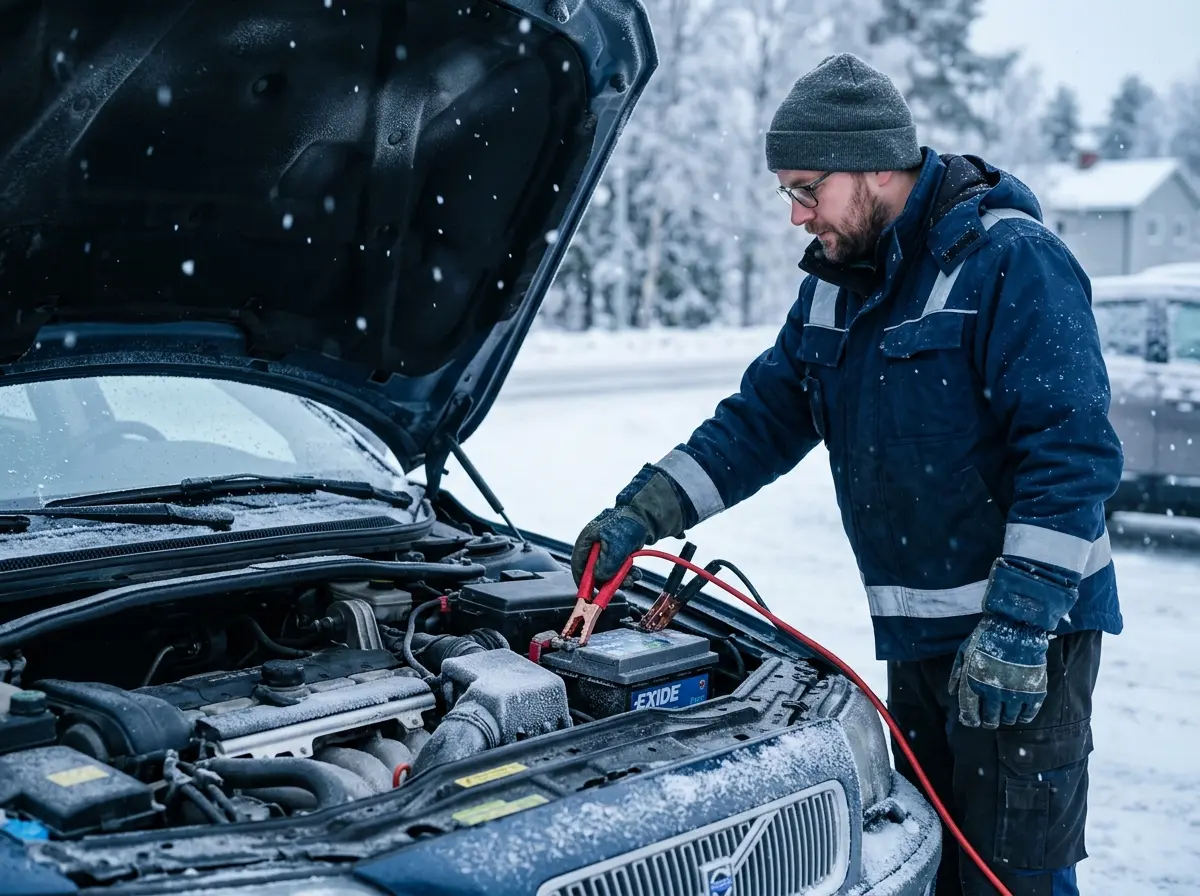
When the temperature drops below freezing, your car battery becomes one of the most vulnerable components under the hood. If you’ve ever turned the key on a frigid morning only to hear a slow, struggling crank (or worse, complete silence), you already understand why cold weather battery care matters. The good news is that with the right approach, you can prevent winter breakdowns, extend battery life, and avoid the cost of an emergency replacement.
This guide walks you through exactly how to maintain car battery in cold weather, based on practical mechanic-level knowledge and the chemistry behind how lead-acid batteries actually behave in low temperatures.
Why Cold Weather Affects Car Batteries?
A car battery generates power through a chemical reaction between lead plates and sulfuric acid. When temperatures fall, that reaction slows down significantly. At the same time, your engine oil thickens, which means the starter motor has to work harder to crank the engine. The result is a double hit: less available power and higher power demand.
According to data from AAA and battery manufacturers, a fully charged lead-acid battery loses roughly 35% of its strength at 32°F (0°C) and around 60% of its strength at 0°F (-18°C). Meanwhile, the engine needs nearly twice the cranking power in subzero conditions compared to a warm summer morning.
Here is a clear breakdown of how cold temperatures impact battery performance:
| Temperature | Battery Capacity Available | Cranking Power Needed | Risk Level |
|---|---|---|---|
| 80°F (27°C) | 100% | 100% (baseline) | Low |
| 32°F (0°C) | 65% | 155% | Moderate |
| 0°F (-18°C) | 40% | 210% | High |
| -20°F (-29°C) | 30% | 250%+ | Critical |
This is also why car battery freezing temperature matters. A fully charged battery will not freeze until around -76°F, but a discharged or weak battery can freeze at temperatures as warm as 20°F. Once the electrolyte freezes, the battery case can crack, and the battery is permanently damaged.
Also Read: What Causes a Car Battery to Die?
Signs of a Weak Battery in Winter
Catching a failing battery before it dies completely is the single best way to avoid being stranded. Watch for these warning signs:
- Slow engine crank. The starter sounds sluggish, drawn out, or strained.
- Dim headlights at idle. Lights brighten noticeably when you rev the engine.
- Clicking sound when starting. A rapid clicking usually means the battery cannot deliver enough amperage.
- Dashboard warning lights. A battery or charging system light should never be ignored.
- Electrical glitches. Power windows move slower, the radio resets, or the dome light flickers.
- Swollen battery case. A bulging case often points to internal damage from freezing or overcharging.
- Battery age over 3 years. Most batteries last 3 to 5 years, and cold weather accelerates failure in older units.
If you notice two or more of these symptoms, test the battery before winter sets in.
Not sure if your battery is about to fail? If you notice slow cranking, dim lights, or clicking sounds, it’s safer to get help immediately instead of risking a full breakdown. Our roadside technicians can reach you fast for jump starts, battery checks, and emergency towing services, so you don’t get stuck in the cold.
Available 24/7 across Milwaukee, Racine & surrounding areas. Call Now: 414-973-1902
How to Maintain Car Battery in Cold Weather?
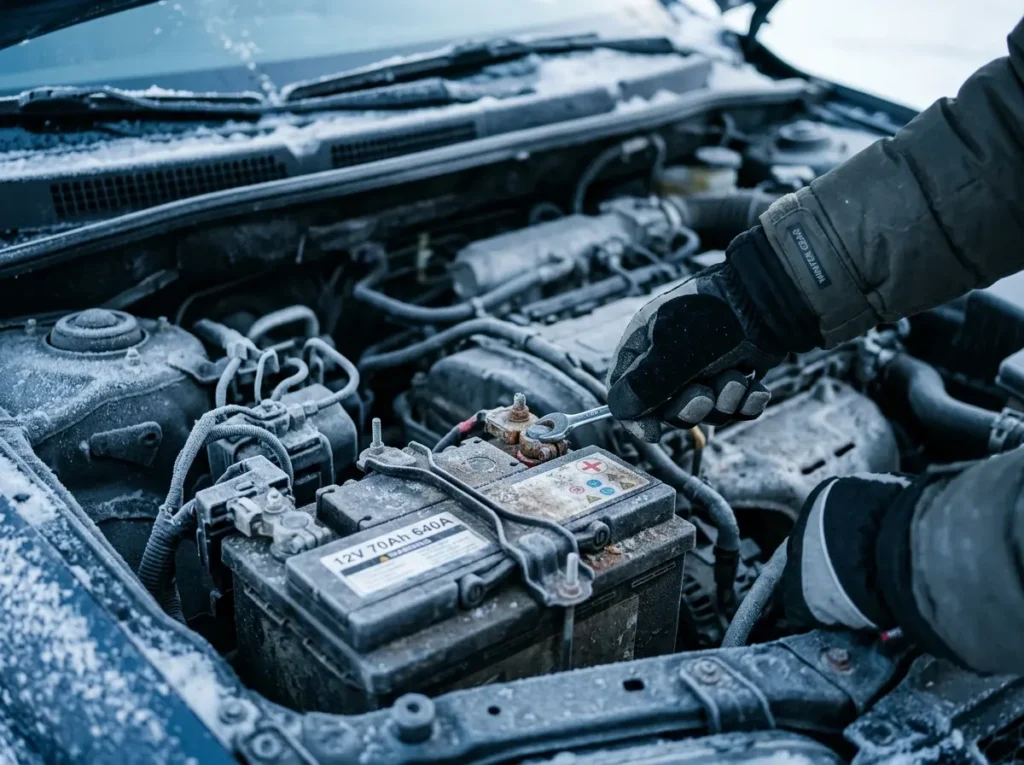
Proper car battery winter care comes down to a handful of practical habits. None of these require advanced tools, and most take only a few minutes.
1. Test Your Battery Before Winter Arrives
A healthy 12-volt battery should read between 12.4 and 12.7 volts when the engine is off and the car has been sitting for several hours. Anything below 12.4 volts indicates partial discharge, and below 12.2 volts means the battery is significantly weakened.
Most auto parts stores in the USA, including AutoZone, Advance Auto Parts, and O’Reilly, offer free battery load tests. Get one done in October or early November. A load test measures cold cranking amps (CCA) under simulated starting conditions, which is far more revealing than a simple voltage reading.
2. Keep the Battery Fully Charged
A fully charged battery resists freezing far better than a partially discharged one. Short trips are one of the biggest culprits behind winter battery failure because the alternator never gets enough time to fully recharge the battery after starting the engine.
If your daily driving consists mostly of short trips under 20 minutes, consider one of the following:
- Take a longer 30 to 45 minute drive once a week.
- Use a smart trickle charger or battery maintainer overnight every week or two.
- Avoid running heavy accessories (heated seats, defroster, radio) before the engine warms up.
3. Clean the Battery Terminals
Corrosion on the terminals acts as electrical resistance, which reduces the current flowing to your starter. White, blue, or greenish powdery buildup is the visible sign.
To clean terminals safely:
- Turn off the engine and remove the key.
- Disconnect the negative cable first, then the positive.
- Mix one tablespoon of baking soda in a cup of warm water.
- Scrub the terminals with an old toothbrush or wire brush.
- Rinse with clean water, dry thoroughly, and apply dielectric grease or terminal protectant.
- Reconnect positive first, then negative, and tighten firmly.
4. Inspect the Cables and Connections
Loose or frayed cables can mimic a dead battery. Wiggle each cable at the terminal. There should be zero movement. Check for cracked insulation, exposed copper, or green corrosion creeping under the cable housing.
5. Park in a Garage or Sheltered Area
Even an unheated garage typically stays 10 to 20 degrees warmer than outside air. That difference alone can dramatically improve cold-start reliability. If a garage is not available, park facing east so morning sunlight warms the engine bay.
6. Use a Battery Blanket or Engine Block Heater
For drivers in northern states like Minnesota, Wisconsin, Michigan, Maine, North Dakota, and Alaska, a battery blanket (an insulated electric wrap) keeps the battery within an optimal temperature range overnight. Engine block heaters reduce strain on the starter by pre-warming the engine oil.
7. Turn Off Accessories Before Starting
Headlights, heater fans, rear defrosters, heated seats, and the radio all draw power. Switching them off before you turn the key sends every available amp to the starter motor. Once the engine is running smoothly, turn accessories back on one at a time.
8. Avoid Letting the Car Sit for Long Periods
Modern vehicles have a constant parasitic draw from alarms, computers, and clocks. A car sitting unused for two or three weeks in freezing weather can drain the battery enough to prevent starting. If your vehicle will sit, either drive it weekly or connect a battery maintainer.
Also Read: Car Battery Life: How Long It Lasts, Signs of Failure & Replacement Tips
Preventive Maintenance Checklist
Use this schedule to stay ahead of winter battery problems:
| Maintenance Task | Recommended Frequency | Why It Matters |
|---|---|---|
| Visual inspection (cracks, leaks, swelling) | Monthly | Catches physical damage early |
| Terminal cleaning | Every 3 months | Prevents resistance buildup |
| Voltage test with multimeter | Every 2 months in winter | Detects gradual discharge |
| Professional load test | Annually before winter | Measures true cranking capacity |
| Check cable tightness | Every 3 months | Prevents intermittent starting issues |
| Battery replacement evaluation | Every 3 years | Most batteries weaken after this point |
| Use of battery maintainer | Weekly for unused vehicles | Prevents deep discharge |
Common Mistakes to Avoid
Even careful drivers make avoidable errors that shorten battery life. Watch out for these.
Ignoring slow cranks. A sluggish start is the battery telling you it is struggling. Waiting until it fails completely usually means a roadside breakdown.
Jump-starting incorrectly. Connecting cables in the wrong order can damage electronics in modern vehicles. Always connect positive to positive first, then negative to a grounded metal surface on the dead vehicle, never directly to the negative terminal.
Leaving accessories on overnight. A dome light, phone charger, or dashcam left running can flatten a battery by morning.
Using the wrong battery size. Replacing a battery with one that has lower cold cranking amps than your owner’s manual specifies almost guarantees winter problems. Always match or exceed the OEM CCA rating.
Topping off with tap water. If you have a serviceable (non-sealed) battery, use only distilled water. Minerals in tap water damage the internal plates.
Skipping the alternator check. A weak alternator forces the battery to do extra work and prevents proper recharging. If your battery keeps dying, the alternator may be the real problem.
Driving only short distances. Repeated short trips are the number one cause of premature battery failure in winter.
Expert Tips for Longer Battery Life
These are the kinds of habits experienced technicians recommend to customers who want maximum battery lifespan:
- Choose an AGM battery for cold climates. Absorbent Glass Mat batteries handle cold cranking and deep discharge cycles better than standard flooded lead-acid batteries.
- Match CCA to your climate. In northern states, look for a battery with at least 600 to 800 CCA depending on engine size.
- Insulate the battery. A factory or aftermarket battery insulation sleeve buffers temperature swings.
- Keep the engine bay clean. Road salt, slush, and debris around the battery accelerate corrosion.
- Test charging system voltage. With the engine running, voltage at the battery should read between 13.7 and 14.7 volts. Anything outside this range points to charging system trouble.
- Replace batteries in pairs for diesel trucks. Dual-battery setups should be replaced together since one weak battery drains the healthy one.
FAQ Section
Q. How cold does it have to be to damage a car battery?
A healthy, fully charged battery can withstand temperatures down to around -76°F before the electrolyte freezes. However, a partially discharged battery can freeze at temperatures as warm as 20°F, which causes permanent internal damage.
Q. How long does a car battery last in cold weather?
Most car batteries last 3 to 5 years on average, but consistent exposure to extreme cold can shorten that lifespan by 30% or more. In northern climates, expect to replace your battery closer to the 3 to 4 year mark.
Q. Does idling the car charge the battery in winter?
Idling charges the battery slowly and inefficiently. The alternator produces less output at idle speeds, and accessories like the heater and defroster consume much of that power. Driving at highway speeds for 20 minutes or more is far more effective.
Q. How do I know if my battery is frozen?
A frozen battery typically has a bulging or cracked case, may leak electrolyte, and will not accept a charge. Never attempt to jump-start a frozen battery, as it can rupture or explode. Allow it to thaw in a warm area and replace it if damage is visible.
Q. What voltage should a car battery be in cold weather?
A resting voltage between 12.4 and 12.7 volts indicates a healthy, fully charged battery. Readings below 12.4 volts mean the battery should be charged and tested, especially before winter.
Conclusion
Cold weather is hard on car batteries, but most winter failures are entirely preventable. The core principle is simple: keep the battery clean, charged, properly connected, and tested before the first hard freeze. Pay attention to early warning signs like slow cranks and dim lights, avoid the common mistakes that drain batteries prematurely, and follow a basic maintenance schedule throughout the season.
If your battery is more than three years old and you live somewhere with harsh winters, do not wait for it to fail. A free load test takes ten minutes and tells you exactly where you stand. A small amount of attention now saves you from a frozen morning, an emergency tow, and a much larger repair bill later.
Take care of your battery, and it will take care of you all winter long.