

At MG Towing and Recovery, we have spent the past three years helping drivers across Milwaukee get back on the road after getting stuck. From cars buried in spring mud to trucks sliding off icy winter shoulders, we have handled nearly every recovery situation this city can throw at a vehicle. In this guide, we will walk you through everything you need to know about winch out services, based on what we see in the field every single day.
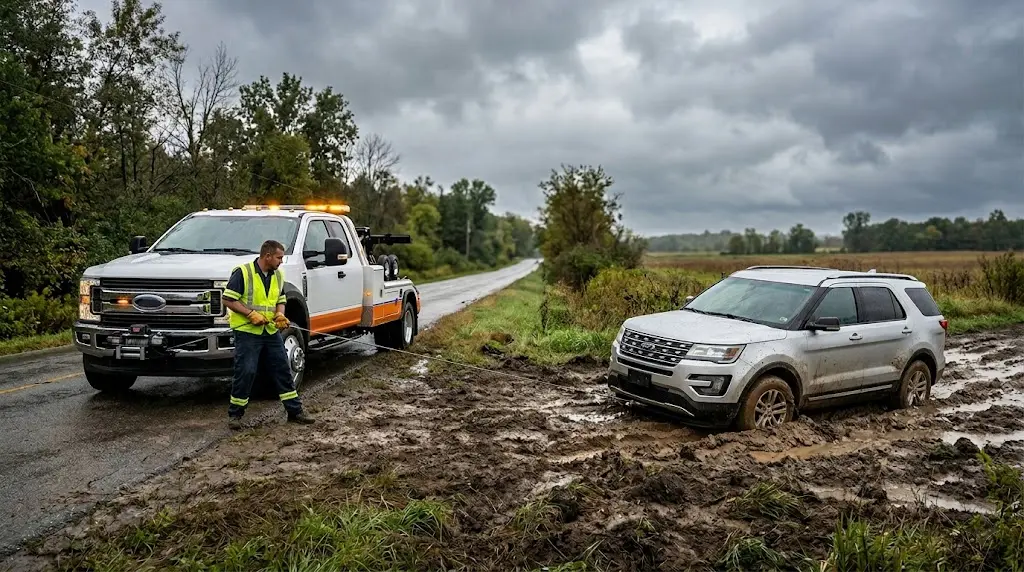
Picture this: you take a shortcut down a gravel road after a rainstorm, your tires start spinning, and within seconds your vehicle sinks into thick mud. No amount of gas pedal pressure helps. You are stuck. It happens to careful drivers all the time, and it is rarely about bad driving.
Vehicles get stuck for simple physical reasons. Tires lose traction on loose, wet, frozen, or uneven surfaces. Mud, snow, sand, and soft grass all reduce the grip your tires need to move forward. Once traction is gone, spinning your wheels usually digs you in deeper.
That is where a winch out service comes in. A winch out uses a powerful cable system to pull your vehicle out of a spot it cannot escape on its own. This article explains what a winch out service is, how it works, when you need one, what equipment is involved, how much it typically costs in Milwaukee, and whether you should ever attempt one yourself.
Quick Answer
A winch out service is a roadside recovery method that uses a motorized winch and steel cable to pull a stuck vehicle out of mud, snow, sand, a ditch, or off-road terrain. A trained operator attaches the cable to a secure point on your vehicle and uses controlled tension to move it back to stable ground safely.
What Is a Winch Out Service?
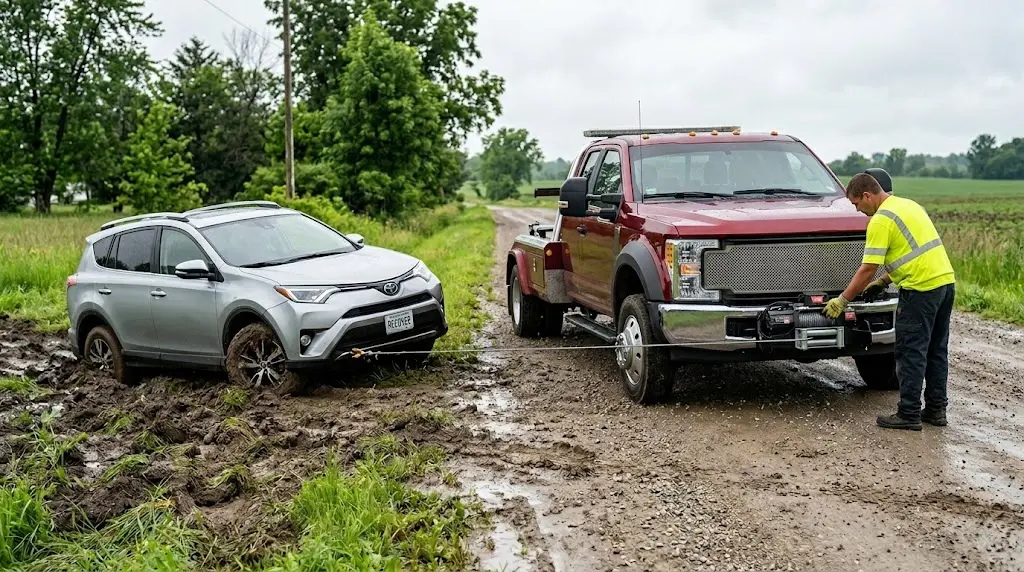
A winch out service is a vehicle recovery service that uses a winch, a mechanical device with a spooled steel cable or synthetic rope, to pull a stuck or disabled vehicle to safety. The winch generates strong, controlled pulling force that can free a vehicle from situations where its own engine and tires cannot.
In plain terms: when your car is stuck and cannot drive itself out, a winch out service pulls it out.
Unlike traditional towing, which moves a working or non-working vehicle from one location to another, a winch out focuses specifically on extraction. The goal is to recover the vehicle from where it is trapped and return it to a drivable surface. Once the vehicle is free, many drivers simply continue on their way.
This service is a core part of emergency roadside assistance and is offered by most professional towing and recovery companies.
How Does a Winch Out Service Work?
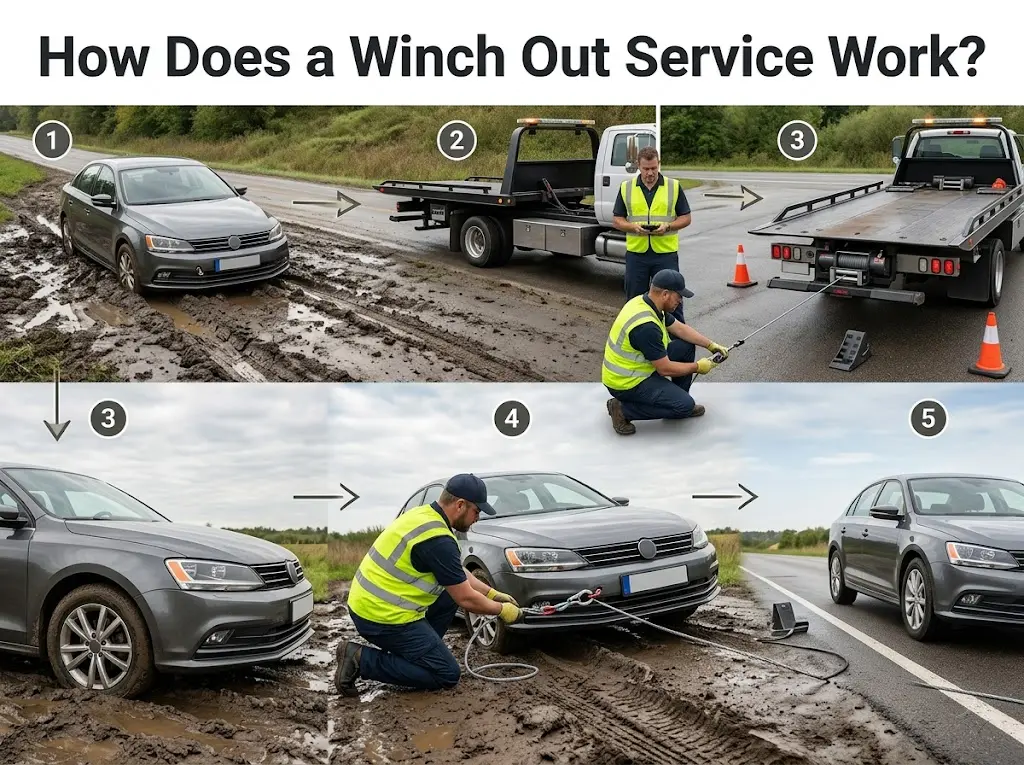
A professional winch out follows a clear, safety-focused process. Here is how our operators handle a typical recovery.
1. Initial Vehicle Assessment
The operator first evaluates the situation. They check how deeply the vehicle is stuck, the type of terrain, the angle of the vehicle, and whether anything is blocking a safe pull. They also identify the strongest attachment points on the vehicle frame. This assessment determines the safest direction and method of recovery.
2. Equipment Setup
Next, the operator positions the recovery truck and sets up the winch. They connect the cable or synthetic rope to a rated attachment point, never to fragile components like bumpers or suspension parts. Anchoring systems or recovery straps may be added when extra stability is needed. Safety zones are established to keep bystanders clear of the cable.
3. Controlled Vehicle Recovery
With everything secured, the operator applies steady, controlled tension. The winch pulls the vehicle slowly and predictably rather than yanking it. The operator watches the cable, the vehicle, and the terrain the entire time, adjusting force as needed. Controlled movement reduces stress on the vehicle and improves safety.
4. Final Safety Inspection
Once the vehicle reaches stable ground, the operator inspects it for visible damage and confirms it is safe to drive. They check tires, undercarriage clearance, and attachment points. If the vehicle is not drivable, the operator can arrange traditional towing to a repair shop.
Common Situations Where Drivers Need a Winch Out Service
Drivers call for a winch out in a wide range of conditions. These are the situations we respond to most often in the Milwaukee area.
1. Vehicle Stuck in Mud
Mud is one of the most common reasons for a winch out. Soft, wet ground swallows tires quickly, and spinning the wheels only digs deeper. A winch provides the steady pull needed to break the suction and free the vehicle.
2. Vehicle Stuck in Snow
Milwaukee winters create plenty of stuck vehicles. Deep snow, snowbanks, and icy shoulders rob tires of traction. According to the Federal Highway Administration, the majority of weather-related crashes happen on wet or snowy pavement, and the same conditions strand countless vehicles each winter.
3. Vehicle Stuck in Sand
Sand shifts under weight and offers very little grip. Drivers near lakeshores, beaches, or construction areas often find their tires sinking. A winch out pulls the vehicle onto firmer ground without the wheel spin that worsens the problem.
4. Vehicle in a Ditch
Sliding into a ditch is common during bad weather or when avoiding another vehicle. Ditches present steep angles that make self-recovery nearly impossible. A winch, often combined with proper anchoring, lifts and guides the vehicle back onto the road.
5. Off-Road Recovery
Drivers exploring trails, rural roads, or job sites can become trapped on uneven or remote terrain. Off-road recovery may require specialized angles, multiple anchor points, and operator experience to extract the vehicle without damage.
6. Wet Grass and Slippery Terrain
Wet grass looks harmless but becomes extremely slick. Vehicles parked at events, parks, or fields frequently lose traction on a slope. A short winch out usually solves the problem quickly.
Need a Professional Winch Out Near Milwaukee?
Whether your vehicle is stuck in snow, mud, sand, or a ditch, our experienced recovery team has the right equipment to safely extract your vehicle. MG Towing & Recovery is available when you need reliable roadside assistance. Call Now: 414-973-1902
Winch Out Service vs Traditional Towing
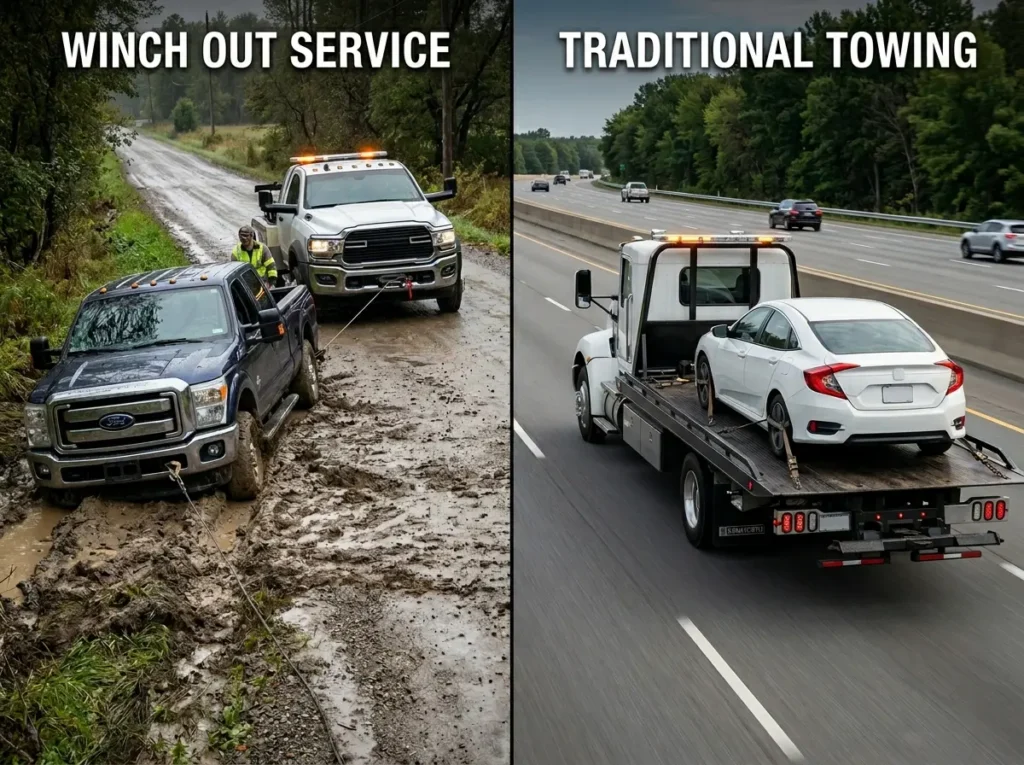
People often confuse these two services. While both are part of towing and recovery, they solve different problems. The table below breaks down the key differences.
| Feature | Winch Out Service | Traditional Towing |
|---|---|---|
| Primary purpose | Extracts a stuck vehicle | Transports a vehicle to another location |
| Vehicle condition | Usually drivable once freed | May be drivable or disabled |
| Equipment focus | Winch, cable, recovery gear | Flatbed or wheel-lift truck |
| Typical scenario | Mud, snow, sand, ditch, off-road | Breakdown, accident, no-start |
| End result | Vehicle returns to the road | Vehicle delivered elsewhere |
| Time on scene | Often shorter | Varies by distance |
| Driver next step | Often drives away | Vehicle hauled to destination |
In short, a winch out gets you unstuck, while towing moves your vehicle from point A to point B. Many recovery jobs combine both when a vehicle is damaged during the incident.
Learn More: Winch Out vs. Towing: What’s the Difference and Why It Matters?
What Equipment Is Used During a Winch Out Service?
Professional recovery relies on specialized, rated equipment. Using the right gear is what keeps both the vehicle and the operator safe. Here is what we typically use.
- Recovery winches: The core tool that generates pulling power.
- Tow trucks: Provide a stable, anchored base for the winch.
- Recovery straps: Distribute force and connect to anchor points.
- Anchoring systems: Stabilize the truck or create a pull point on loose terrain.
- Safety equipment: Includes gloves, cable dampers, cones, and high-visibility gear.
| Equipment | Purpose | Typical Capacity |
|---|---|---|
| Recovery winch | Generates controlled pulling force | 8,000 to 30,000+ lbs |
| Steel or synthetic cable | Transfers force to the vehicle | Rated to winch capacity |
| Recovery straps | Connect and distribute load safely | 10,000 to 30,000 lbs |
| Snatch block | Increases pulling power and changes angle | Doubles winch capacity |
| Anchor system | Stabilizes the recovery point | Varies by setup |
| Cable damper | Absorbs energy if a cable fails | Safety device |
A cable damper deserves special mention. If a cable or strap breaks under tension, it can snap back with dangerous force. Dampers reduce that risk, which is one reason professional recovery is safer than improvised attempts.
How Much Does a Winch Out Service Cost in Milwaukee?
Winch out pricing depends heavily on the situation. A quick pull off a slushy shoulder costs far less than a deep off-road recovery. The table below shows realistic ranges based on common Milwaukee scenarios. Prices vary by location, provider, and conditions, so treat these as general estimates rather than fixed quotes.
| Situation | Typical Price Range | Difficulty Level |
|---|---|---|
| Simple roadside pull | $75 to $150 | Low |
| Vehicle stuck in snow | $100 to $200 | Low to moderate |
| Vehicle stuck in mud | $150 to $300 | Moderate |
| Vehicle in a ditch | $200 to $400 | Moderate to high |
| Off-road recovery | $250 to $600+ | High |
| Heavy or complex recovery | $400 to $1,000+ | Very high |
Several factors influence the final price:
- Vehicle size: Larger trucks and SUVs require more pulling force and heavier equipment.
- Distance from roadway: The farther your vehicle sits from solid ground, the more cable and effort are needed.
- Terrain conditions: Steep, soft, or unstable ground increases difficulty.
- Time required: Longer recoveries cost more in labor.
- Weather conditions: Snow, ice, and rain raise both risk and time.
- Recovery complexity: Multiple anchor points or specialized angles add cost.
According to AAA, the organization responds to tens of millions of roadside assistance calls every year, and recovery situations like winch outs make up a meaningful share of cold-weather calls. Always ask for an estimate before work begins so there are no surprises.
Is a Winch Out Service Safe for Your Vehicle?
When performed by a trained operator, a winch out is very safe for your vehicle. The risk of damage comes almost entirely from improper technique, not from the service itself.
Professional operators reduce risk in several ways:
- Proper attachment points: They connect only to rated tow hooks or frame points, never to bumpers, axles, or plastic components.
- Controlled tension: Slow, steady pulling avoids sudden jerks that can bend or crack parts.
- Correct pulling angles: The right angle protects the suspension and prevents the vehicle from tipping.
- Trained operators: Experience matters more than horsepower. A skilled operator reads the terrain and chooses the safest method.
The biggest safety advantage of hiring a professional is knowledge. An experienced operator knows where your specific vehicle can be safely pulled and how much force is appropriate. That judgment is what keeps your vehicle, and everyone nearby, out of harm’s way.
Can You Perform a Winch Out Yourself?
It is possible to perform a self-recovery if you own the right equipment and have real experience, but it carries serious risks. We generally recommend caution.
The main concerns include:
- Injury risk: A cable or strap under tension stores enormous energy. If it fails, it can snap back and cause severe injury or death.
- Vehicle damage: Attaching to the wrong point can bend frames, tear off bumpers, or damage suspension components.
- Equipment requirements: Safe recovery needs a rated winch, proper straps, shackles, a snatch block, gloves, and a cable damper. Most drivers do not carry these.
- Terrain misjudgment: Without experience, it is easy to choose the wrong angle or anchor, which can make the situation worse.
You might safely handle a very minor situation, such as a light pull on flat ground with proper gear. But for deep mud, ditches, steep angles, or any recovery near traffic, professional help is the safer choice. The National Highway Traffic Safety Administration emphasizes that roadside incidents near moving traffic are especially dangerous, which is another reason to let trained operators manage recovery in those locations.
When in doubt, call a professional. The cost of a winch out is almost always lower than the cost of an injury or vehicle repair.
Frequently Asked Questions
Q. How long does a winch out service take?
Most winch out recoveries take 20 to 45 minutes once the operator arrives. Simple roadside pulls can be done in under 15 minutes. Complex situations, such as deep mud, steep ditches, or off-road recovery, may take an hour or more depending on terrain, vehicle size, and weather conditions.
Q. Will a winch out damage my vehicle?
When performed by a trained operator using proper attachment points and controlled tension, a winch out rarely causes damage. Risk increases only with improper technique, such as connecting to a bumper or pulling at a bad angle. This is why hiring an experienced professional is strongly recommended over attempting it yourself.
Q. Is a winch out covered by insurance?
It depends on your policy. Many roadside assistance plans and some auto insurance add-ons cover winch out and recovery services, often up to a set dollar amount. Coverage varies widely, so check your specific plan. Always confirm details with your provider before assuming a recovery will be reimbursed.
Q. How much does a winch out service cost?
In Milwaukee, a winch out typically costs between $75 and $400, depending on difficulty. Simple roadside pulls fall on the lower end, while ditch recovery, deep mud, and off-road extractions cost more. Final pricing depends on vehicle size, terrain, time, and weather. Always request an estimate before work begins.
Q. What should I do while waiting for a winch out service?
Turn on your hazard lights, stay inside your vehicle if you are near traffic, and keep your seatbelt fastened. If it is safe, place a warning triangle or flares behind your vehicle. Avoid spinning your tires, since that usually digs you in deeper and makes recovery harder.
Q. Should I spin my tires to get unstuck?
No. Spinning your tires usually makes the situation worse by digging the vehicle deeper and creating slick, polished ruts. It can also overheat your transmission. If gentle acceleration does not work within a few attempts, stop and call a winch out service to avoid further trouble.
Final Thoughts
Getting stuck is stressful, but it is also extremely common and almost always fixable. A winch out service exists for exactly these moments, when mud, snow, sand, or a ditch leaves your vehicle going nowhere.
The most important thing to remember is safety. Spinning your tires or attempting a risky self-recovery can turn a small problem into an expensive or dangerous one. Trained operators have the equipment, judgment, and experience to free your vehicle without putting you or your car at risk.
If you find yourself stuck anywhere around Milwaukee, the smartest move is to stay calm, stay safe, and call a professional recovery team. At MG Towing and Recovery, we handle these situations every day, and we are always ready to help you get back on the road.

One thought on “What Is a Winch Out Service? The Complete Guide for Drivers”