

A Step-by-Step Safety Guide for Milwaukee Drivers Who Break Down on I-94, I-43, I-894 or Any Wisconsin Interstate
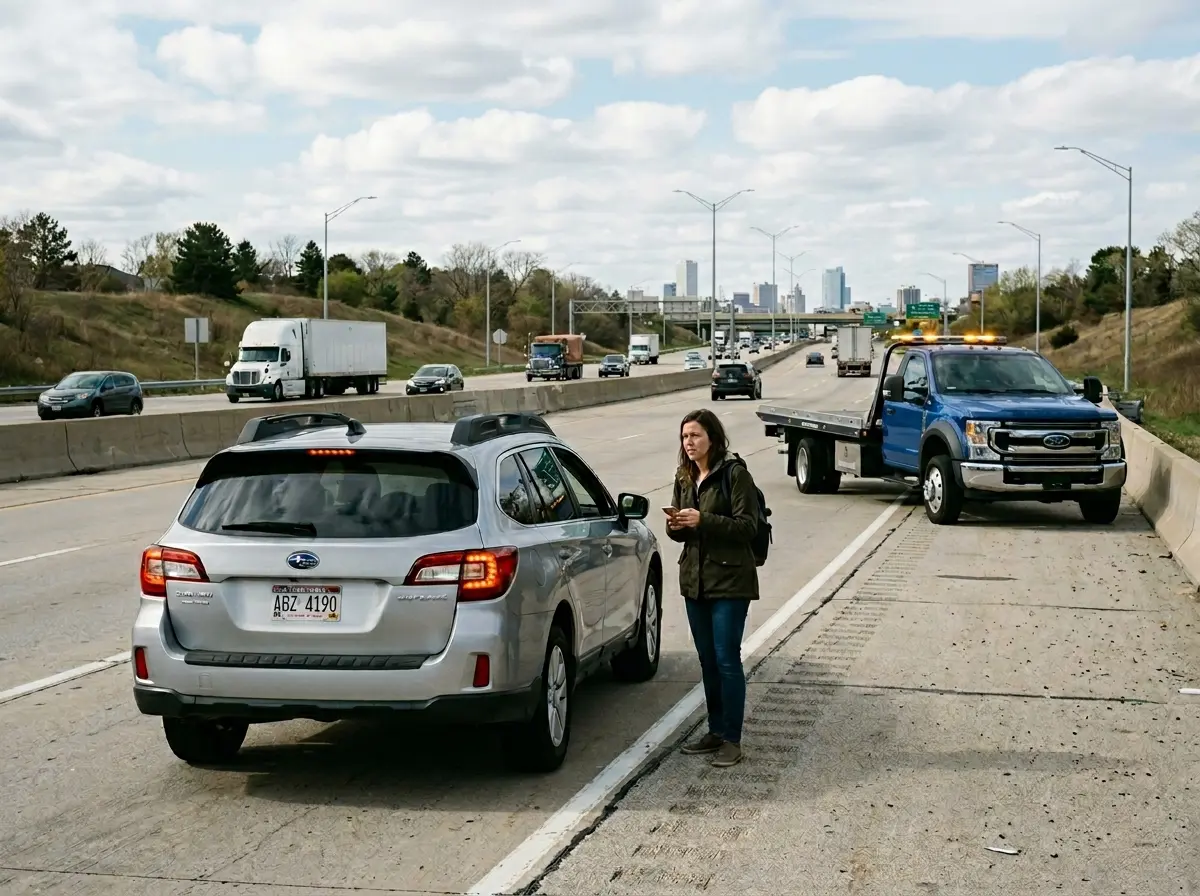
A highway breakdown is a different category of emergency from a breakdown in a parking lot or on a quiet city street. The threat environment changes instantly. Vehicles traveling at 65 miles per hour are passing within feet of your stopped car. Visibility may be limited by traffic, weather, or the curve of the road. You have very little time to make decisions that could directly affect your safety and the safety of everyone else on the road.
I-94 through Milwaukee is one of the busiest and most complex highway corridors in Wisconsin carrying heavy commuter and freight traffic daily, with active reconstruction zones creating shifting lane configurations and reduced shoulder widths in several sections. I-43, I-894, and US-45 add further high-speed corridors where Milwaukee drivers regularly find themselves when something goes wrong with a vehicle.
The difference between a breakdown that is resolved safely and efficiently and one that becomes a secondary accident or worse, almost always comes down to the actions taken in the first 30 to 60 seconds after a vehicle problem begins.
This guide gives you those actions in the right order, along with what to do next, how to get the right help fast, what Milwaukee-specific resources are available to you, and how to be better prepared before you ever need this information.
Related Articles:
What Causes Most Car Accidents in Milwaukee?
Who Actually Pays for Towing After a Car Accident in Wisconsin?
The First 60 Seconds: Immediate Steps When Your Vehicle Starts Failing on I-94
The moment you notice your vehicle is experiencing a problem on a Milwaukee highway warning light, loss of power, strange sound, flat tire sensation, the clock starts. Here is the exact sequence of actions that protects you most effectively.
Step 1: Do Not Panic – Control Your Vehicle First
Panic-braking on a highway is one of the most dangerous responses to a vehicle problem. Sudden, hard braking on I-94 at highway speed can cause the vehicle behind you to rear-end you at full speed. Your first priority is smooth, controlled deceleration, ease off the accelerator gradually, keep both hands on the wheel, maintain your lane, and signal your intent before changing lanes.
If you have a blowout, the sudden explosive failure of a tire, the vehicle may pull sharply to the side of the failure. Do not overcorrect. Grip the wheel firmly, ease off the gas, and allow the vehicle to slow down before attempting to steer to the shoulder. Overcorrecting a blowout at highway speed is a leading cause of rollover accidents.
Step 2: Turn On Your Hazard Lights Immediately
The moment you are aware of a vehicle problem, before you have reached the shoulder, before you have assessed the situation, before you have called anyone, your hazard lights must be on. This is the single most important visibility action you can take. Hazard lights alert every driver behind you that something has changed and that they need to react.
On a busy Milwaukee highway like I-94, where following distances are often compressed during rush hour, even an extra second of warning can be the difference between a driver having time to react and a rear-end collision. Turn on your hazard lights immediately. Do not wait until you have stopped.
Step 3: Move to the Right Shoulder as Quickly and Safely as Possible
Your destination is the right shoulder, the paved area to the far right of the rightmost travel lane. Signal right, check your mirrors and blind spots, and move across traffic lanes one at a time as safely as traffic conditions allow. If you cannot safely reach the right shoulder, an exit ramp is the next best option, even if it takes you off your intended route. Getting completely out of the travel lanes is the priority.
On I-94 through Milwaukee’s active construction zones, the right shoulder may be reduced in width or temporarily closed. If you encounter this situation, advance along the shoulder to the nearest emergency pull-off or designated stopping area rather than stopping in a narrowed shoulder adjacent to fast-moving traffic.
Left shoulders, the median side of the highway are significantly more dangerous and should be used only when the right shoulder is completely inaccessible. Drivers on the highway are not expecting a stopped vehicle on the left, and approaching traffic from behind on the driver’s side is far more dangerous than from the passenger side.
Step 4: Pull as Far Right as Possible – Wheels Off the Pavement if Able
Once on the shoulder, continue moving as far right as the terrain allows. Ideally, your right-side wheels should be on the unpaved verge beyond the white shoulder line, and your entire vehicle should be as far from the travel lanes as the shoulder width permits.
On highway shoulders, the difference between being 2 feet from the travel lane and 8 feet from the travel lane is significant, distracted drivers who drift onto the shoulder have struck parked vehicles that were too close to the travel lane edge.
Step 5: Keep the Vehicle in Drive (or Park on Flat Ground) and Engine Running if Safe
If your vehicle is still running and there’s no immediate danger like smoke, fire, or serious overheating, keep it in Drive with your foot on the brake or shift to Park depending on the situation. Leaving the engine on helps keep your hazard lights and other warning systems working. If you notice smoke, a burning smell, or anything that suggests a fire, turn off the engine right away and get out of the vehicle.
After You Have Stopped: The Next Critical Actions
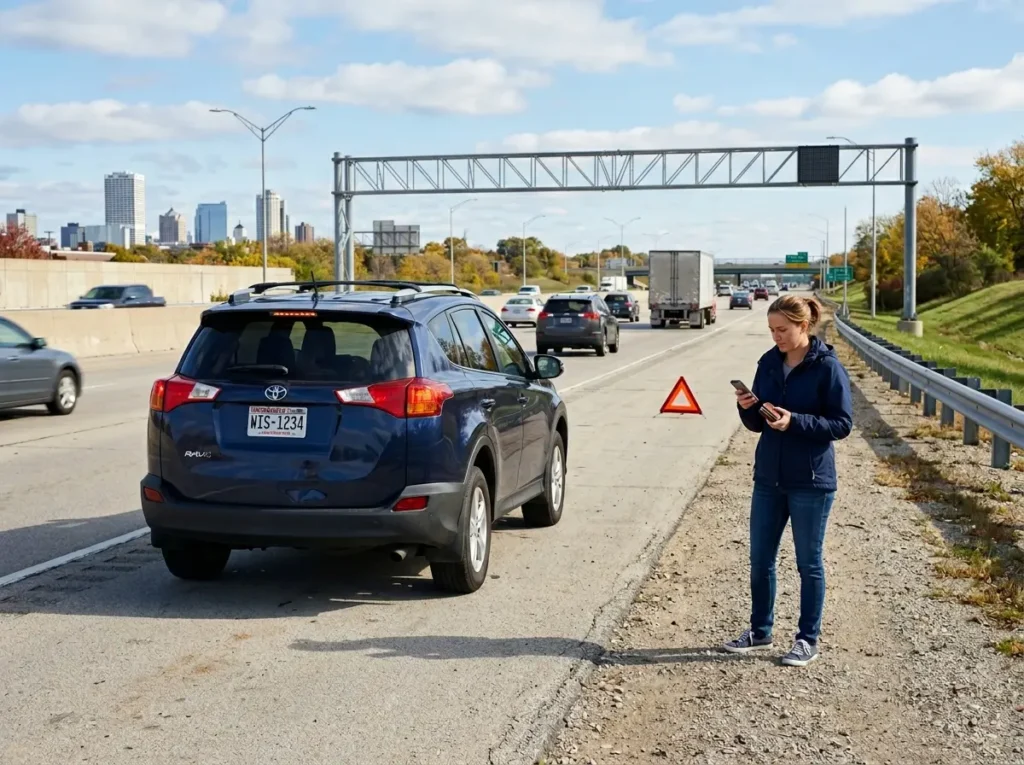
Stay Inside the Vehicle – Unless It Is Unsafe to Do So
This is one of the most important but often misunderstood highway safety tips. When a car breaks down, many drivers instinctively get out. The problem is that standing outside on a highway shoulder puts you dangerously close to fast-moving traffic, with very little protection.
Research shows that a significant number of highway fatalities involve people who were outside their disabled vehicles and struck by passing traffic. Even when your car is stopped, it still offers far more protection than being exposed on the roadside. The safest choice in most situations is to stay inside your vehicle with your seatbelt on.
The only time you should leave the vehicle is when staying inside becomes more dangerous. This includes situations like a fire, smoke from the engine, or a strong smell of fuel or burning. If that happens, exit quickly from the side away from traffic and move to a safer area, such as behind a guardrail or up an embankment. Put as much distance as possible between yourself and the vehicle.
Assess Your Location and Note Your Position
Before making any calls, take 20 seconds to establish exactly where you are on I-94. The information you need: the direction you are traveling (eastbound, westbound, northbound, southbound), your approximate location by mile marker (green signs posted along the highway shoulder give the mile number), your proximity to the nearest exit (the last exit you passed and the number of the next one visible on signage), and any identifiable landmarks, bridges, overpasses, business signs visible from the highway.
This information lets you give emergency services and roadside assistance providers an accurate location immediately. On a 30-mile stretch of I-94 through Milwaukee, vague location information can add 15 to 20 minutes to response time. Specific information, ‘eastbound I-94, mile marker 307, approximately half a mile past the Moorland Road exit’, allows precise dispatch.
Call for Help: Who to Call and in What Order
The call sequence depends on the nature of your situation:
- If there is any injury, active fire, or your vehicle is blocking a travel lane: call 911 first, immediately. Do not make any other calls before this one. Wisconsin State Patrol responds to highway emergencies and will coordinate additional help.
- If your vehicle is safely on the shoulder and you or your passengers are uninjured: call MG Towing & Recovery or your roadside assistance provider for emergency help. Then notify your destination, employer, or family as appropriate.
- If you have an active roadside assistance plan (AAA, insurance endorsement, or manufacturer program): use their number for roadside assistance services but be aware that during peak demand periods or severe weather, national dispatch programs can have significantly longer response times than local Milwaukee providers.
MG Towing & Recovery’s local Milwaukee dispatch means your call goes to an operator who knows I-94’s specific mile markers, exit points, and the fastest routes to reach you, not a national call center routing your call to the nearest contracted provider.
Make Yourself Visible
Once you’ve pulled over safely and turned on your hazard lights, you can make your vehicle even more visible to other drivers. If you have reflective triangles or road flares in your car, place them behind your vehicle. It’s recommended to set them about 10 feet, 100 feet, and 300 feet back in the direction of traffic.
At night, visibility becomes even more important. Use a flashlight or LED flare near the rear of your vehicle and turn on the interior lights. If you need to step outside briefly to place warning devices, wear bright clothing and move quickly. Stay close to your vehicle and avoid standing near or in the traffic lane.
| Wisconsin DOT Highway Helpers: Wisconsin DOT operates a Highway Helper program that patrols major Milwaukee-area highways including I-94, I-43, and I-894 during peak hours. Highway Helpers are equipped to assist with minor mechanical issues, fuel delivery, tire changes, and can coordinate towing. They are free to use and patrol the freeway looking for disabled vehicles. If a Highway Helper finds you before you have arranged other assistance, accept their help, they are experienced with the specific hazards of Milwaukee’s interstate environment. |
I-94 Milwaukee: Specific Hazards and Breakdown Considerations
I-94 through Milwaukee is not a uniform highway environment. Different sections have different characteristics that affect how a breakdown should be managed and what specific precautions are warranted.
The Zoo Interchange (I-94 / I-41 Interchange, Exits 305–310)
The Zoo Interchange is Milwaukee’s most complex highway interchange and one of the most active ongoing construction zones in the state. Lane configurations at this interchange change regularly during the I-94 East-West reconstruction project.
Shoulder availability is reduced or eliminated in some active construction segments, and concrete barriers replace the open shoulders that allow breakdown vehicles to pull well clear of traffic.
If your vehicle begins failing in or near the Zoo Interchange, your priority is getting through the interchange before stopping if at all possible, the shoulders are most restricted in the interchange itself. If you cannot continue, activate hazard lights and move as far right as possible even within a reduced shoulder, and call 911 immediately given the reduced safety margin.
The Marquette Interchange (I-94 / I-43 / I-894, Downtown Milwaukee)
The Marquette Interchange, where I-94 meets I-43 and I-894 in downtown Milwaukee, carries some of the highest traffic volumes on any Wisconsin highway and has multiple levels of overlapping ramps. A breakdown in this interchange involves elevated exposure to traffic from multiple directions and limited shoulder options.
If you sense vehicle trouble approaching the Marquette Interchange, your best option is to exit before entering it, there are several exits immediately before the interchange on both the east and west approaches. Exiting onto surface streets, even if it adds time to your journey, removes you from the most dangerous stopping environment on Milwaukee’s highway system.
The I-94 East-West Freeway Construction Corridor
The ongoing I-94 reconstruction between 70th Street and 16th Street has created a long construction zone with narrower lanes, shifting traffic patterns, and limited shoulder space. Fines for traffic violations are doubled in Wisconsin construction zones because the risk of crashes is higher.
If your vehicle breaks down, keep in mind that shoulders may not always be wide enough to pull over safely. If possible, continue driving carefully until you reach a section where the shoulder is wide enough to stop safely.
I-43 and I-894 in Milwaukee
I-43 on Milwaukee’s north and south sides and I-894 on the southwest both handle heavy traffic and come with challenges similar to I-94. On I-43, the north-south direction can make vehicles stopped on the shoulder harder to see in the late afternoon, especially on the west side where shadows reduce visibility for northbound drivers.
On I-894, some elevated sections don’t have proper shoulder access, which makes breakdowns more dangerous. If your vehicle starts failing on one of these sections, the safest move is to slow down carefully and continue to the next ground-level area before stopping.
Roadside Assistance Services Availability on I-94 Milwaukee
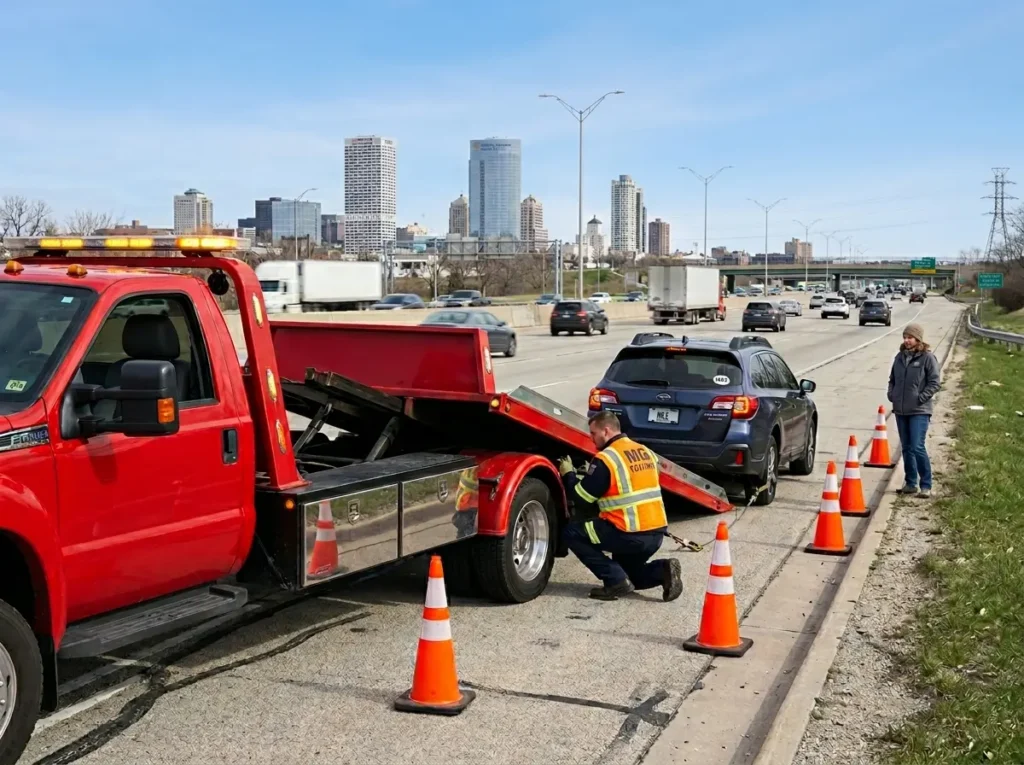
Once you are safely stopped on the shoulder and have made contact with a roadside assistance or towing provider, the specific service dispatched depends on your vehicle’s problem. Here is how the most common I-94 breakdown scenarios map to the available services:
| Breakdown Situation | Service Needed | Typical Response (Milwaukee) |
| Dead battery, won’t start | Jump start service | 30–45 min |
| Flat tire with usable spare | Flat tire roadside service | 30–45 min |
| Flat tire, no usable spare | Tow truck service | 30–60 min |
| Ran out of fuel | Emergency fuel delivery | 30–45 min |
| Keys locked in car | Car lockout service | 30–45 min |
| Engine failure / overheating | Emergency towing | 30–60 min |
| Transmission failure | Emergency towing | 30–60 min |
| Accident damage | Emergency towing + 911 | Immediate |
| Unknown – vehicle will not move | Emergency towing | 30–60 min |
Jump Start Service on I-94
A dead battery on I-94 can be quickly fixed with a mobile jump start. A technician arrives with proper equipment and safely gets your car running. They work carefully around traffic with warning lights on. After the jump, drive for 20 to 30 minutes at highway speed to recharge the battery.
Flat Tire Roadside Service on I-94
If you have a usable spare and your car is safely on the shoulder, a roadside service can change your tire on the spot. If not, or if conditions are unsafe, your vehicle should be towed. MG Towing & Recovery technicians always assess safety first at your I-94 location.
Emergency Fuel Delivery on I-94
Running out of fuel on I-94 can be quickly handled with emergency fuel delivery, where one to three gallons are brought to your vehicle. It is a simple service, but some fuel injected cars may need a specific restart process, and a technician will guide you before leaving.
Emergency Towing from I-94
For mechanical breakdowns or damage where a vehicle cannot be driven, emergency towing on I-94, I-43, I-894, and US-45 requires experienced operators who follow safe recovery procedures, proper positioning, and correct flatbed towing for each vehicle type.
MG Towing & Recovery provides 24/7 emergency towing in Milwaukee with safe loading and navigation through construction and shoulder conditions.
Broke Down on I-94 or Another Milwaukee Highway? MG Towing & Recovery – 24/7 Highway Roadside Assistance & Emergency Towing, Milwaukee. Call Now: 414-973-1902
Breaking Down on I-94 in Winter: Additional Safety Considerations
A Milwaukee winter breakdown on I-94 introduces cold-weather hazards that compound the standard highway breakdown risks. Here are the additional considerations specific to Wisconsin winter highway breakdowns.
1. Cold Exposure Risk
Waiting for roadside assistance on a Milwaukee highway shoulder in January means preparing for cold exposure. During winter storms, Wisconsin DOT Highway Helpers and private services can take 60 to 90 minutes due to high demand. Dress warmly before winter travel.
Run your engine intermittently for heat instead of continuously to save fuel and reduce carbon monoxide risk. Always check exhaust pipe is clear of snow before starting the vehicle.
2. Black Ice and Reduced Traction Near Your Vehicle
A disabled vehicle on I-94 during winter conditions can create a hazard. Drivers who suddenly brake after spotting it may lose control, especially on black ice, and fail to stop in time before reaching the shoulder. That’s why it is important to park as far from traffic as possible and ensure visibility using hazard lights, reflective markers, and interior lighting. Winter conditions make visibility and distance critical than in summer.
3. Reduced Visibility During Snow and Blizzard Conditions
In heavy snowfall or a ground blizzard, strong winds can reduce visibility to near zero, making a disabled vehicle’s hazard lights visible only at short distances. This greatly increases the risk of another vehicle hitting a stopped car on the highway. If conditions worsen while you are on the shoulder, call 911 with your location. Wisconsin State Patrol may slow or stop traffic and your call creates an official record.
4. Wisconsin’s Move Over Law
Wisconsin’s Move Over Law requires drivers approaching stopped emergency vehicles, tow trucks, or roadside assistance vehicles on the shoulder to move over one lane when safe or slow down to 25 mph below the posted speed limit. It protects tow truck operators working near disabled vehicles, but not all drivers comply, so warning lights and safe positioning remain essential for technician safety.
How to Prepare Before You Need This Guide: The I-94 Pre-Trip Checklist
The best highway breakdown is the one that never happens, and the best response to one is one you have mentally rehearsed before it occurs. Here is the preparation framework every Milwaukee driver who regularly uses I-94 should have in place.
Vehicle Readiness
- Check tire pressure and overall condition before every highway trip in winter, since cold temperatures can quickly reduce tire safety and increase blowout risk.
- Test your battery every autumn because cold weather often causes weak or failing batteries to stop working suddenly on Milwaukee highways.
- Keep your fuel tank above a quarter full when driving on I-94 to avoid running out of fuel in unsafe traffic conditions.
- Make sure your spare tire is properly inflated, available, and easy to access in case of emergency roadside issues.
- Maintain correct engine coolant levels since overheating is a common cause of breakdowns during heavy summer traffic congestion.
Your Vehicle’s Emergency Kit for Highway Travel
Reflective triangles or LED road flares are visible from far away and safer around fuel leaks. A bright flashlight or headlamp with fresh batteries is essential. Wear a high-visibility vest or bright jacket if you need to exit your vehicle so you can be seen easily.
Keep a phone charger cable and portable power bank since your phone is your lifeline and should not die while you are waiting. Carry a basic tool kit including a tire gauge, jumper cables or a jump starter pack. In winter, add a blanket, extra clothing, hand warmers, non perishable snacks, and a small folding shovel.
Information to Have Saved Before You Travel I-94
- MG Towing & Recovery: Save our number, 414-973-1902, for 24/7 Milwaukee highway roadside assistance and towing
- Wisconsin State Patrol Southeast Region dispatch: (262) 782-4055, the direct non-emergency line for I-94 Milwaukee corridor incidents
- 511wi.gov and the 511 Wisconsin app: Real-time highway construction zone updates, incident reports, and lane closure information for I-94 Milwaukee
- Your auto insurance roadside assistance number if your policy includes this coverage
- Your vehicle’s manufacturer roadside assistance number if your vehicle is under warranty
Frequently Asked Questions: I-94 Milwaukee Breakdowns
Should I stay in my car or get out after breaking down on I-94?
Stay inside your vehicle with your seatbelt fastened in most situations because the vehicle offers strong protection from passing traffic. Getting out on an active highway shoulder is risky due to passing vehicles drifting from the lane. Only exit if there is smoke, fire, fuel smell, or severe damage. In those cases move away from traffic and the vehicle.
What if I break down in one of I-94’s construction zones?
In construction zones on I-94, shoulders may be narrow or unavailable. If your vehicle starts failing, try to move past the work zone if it is safe. If you must stop, pull as far right as possible, turn on hazard lights, and call 911 right away. These situations are more dangerous and need immediate emergency attention.
How long will I wait for roadside assistance on I-94 Milwaukee?
MG Towing & Recovery in Milwaukee typically reaches I-94 breakdowns within 30 to 45 minutes in normal conditions. During rush hours, severe weather or major accidents, delays may occur. Wisconsin DOT Highway Helpers may arrive faster during peak times. If you are waiting in unsafe conditions such as winter cold, night shoulder or construction zone call 911 State Patrol can alerted.
Can MG Towing & Recovery reach me anywhere on I-94 through Milwaukee?
Yes. MG Towing & Recovery provides 24/7 dispatch across I-94 through Milwaukee and the greater metro area from the Marquette Interchange to the Zoo Interchange and into Waukesha County. We also serve I-43 I-894 and US-45. Our local team knows mile markers construction zones and fastest routes responding anytime day or night.
My car overheated and I had to stop on I-94. What should I do with the engine?
Turn off the engine as soon as you safely pull over. Do not keep it running because overheating can cause serious engine damage. Never open the radiator cap while hot as it may cause burns. Wait for it to cool before checking coolant. Call roadside assistance or a tow truck since the vehicle likely needs inspection before driving again.