

Complete Guide to Insurance Coverage, Wisconsin Towing Laws, Your Legal Rights & How to Avoid Paying More Than You Owe
| Legal Disclaimer: This guide is intended for general educational purposes only. It does not constitute legal or financial advice. Insurance policy terms vary significantly, always review your specific policy documents and consult a licensed insurance professional or attorney for guidance specific to your situation. |
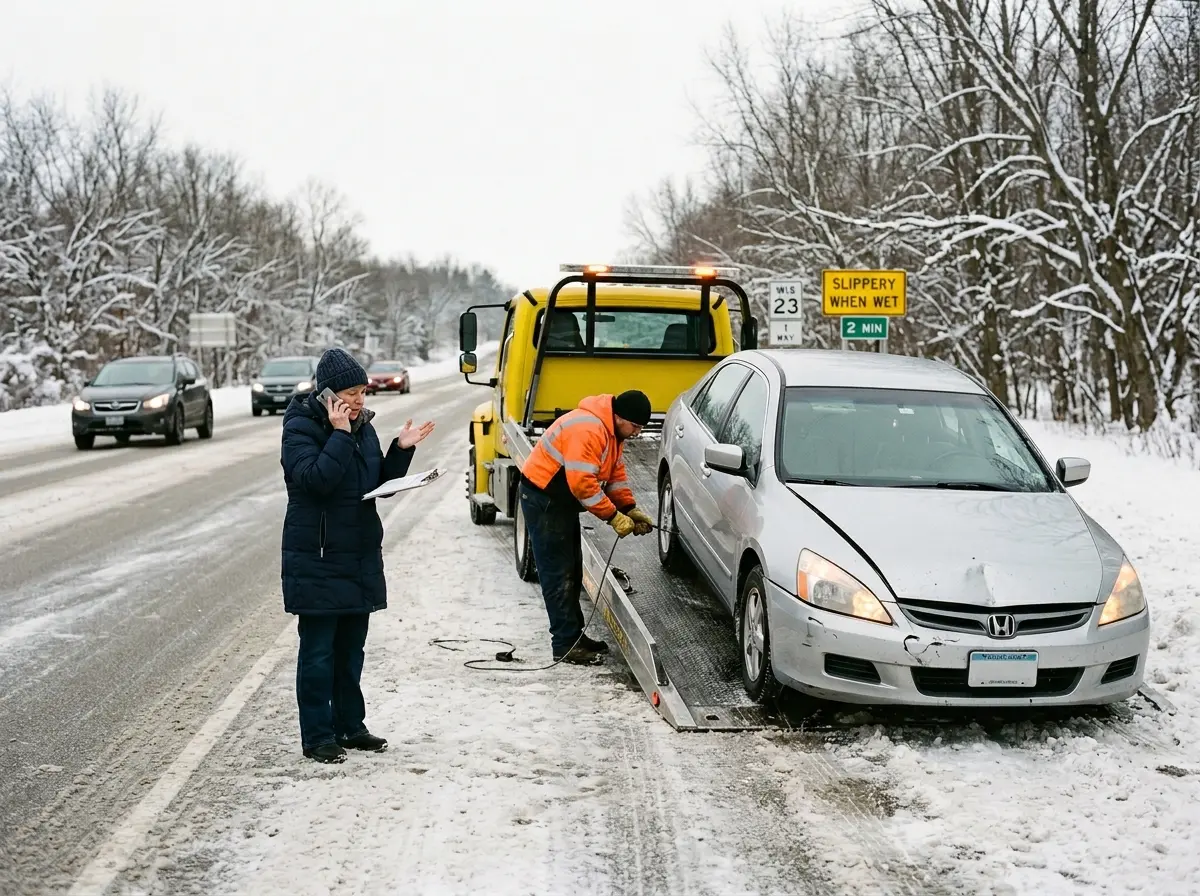
You have just been in a car accident in Wisconsin. Your vehicle is damaged and cannot be driven. A tow truck shows up possibly one you called, possibly one dispatched by police and takes your car somewhere. Then you find out what it costs. And the question that almost every driver asks at this moment is the same: who is actually supposed to pay for this?
The answer in Wisconsin is almost never as simple as ‘the other driver pays’ or ‘your insurance covers it.’ Post-accident towing costs sit at the intersection of fault determination, insurance policy types, Wisconsin statutes governing towing and impound, and your own rights as a vehicle owner, rights that many Wisconsin drivers do not know they have until after they have already paid more than they should have.
This guide walks through every dimension of post-accident towing payment responsibility in Wisconsin: how fault affects who pays, what each insurance coverage type does and does not cover, how Wisconsin towing laws protect you from excessive charges, your legal rights when police order a tow, how to file a towing reimbursement claim, and what to do if you are disputing charges you believe are unfair.
It covers the Milwaukee-specific context where applicable, because Milwaukee’s accident towing environment has specific characteristics that Wisconsin drivers need to understand.
Need Accident Towing in Milwaukee? MG Towing & Recovery – Professional Collision Towing & Vehicle Recovery, Milwaukee. Call Now: 414-973-1902
How Fault Determines Who Is Responsible for Towing Costs?
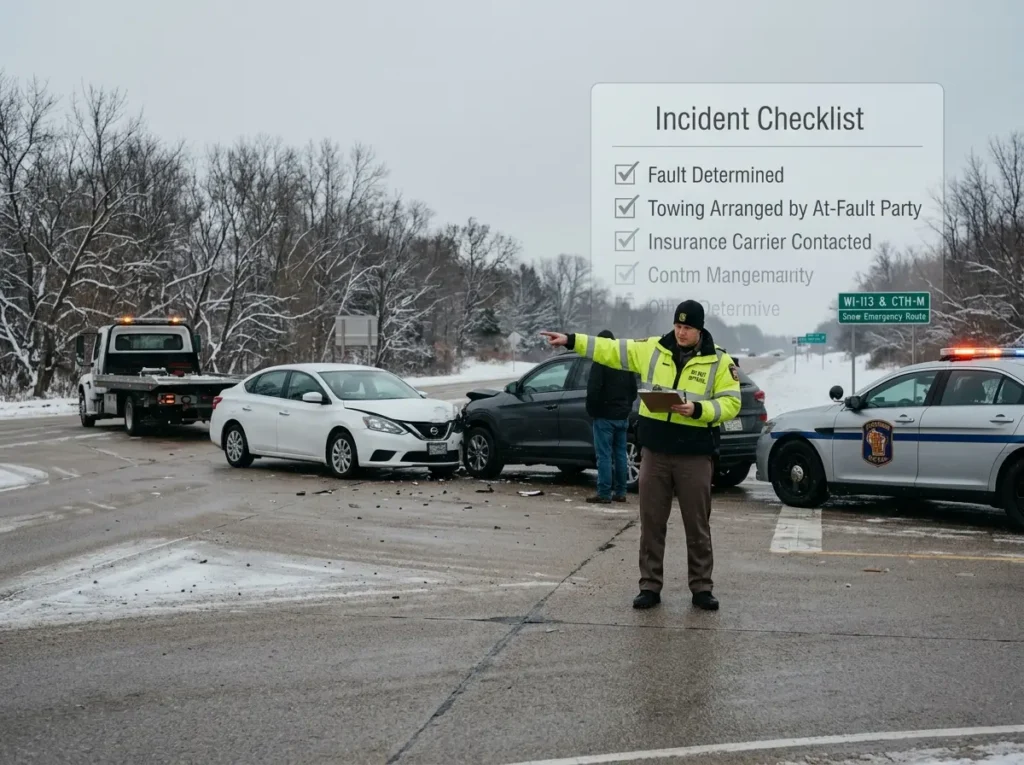
Wisconsin is a fault-based state for auto insurance purposes, meaning the driver who caused the accident bears financial responsibility for damages to others.
In theory, this means that if another driver caused your accident, their liability insurance should cover your towing costs as part of the property damage claim against them. In practice, the path from ‘the other driver was at fault’ to ‘the other driver’s insurance has paid your towing bill’ involves several steps that do not happen automatically.
When the Other Driver Is at Fault?
If another driver’s negligence caused the accident, they ran a red light, rear-ended you, were driving under the influence, you have the right to seek reimbursement for all property damage from their liability insurance carrier, and towing fees are considered part of that property damage.
This includes the initial tow from the accident scene, reasonable storage fees incurred while the claim is being processed, and transport costs to a repair facility.
The practical challenge is timing. Tow trucks arrive and towing fees begin accruing from the moment the vehicle reaches the storage facility. The other driver’s insurer does not pay these costs in real time, they pay them after a claim is filed, liability is confirmed, and the claim is processed.
That process takes days to weeks. During that time, storage fees accumulate daily, often at $35 to $75 per day in Milwaukee facilities. You may need to pay the towing and storage costs upfront and then seek reimbursement from the at-fault driver’s insurer or use your own collision coverage to manage costs while the third-party claim is resolved.
When You Are at Fault?
When you caused the accident or when fault is unclear your own insurance coverage becomes the primary mechanism for towing cost coverage. The specific coverage that applies depends on what your policy includes, which is addressed in detail in the next section.
Wisconsin law requires all drivers to carry minimum liability insurance, but liability coverage protects other people from your negligence, it does not cover your own vehicle’s towing or repair costs.
When Fault Is Disputed?
Wisconsin uses a modified comparative negligence standard, which means that if both drivers share responsibility for a crash, each bears a proportional share of the other’s damages. A driver who is 30 percent at fault can recover 70 percent of their damages from the other driver.
However, determining fault percentages takes time, often weeks or months if insurance companies dispute the finding. During that time, towing and storage costs continue to accumulate, and the practical answer to ‘who pays right now’ is almost always ‘you do, until the claim is resolved.
| The Practical Reality of Post-Accident Towing Payment: Regardless of who is ultimately at fault, towing and storage fees in Wisconsin are almost always paid initially by the vehicle owner, either directly out of pocket or through their own insurance coverage and then recovered through an at-fault claim or reimbursement process afterward. Understanding this timeline is critical for making smart decisions at the accident scene and in the hours immediately following. |
Which Insurance Coverage Pays for Towing After a Wisconsin Accident?
The answer to ‘does car insurance cover towing after an accident’ depends entirely on what coverage types your specific policy includes. Wisconsin requires minimum liability coverage but does not require collision coverage, comprehensive coverage, or roadside assistance which means many Wisconsin drivers discover coverage gaps for the first time at an accident scene. Here is a complete breakdown of each coverage type and its relationship to post-accident towing.
Liability Coverage – What It Covers and What It Does Not
Wisconsin requires all drivers to carry minimum liability insurance: $25,000 per person for bodily injury, $50,000 per accident for bodily injury, and $10,000 for property damage.
Your liability coverage pays for damage you cause to other people and their property including their towing costs if you are at fault. It does not pay for any damage to your own vehicle or your own towing costs.
If you are involved in an accident and the other driver is at fault, their liability coverage, specifically the property damage portion, is what should ultimately reimburse your towing and storage costs. But again, this reimbursement happens through the claims process, not at the moment of the tow.
Collision Coverage – Your Primary Post-Accident Towing Protection
Collision coverage pays for damage to your vehicle caused by a collision with another vehicle or object, regardless of fault. If your policy includes collision coverage, your insurer will typically cover towing from the accident scene to a repair facility as part of the overall collision claim, treating it as part of the cost of repairing or replacing the vehicle.
Important details to understand about collision coverage and towing: most policies have a deductible that applies to collision claims, meaning you pay the first $500, $1,000, or whatever your deductible amount is before coverage kicks in.
Towing costs are usually included within the claim rather than assessed separately against the deductible. And if the other driver is found at fault, your insurer can pursue subrogation, recovering what they paid from the at-fault driver’s insurer, which may result in your deductible being refunded.
Comprehensive Coverage
Comprehensive coverage pays for non-collision damage to your vehicle theft, vandalism, natural disasters, falling objects, fire. If your vehicle was damaged in a non-collision event (a tree fell on it during a storm, it was stolen and recovered damaged), comprehensive coverage typically includes associated towing costs. It does not cover towing from a collision accident, that falls under collision coverage.
Roadside Assistance Coverage – The Most Direct Towing Benefit
A roadside assistance endorsement added to your auto policy is the most direct and often least expensive coverage for towing costs. Roadside assistance coverage typically covers towing up to a specified mileage or dollar limit per incident, along with jump starts, flat tire changes, fuel delivery, and lockout service.
Crucially, roadside assistance coverage often applies regardless of fault and regardless of whether an accident was involved, it covers any towing need.
The limitation is that roadside assistance endorsements usually have per-incident limits that may not cover long-distance towing or the full cost of towing from a complex accident scene. Verify your specific policy’s towing limits, common limits range from $50 to $100 per incident for basic endorsements, up to $300 or more for premium roadside plans.
Uninsured/Underinsured Motorist Coverage
If you are hit by an uninsured driver, a real risk in Milwaukee, where uninsured motorist rates are higher than the state average, your own collision coverage or uninsured motorist property damage coverage becomes your mechanism for recovering towing and repair costs.
Wisconsin allows uninsured motorist coverage for property damage but does not mandate it. Drivers who carry only minimum required coverage and are hit by an uninsured driver face out-of-pocket exposure for all vehicle costs including towing.
| Coverage Type | Required in WI? | Covers Your Towing? | Covers Other Driver’s Towing? |
| Liability (property damage) | Yes | No | Yes – if you are at fault |
| Collision | No | Yes – per claim | No |
| Comprehensive | No | Yes – non-collision events | No |
| Roadside assistance add-on | No | Yes – up to plan limit | No |
| Uninsured motorist property | No | Yes – if hit by uninsured driver | No |
| Liability only (minimum WI) | Yes | No | Yes – if you are at fault |
Related Article: How to File an Insurance Claim for Towing Services?
Wisconsin Towing Laws: Your Legal Rights After a Post-Accident Tow
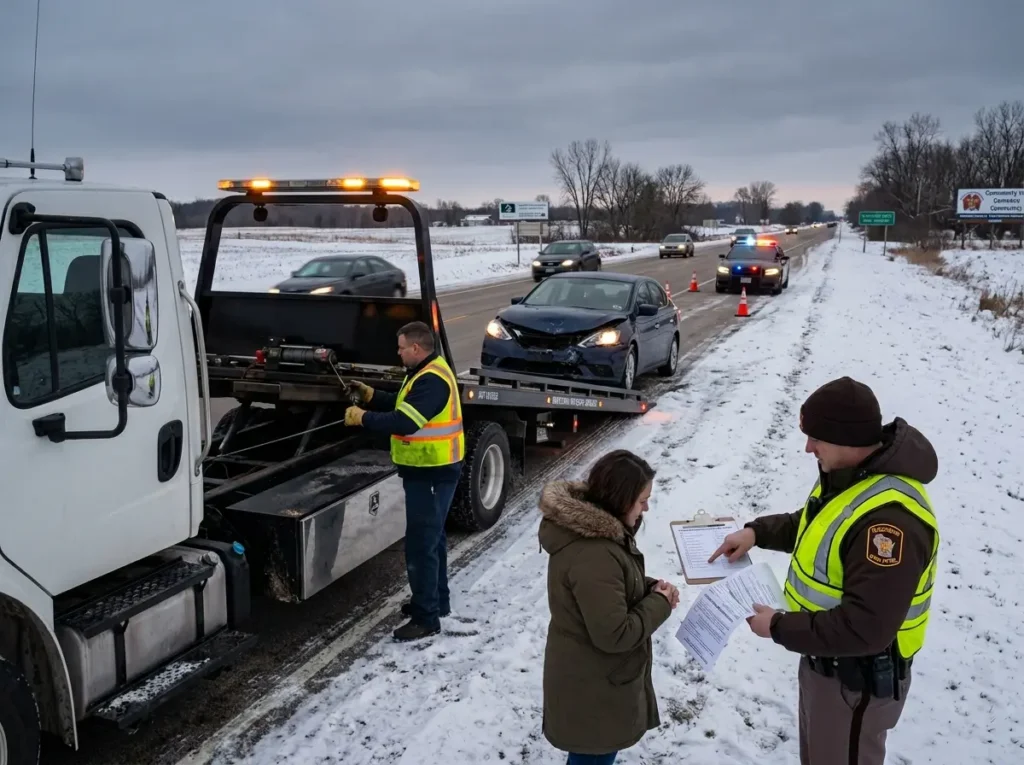
Wisconsin law provides vehicle owners with specific legal protections around towing and impoundment protections that apply directly after accident towing situations. Many Wisconsin drivers are unaware of these rights and end up paying more than the law allows, or waiting longer to retrieve their vehicle than they are legally required to. Understanding Wisconsin’s towing regulations is not just academic it has direct financial implications after any accident.
Your Right to Choose Your Own Towing Company
In Wisconsin, you generally have the right to choose your own towing company after an accident, even if police are on the scene. If law enforcement orders a tow due to traffic blockage, hazards, or an arrest, they may call a company from an approved rotation list. Still, you can usually request your preferred towing service if it can arrive in a reasonable time.
The key is to speak up immediately at the scene. Don’t assume the first tow truck is your choice—confirm who was called and request your preferred company if needed.
Police-Ordered Towing in Wisconsin
When police order a vehicle towed from an accident scene, Wisconsin Statute 349.13 governs police authority to order towing of vehicles from public roadways, the tow is authorized regardless of whether the owner consents. However, this statutory authority does not override your right to choose the towing company or your right to challenge excessive fees after the fact.
A key protection under Wisconsin law: when a vehicle is towed under police authority, the towing company is required to notify the registered owner within a specified timeframe, and the vehicle must be stored at a location accessible for retrieval during reasonable business hours.
Towing companies operating under police-ordered tow authority in Wisconsin must be licensed and their rates are subject to oversight.
Vehicle Storage and Impound Laws in Wisconsin
Once a vehicle is towed to a storage facility after an accident, Wisconsin law, particularly Wisconsin Statute 779.415 provides protections around storage conditions and fee limits. Key provisions include:
- The storage facility must maintain the vehicle in a secure location and is responsible for damage that occurs to the vehicle while in their custody.
- The vehicle owner has the right to retrieve personal property from inside the vehicle without being required to pay storage fees first, in most circumstances.
- Storage fees must be reasonable and the facility must provide an itemized accounting of all charges upon request.
- Wisconsin law prohibits certain predatory towing practices, including towing a vehicle without authorization and padding charges with fabricated fees.
Towing Fee Regulations in Milwaukee
Milwaukee has specific municipal regulations governing towing fees charged within city limits. The City of Milwaukee periodically reviews and updates its schedule of maximum allowable towing and storage fees for tow companies operating under city authority.
Tow companies that operate under police dispatch or city contracts in Milwaukee are bound by these fee schedules. If you receive a towing or storage bill that appears to exceed Milwaukee’s regulated fee schedule, you have grounds to challenge the charges.
To verify current Milwaukee towing fee schedules and file a complaint about excessive towing charges, contact the Milwaukee Department of Neighborhood Services or the Wisconsin Department of Agriculture, Trade and Consumer Protection, which has jurisdiction over predatory towing complaints statewide.
| Excessive Towing Fees, Know Your Rights: If a towing company presents you with charges that seem unreasonably high after a Milwaukee accident, do not simply pay without documentation. Request an itemized invoice in writing. Compare the charges to Milwaukee’s published fee schedule. If the charges exceed regulated maximums or include fabricated fees, you have the right to file a complaint with the Wisconsin Department of Agriculture, Trade and Consumer Protection (DATCP) and to dispute the charges. Paying a disputed bill in full without documentation can complicate later recovery efforts. |
How to File a Towing Reimbursement Insurance Claim in Wisconsin?
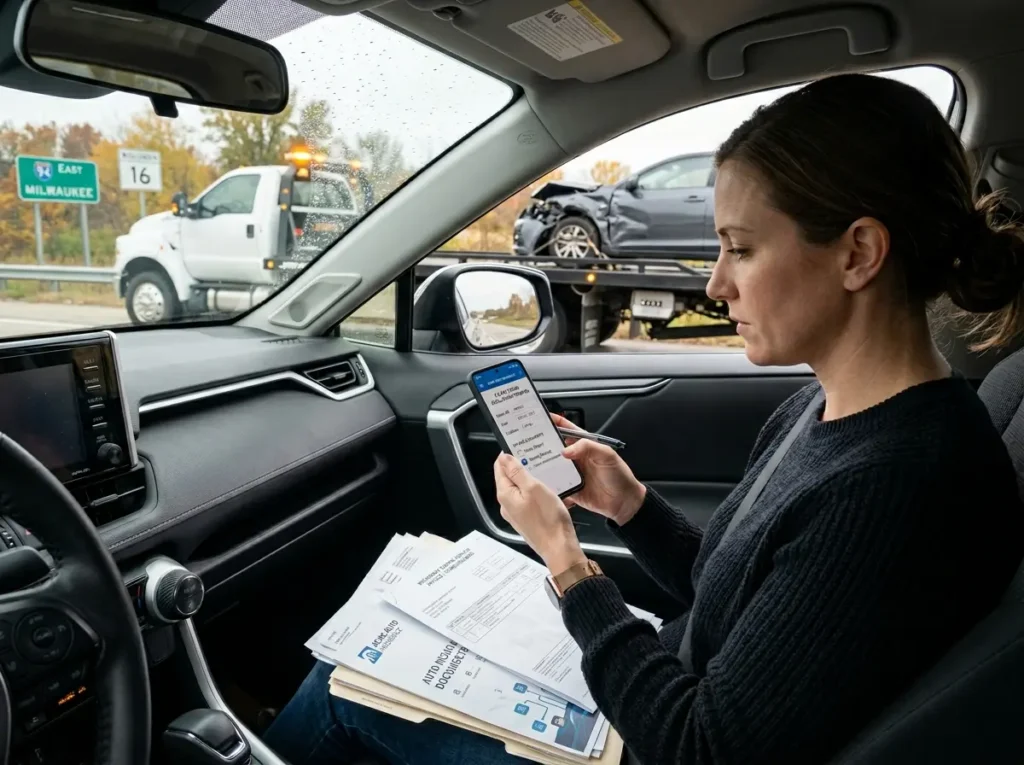
Whether you are seeking reimbursement from the at-fault driver’s insurance or filing through your own coverage, the claims process for post-accident towing follows a specific sequence. Following it correctly and documenting everything from the start maximizes your recovery and minimizes delays.
Step 1: Document Everything at the Accident Scene
Your reimbursement claim starts at the accident scene. Before your vehicle is towed, document its condition and position with photographs from multiple angles. Note the tow company name, their phone number, and the destination they state for your vehicle. Get the tow driver’s name and the tow truck license plate number.
Obtain a copy of the tow authorization form if one is presented to you. This documentation establishes the baseline condition of your vehicle before the tow and creates a clear record of who towed it and where.
Step 2: Get the Towing Invoice in Writing
Request a written itemized invoice from the towing company before paying anything. The invoice should specify the base tow fee, any additional charges (fuel surcharge, after-hours surcharge, mileage beyond a base distance), the storage location and rate per day, and the total amount owed.
If the tow has already occurred and you are retrieving the vehicle from storage, request the itemized invoice at pickup. Keep a copy for your insurance claim.
Step 3: Notify Your Insurance Company Promptly
Notify your insurance company of the accident as soon as possible, most policies require prompt notification and some have specific timeframes. When you report the accident, specifically mention the towing costs and provide the towing company’s information and invoice. Your insurer will tell you which coverage applies based on your specific policy and the facts of the accident.
Step 4: File the Third-Party Claim If the Other Driver Was at Fault
If the other driver was at fault, also file a property damage claim directly with their insurance company. Provide the towing invoice as part of your documented property damage. The other driver’s insurer will review the claim, investigate liability, and if they accept fault, should reimburse towing and storage costs as part of the overall property damage settlement.
Be aware that third-party liability claims can take weeks or months to resolve, particularly when fault is disputed. If you need your vehicle quickly, using your own collision coverage to manage the immediate costs while the third-party claim is pending is often the practical approach.
Step 5: Minimize Ongoing Storage Fees
Storage fees are often the most controllable post-accident cost and they are frequently overlooked. From the moment your vehicle arrives at a storage facility, fees begin accruing daily. The sooner you arrange for the vehicle to be released to your insurer, moved to a repair facility, or declared a total loss, the less storage cost you accrue.
Contact your insurance adjuster immediately and push for a prompt inspection, insurers who do not inspect quickly may still owe the storage fees that accrue during their delay, but you may need to document and dispute that allocation.
| Pro Tip: Storage Fees Add Up Fast: At $50 per day, a typical Milwaukee storage facility rate, a vehicle sitting for 14 days while an insurance claim is processed accumulates $700 in storage fees alone, on top of the initial towing charge. If your collision deductible is $500, the storage fees can exceed your deductible within two weeks. Proactive communication with your adjuster to arrange a prompt inspection and release authorization is one of the highest-value actions you can take in the days after an accident. |
Common Scenarios: Who Pays in Each Situation
Real-world post-accident towing payment questions almost always fit into one of several recognizable scenarios. Here is how Wisconsin law and insurance coverage apply to the most common situations Milwaukee drivers encounter.
Scenario 1: You Are Rear-Ended by an At-Fault Driver Who Has Insurance
This is the most straightforward scenario. The at-fault driver’s liability insurance property damage coverage should reimburse your towing costs as part of the overall property damage claim. You will likely need to pay the towing company at pickup and seek reimbursement through the claim. Keep all invoices. The process typically takes two to four weeks for a clear-liability rear-end claim.
Scenario 2: You Are Hit by an Uninsured Driver
If you have uninsured motorist property damage coverage, that coverage applies to your towing and vehicle repair costs. If you do not have this coverage and carry only minimum liability, you may have no insurance mechanism for recovering costs, your only recourse is a civil judgment against the uninsured driver, which is collectible in theory but often difficult in practice.
This scenario illustrates exactly why uninsured motorist coverage is worth carrying in Milwaukee, where uninsured driver rates are higher than the Wisconsin state average.
Scenario 3: You Are at Fault – The Accident Is Your Fault
Your collision coverage (if you carry it) covers your towing costs minus your deductible. Your liability coverage covers the other driver’s towing costs. If you do not carry collision coverage, you pay your own towing costs out of pocket. This is the most financially exposed position for Wisconsin drivers with minimum coverage only.
Scenario 4: Fault Is Disputed – Both Insurance Companies Are Investigating
This is the most frustrating scenario for towing cost management. While fault is being determined, your most practical option is using your own collision coverage to manage the immediate towing and storage costs, then allowing subrogation, your insurer pursuing the at-fault driver’s insurer for reimbursement to recover those costs once fault is established. Without collision coverage, you may be waiting weeks for cost recovery while storage fees accumulate.
Scenario 5: Police Order the Tow Without Your Consent
When police order a tow after an accident in Milwaukee, the cost is still your responsibility, either through insurance or out of pocket. You still have the right to choose your own towing company, but you need to say it clearly before a police-dispatched truck hooks up your vehicle.
Once it’s already on the truck, changing it becomes much harder. That’s why it helps to save your preferred towing company’s number and tell officers your choice right away.
Scenario 6: Your Vehicle Is a Total Loss
If your vehicle is declared a total loss, meaning repairs cost more than the car is worth, towing and storage fees are usually included in your insurance settlement. The insurer pays the vehicle’s actual cash value and accounts for those extra costs. However, this can vary depending on your policy, so it’s best to confirm with your adjuster how towing charges are handled.
Post-Accident Towing Costs in Milwaukee: What to Expect
Understanding realistic post-accident towing costs in Milwaukee helps you evaluate invoices, catch excessive charges, and understand the total financial exposure of a towed vehicle in the Milwaukee area.
| Post-Accident Towing Cost Item | Typical Milwaukee Range | Notes |
| Accident scene tow (local, under 10 miles) | $100 – $250 | Base hook-up plus mileage |
| Flatbed tow (AWD, luxury, or damaged vehicle) | $120 – $350 | Required for AWD and significantly damaged vehicles |
| After-hours accident tow surcharge | $25 – $75 | Nights, weekends, holidays |
| Winching from ditch or off-road position | $75 – $300+ | If vehicle is not accessible from road surface |
| Daily storage fee (impound or tow yard) | $35 – $75 per day | Begins accruing upon arrival – act fast |
| Gate/release fee (to retrieve from storage) | $25 – $75 | One-time fee at pickup |
| Vehicle inspection before release | $0 – $50 | Some facilities charge an inspection fee |
| Transport to repair facility (separate tow) | $75 – $200+ | If vehicle moved from initial storage to shop |
| Total Cost Example: A Milwaukee driver involved in a nighttime accident whose AWD vehicle must be towed on a flatbed (with after-hours surcharge) and stored for 10 days while the insurance claim is processed faces: $250 flatbed tow + $50 after-hours surcharge + $50/day x 10 days storage + $50 gate fee = $850 total before any repair costs. Understanding this exposure explains why prompt insurance notification and adjuster engagement is financially significant. |
Choosing the Right Towing Provider After a Milwaukee Accident
Not all tow companies that respond to Milwaukee accident scenes are equal. The choice of towing company after an accident affects the safety of your vehicle during the tow, the storage conditions and fees during the claim process, and critically your ability to get the vehicle released promptly and without a battle over inflated fees.
What to Look for in a Post-Accident Towing Company
- Make sure the company is licensed and bonded in Wisconsin. This ensures they operate legally and have insurance to cover any damage during the tow.
- Check if they have the right equipment for your vehicle. Flatbeds are best for AWD, damaged, or luxury vehicles, and proper securing tools are important for every tow.
- Look for clear and upfront pricing. A reliable company will explain the base fee and any extra charges before they hook up your vehicle.
- Ask about their storage facility. Good companies document vehicle condition with photos to avoid any disputes later.
- Choose a company that offers 24/7 service. Accidents can happen anytime, so round-the-clock availability is essential.
- Going with a local Milwaukee company is a smart choice. They understand local regulations, storage options, and how to work with insurance adjusters.
Why MG Towing & Recovery for Milwaukee Accident Towing?
MG Towing & Recovery provides professional accident towing services across Milwaukee and the surrounding area, 24 hours a day, every day.
Our operators are trained in post-accident vehicle handling, including pre-tow documentation, correct towing method selection for all vehicle types, and coordination with law enforcement when required at the scene.
- We provide written, itemized invoices for all accident towing services so you always know exactly what you’re paying for.
- We use flatbed towing as our standard approach for damaged vehicles, AWD models, luxury cars, and specialty vehicles to ensure maximum safety.
- Before towing, our operators carefully document the condition of your vehicle, helping protect you from any potential damage disputes later.
- We also work directly with major insurance carriers, making the claims process smoother and less stressful for you.
- Local Milwaukee dispatch means faster response than nationally routed services, critical when your vehicle is in a live traffic lane or unsafe position.
FAQs: Towing After a Wisconsin Accident
Does the at-fault driver’s insurance pay for towing immediately?
Not right away. The at-fault driver’s insurance usually covers towing and damage, but the claims process can take days or even weeks. In most cases, you’ll need to pay the towing company upfront or have your own insurer handle it first. Once liability is confirmed, you can get reimbursed by the at-fault driver’s insurance. Be sure to keep all your invoices and receipts from the start.
Can I refuse a tow truck at an accident scene in Wisconsin?
If your vehicle is still drivable, you can choose not to have it towed and simply drive it away. If police order a tow due to safety reasons or an arrest, you must comply, but you still have the right to request your preferred towing company. Make that request right away, because once the vehicle is loaded, changing the tow becomes much harder.
What if I can’t afford to pay the towing fees upfront?
If you can’t pay towing and storage fees upfront, contact your insurance company right away. Many insurers can pay the towing and storage company directly, so you don’t have to pay out of pocket. If the accident was caused by another driver, their insurance may also cover the costs, but it can take longer to process. Some towing companies can work directly with insurance and keep your vehicle until the claim is settled, so it’s worth asking if that option is available.
Are there limits on what a tow company in Milwaukee can charge after an accident?
Yes. Tow companies operating under city authority in Milwaukee are subject to the city’s regulated fee schedule for towing and storage rates. Tow companies operating on private contracts without city authority are less directly regulated but are still subject to Wisconsin consumer protection laws prohibiting deceptive and unfair business practices.
If you believe you have been charged excessive or fraudulent towing fees in Milwaukee, file a complaint with the Wisconsin Department of Agriculture, Trade and Consumer Protection (DATCP) at datcp.wi.gov.
How long can a tow yard hold my vehicle in Wisconsin?
Wisconsin law requires towing and storage facilities to notify the registered owner of a towed vehicle promptly and to maintain the vehicle in accessible storage. There is no fixed statutory maximum storage period before a facility can begin lien proceedings for unpaid fees, but the process for establishing a lien and disposing of a vehicle requires specific legal steps including proper notification to the registered owner.
If you are unable to retrieve your vehicle or arrange insurance-covered storage, contact the facility and your insurer immediately to avoid lien complications.
Know Your Coverage, Know Your Rights, Know Who to Call
Post-accident towing in Wisconsin usually works in a simple sequence. First, the towing cost is often paid upfront by the vehicle owner or later covered by insurance. After that, it may be reimbursed through the at-fault driver’s liability coverage, your own insurance, or collision and roadside coverage depending on the situation. Understanding this ahead of time helps you avoid unexpected financial stress after an accident.
In Wisconsin, you also have important rights like choosing your tow company, requesting itemized invoices, and questioning unfair fees. These protections help prevent unnecessary charges during a stressful time. MG Towing & Recovery provides 24 hour accident towing in Milwaukee, works with all major insurance companies, and offers clear itemized billing. In an accident, call 911 if needed first, then contact MG Towing & Recovery so your vehicle is handled safely and the insurance process starts correctly.