

What Wisconsin Law Says About Towing, Your Rights as a Vehicle Owner, Police-Ordered Tows, Impound, Towing Company Requirements & Milwaukee Local Rules
| Legal Disclaimer: This guide is for general educational purposes only and does not constitute legal advice. Wisconsin towing statutes are subject to legislative amendment and local ordinance variation. Always consult a licensed Wisconsin attorney for legal guidance specific to your situation. Statute references are accurate as of the date of publication, verify current text at docs.legis.wisconsin.gov. |
Most Wisconsin drivers think about towing only at the worst possible moment, when their car is being hooked up to a truck they did not call, or when they arrive at an empty parking space where their vehicle used to be, or when a towing bill arrives that is significantly higher than they expected. At that moment, not knowing Wisconsin’s towing laws puts you at a serious disadvantage.
Wisconsin has a specific, layered framework of towing regulations that governs what towing companies can and cannot do, what rights vehicle owners have when their car is towed, what authority police have to order a tow, what impound facilities must provide, and what remedies exist when towing rules are violated. These laws exist specifically to protect drivers and vehicle owners but only for people who know they exist.
This guide translates Wisconsin’s towing legal framework into plain language for drivers and vehicle owners. It covers the key statutes, the rules for police-ordered towing, the requirements that licensed towing companies must meet, your rights when your vehicle is towed or impounded, how to recover a towed vehicle, the specific Milwaukee local towing rules that apply within the city, and what to do when towing rules are violated.
Whether you are preparing for an emergency or responding to one that has already happened, this guide gives you the foundational legal knowledge every Wisconsin driver should have.
Related Article: How to File an Insurance Claim for Towing Services?
The Legal Framework: Key Wisconsin Statutes Governing Towing
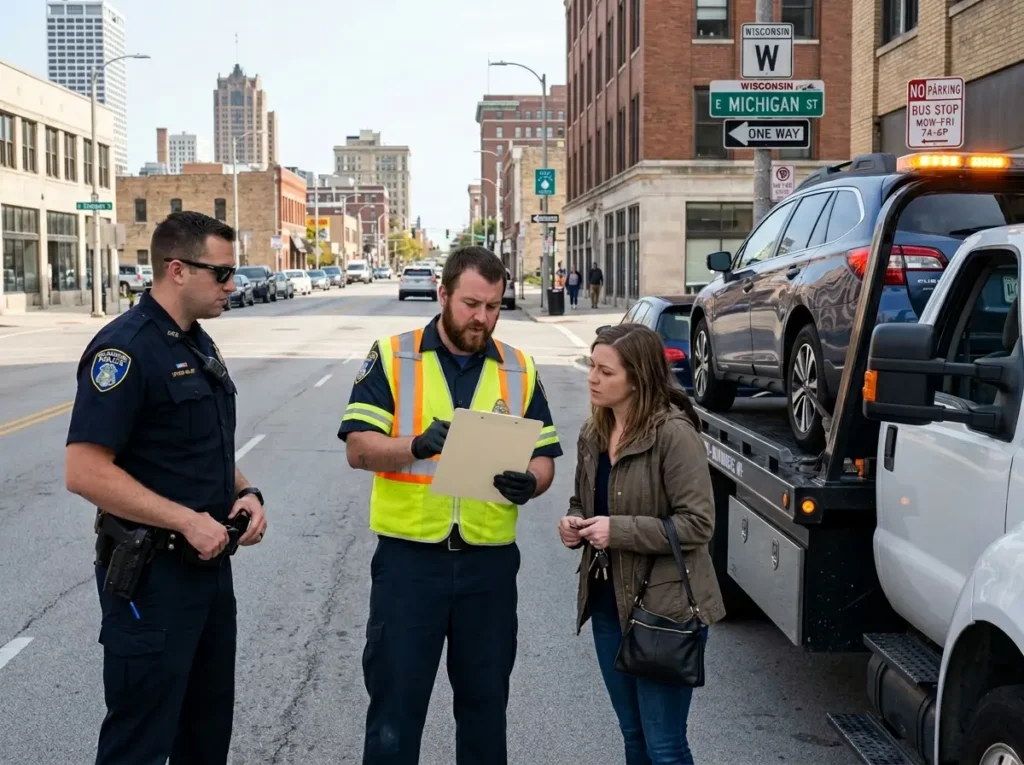
Wisconsin’s towing regulations are spread across several statutes rather than contained in a single towing law. Understanding which statute governs which aspect of towing helps you identify your legal basis when a specific situation arises.
Wisconsin Statute 349.13 – Police Authority to Order Towing
Wisconsin Statute 349.13 is the foundational authority for law enforcement to order the removal of vehicles from public roads and rights-of-way. Under this statute, law enforcement officers including Wisconsin State Patrol, city and county police, and sheriff’s deputies are authorized to remove or have removed any vehicle that is:
- Abandoned on a highway or public right-of-way
- Disabled in a manner that creates a traffic hazard
- Parked in violation of state or local traffic regulations in a way that impedes traffic or creates a safety hazard
- Left unattended at the scene of an accident when the driver is unable to make arrangements for removal
- Involved in a serious traffic violation or arrest where the driver is being taken into custody
Section 349.13 establishes that the cost of towing ordered under this authority is the responsibility of the vehicle owner, not the municipality ordering the tow. This is a critical provision: when police order your vehicle towed, you will pay for it regardless of whether you agreed to the tow or believe the order was justified. Your recourse is through the legal and administrative dispute processes described later in this guide, not through refusing payment at the tow yard.
Wisconsin Statute 342.40 – Abandoned Vehicle Procedures
Wisconsin Statute 342.40 governs the handling of abandoned vehicles, vehicles left unattended on public or private property for an extended period. Under this statute:
- A vehicle left on public property for more than 48 hours without authorization may be reported as abandoned and subject to towing.
- A vehicle left on private property without the property owner’s consent may be towed at the property owner’s request without a mandatory waiting period, provided the required authorization and notification procedures are followed.
- Once a vehicle is classified as abandoned, the towing company and storage facility must make reasonable efforts to identify and notify the registered owner within specified timeframes.
- If a vehicle is not reclaimed within the statutory period and applicable fees are not paid, the vehicle may become subject to a lien sale under Chapter 779.
For Milwaukee drivers, the 48-hour rule on public property is particularly relevant during street sweeping, snow emergency, and permit parking enforcement periods, vehicles that appear parked normally may be subject to towing as abandoned if they overstay posted time restrictions.
Wisconsin Statute 779.415 – Towing and Storage Liens
Wisconsin Statute 779.415 governs the lien rights of towing operators and storage facilities, the legal mechanism by which a towing or storage company can ultimately claim ownership of a vehicle if fees go unpaid. Key provisions affecting vehicle owners include:
- A towing operator or storage facility that has lawfully towed and stored a vehicle acquires a possessory lien on the vehicle for the reasonable costs of towing and storage.
- The lien holder must follow specific notification procedures to the registered owner and lienholder before proceeding to a lien sale.
- The vehicle owner has the right to redeem the vehicle by paying the outstanding fees at any time before the lien sale is completed.
- Storage fees must be reasonable, the statute does not set a fixed cap but provides grounds for challenging fees that exceed market rates.
- A lien sale conducted without proper notification to the registered owner is legally defective and may be challenged.
The practical implication of Chapter 779.415 for Milwaukee drivers: if your vehicle is towed and stored and you do not act promptly, you risk losing the vehicle entirely through a lien sale process. The longer you wait, the more fees accrue and the less time you have to reclaim the vehicle. Act immediately.
Wisconsin Statute 194.01 et seq. – Towing Company Licensing Requirements
Wisconsin regulates towing companies as motor carriers under Chapter 194 of the Wisconsin Statutes, overseen by the Wisconsin Department of Transportation. To operate legally as a towing company in Wisconsin, a business must:
- Register with the Wisconsin DOT as a motor carrier
- Maintain minimum liability insurance coverage for vehicles and cargo in their care
- Comply with federal motor carrier safety regulations applicable to their operations
- Meet equipment standards for the classes of vehicles they are licensed to tow
A towing company operating without proper registration and insurance is operating illegally. If your vehicle is damaged by an unlicensed, uninsured towing operator, your recourse is significantly more complicated than it would be with a properly licensed provider.
This is one of the strongest practical reasons to request a towing company by name, using a known licensed local provider like MG Towing & Recovery rather than an unknown operator dispatched without your choice.
| Wisconsin Statute Quick Reference: 349.13 – Police authority to order towing from public roads. 342.40 – Abandoned vehicle procedures and timelines. 779.415 – Towing and storage liens; lien sale process. 194.01 et seq. – Towing company licensing and carrier registration. Chapter 348 – Vehicle size, weight, and equipment requirements for towing. Chapter 346 – General traffic regulations affecting towing operations on public roads. |
Police-Ordered Towing in Wisconsin: What Officers Can Do and What You Can Do
Police-ordered towing is the most common scenario where drivers encounter Wisconsin’s towing laws unexpectedly and feel powerless. Understanding exactly what law enforcement authority covers and where it ends gives you the ability to assert your rights effectively at the scene.
What Police Can Legally Order?
Under Wisconsin Statute 349.13 and related traffic regulations, law enforcement officers have broad authority to order the removal of vehicles from public roadways. In practical terms, this means police can order your vehicle towed without your consent when:
- Your vehicle is blocking a travel lane after a breakdown or accident and you cannot arrange private removal within a reasonable time.
- You are being arrested and there is no licensed driver available to move the vehicle from a no-parking zone.
- Your vehicle is creating an immediate traffic or safety hazard.
- Your vehicle has been identified as abandoned under the statutory definition.
- Your vehicle is parked in a designated no-parking zone during a posted snow emergency, street sweeping, or special event.
- Your vehicle has been involved in a serious accident and must be moved for scene investigation.
Your Right to Choose the Towing Company
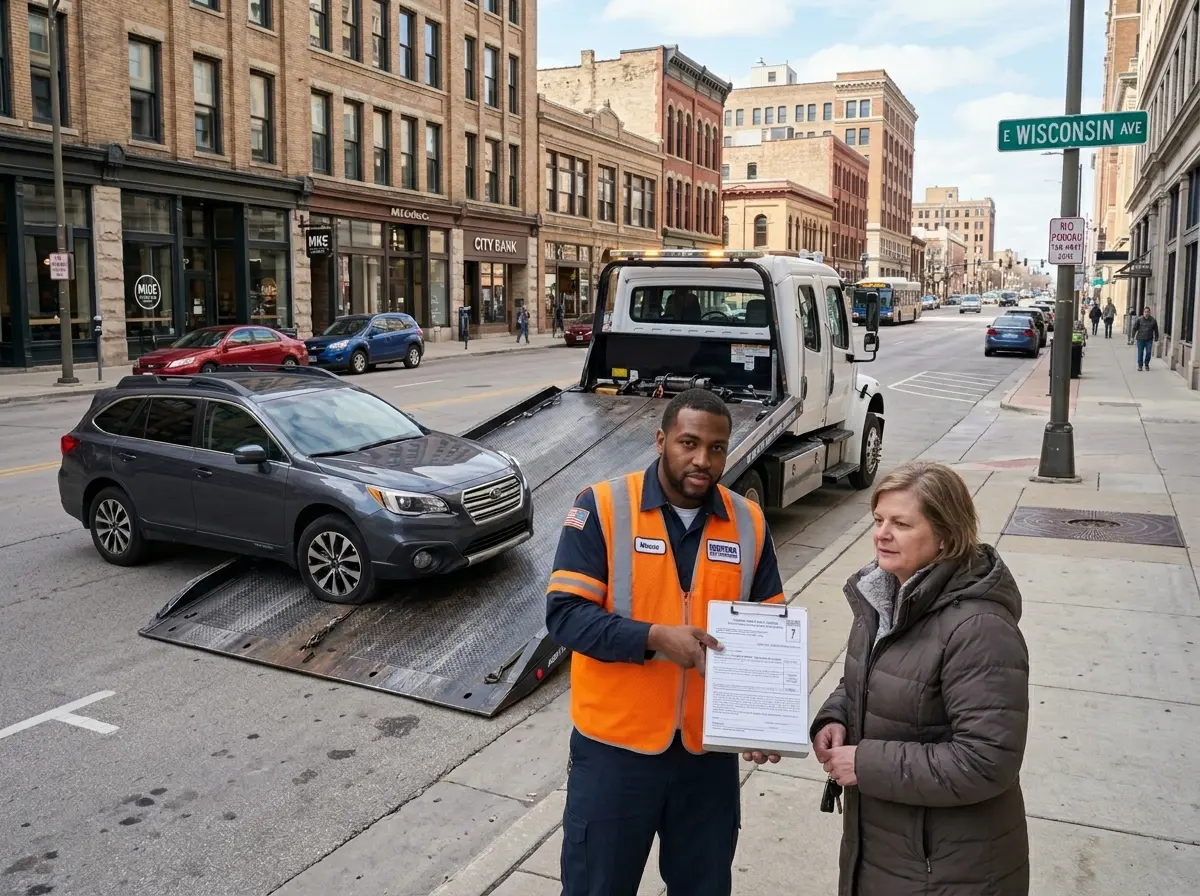
This is the most important and most frequently unknown right Wisconsin vehicle owners have during a police-ordered tow: you have the right to request a specific towing company, and in most circumstances, law enforcement is required to honor that request within a reasonable time.
Wisconsin administrative code and local ordinances in Milwaukee and most Wisconsin municipalities require that police allow a present vehicle owner to designate their preferred towing company. The only condition is that the company can respond within a time period that doesn’t unreasonably prolong the traffic hazard.
If your vehicle is blocking a live highway lane in an active construction zone, ‘reasonable time’ may be 15 minutes. If your vehicle is on a residential street after a non-injury accident, reasonable time may be 30 to 45 minutes.
The practical approach: the moment law enforcement arrives at a scene where your vehicle may be towed, state clearly and immediately: ‘I am requesting that MG Towing & Recovery tow my vehicle. I am calling them now.’ Hand the officer the company name and your phone. This assertion, made promptly and clearly, creates a record of your request and obliges the officer to factor it into their decision.
| Assert Your Towing Preference Immediately: Once a tow truck driver has hooked up your vehicle, even under police order, redirecting the tow to your preferred provider becomes significantly more complicated and may involve additional fees. The time to assert your right to choose is before the hook-up, not after. State your preference clearly to the officer, not just to the tow truck driver who arrives uninvited. |
When Police Use Rotation Lists?
Many Wisconsin municipalities, including Milwaukee maintain rotation lists of pre-approved towing companies that officers can dispatch when a vehicle owner has not made a specific request or when the owner is not present. These rotation list companies have typically undergone a basic vetting process: they are licensed, bonded, and have agreed to the municipality’s fee schedule.
Rotation list tows are not inherently problematic the participating companies are often legitimate, licensed operators. The issue arises when an officer dispatches a rotation company without informing the vehicle owner of their right to request an alternative.
If you are present at the scene and the officer calls a tow without asking your preference, that is the moment to assert your right. Do not wait until after the hook-up.
Snow Emergency Towing in Milwaukee
Milwaukee declares snow emergencies after significant snowfall events, requiring vehicles to be moved from designated snow emergency routes within a specified timeframe typically two hours after the emergency is declared.
Vehicles remaining on snow emergency routes after the deadline are subject to immediate towing under Milwaukee’s snow emergency ordinance, which operates independently of the general police-ordered towing framework.
Milwaukee’s snow emergency routes are posted on permanent signs and available through the City of Milwaukee’s website and the SnowMKE app. Drivers who park on these routes are responsible for monitoring snow emergency declarations ‘I didn’t know there was a snow emergency’ is not a legal defense against towing charges under Milwaukee’s ordinance.
What Wisconsin Towing Companies Are Legally Required to Do?
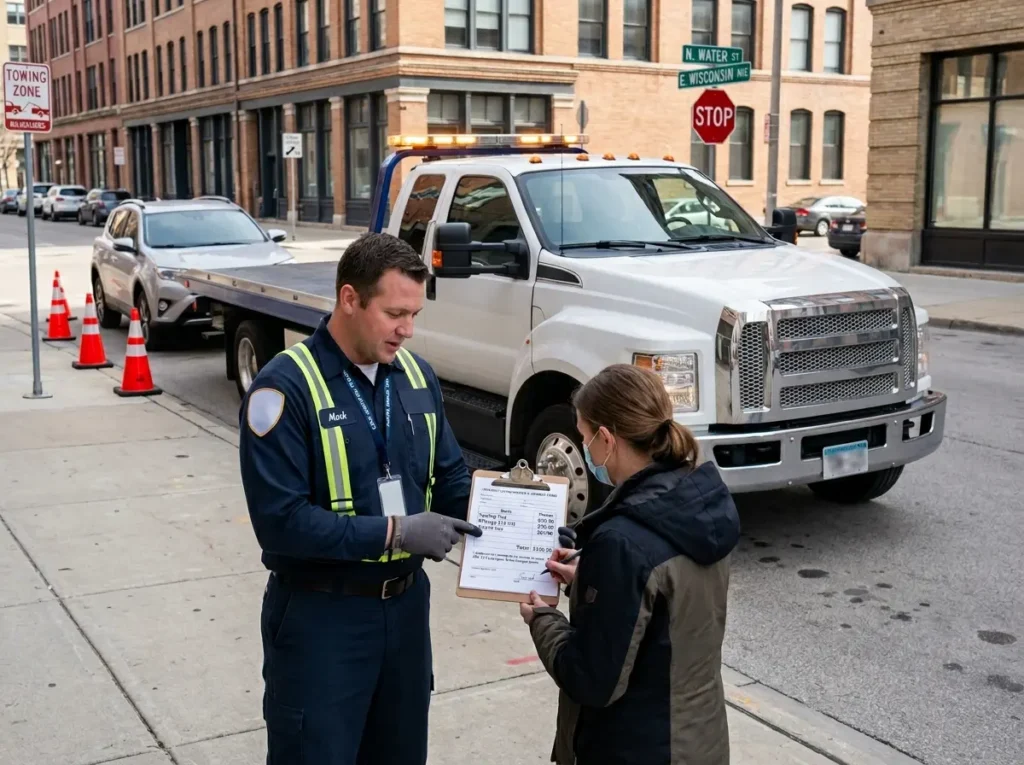
Wisconsin law places specific obligations on towing companies operating within the state. Understanding these obligations tells you what you should expect from any legitimate towing provider and what to document when a company falls short.
Licensing and Insurance Requirements
Every towing company operating in Wisconsin must be registered as a motor carrier with the Wisconsin Department of Transportation and must maintain the minimum liability insurance required for their operating class. For towing companies transporting private passenger vehicles, this includes liability coverage for property in their care, custody, and control, meaning your vehicle while it is on their truck or in their storage facility.
You have the right to ask any towing company for their DOT registration number and proof of insurance before they tow your vehicle. A legitimate company will provide this without hesitation. A company that refuses or evades this request is operating outside legal requirements and should not be used.
Notification Requirements After Towing
When a vehicle is towed without the owner’s presence whether under police authority, as an abandoned vehicle, or from private property, Wisconsin law requires the towing company or storage facility to notify the registered owner within a specified timeframe. For police-ordered tows, this notification is typically required within 24 hours of the tow. The notification must include:
- The location where the vehicle is stored
- The contact information for the storage facility
- The accruing daily storage rate
- Information about how to retrieve the vehicle
If you discover your vehicle is gone and you have not received notification, contact the towing company through the Milwaukee Police Department’s vehicle towing inquiry line – (414) 933-4444 – which maintains records of police-authorized tows within Milwaukee. Wisconsin State Patrol also maintains records of state highway tows.
Fee Transparency and Itemization Requirements
Wisconsin consumer protection law and local ordinances require towing companies to provide itemized billing for all towing and storage services. You are entitled to a written, itemized invoice that separately identifies:
- The base tow fee or hook-up charge
- Any mileage charges and the per-mile rate applied
- Any surcharges (after-hours, holiday, vehicle size, complexity)
- Daily storage rate and the number of days charged
- Gate or release fees
- Any other charges with a specific description of what each covers
A towing company that presents a single lump-sum invoice without itemization is not meeting Wisconsin’s transparency requirements.
Request itemization in writing. If the company refuses, that refusal is itself documented evidence for a complaint to the Wisconsin Department of Agriculture, Trade and Consumer Protection (DATCP).
Storage Facility Requirements
Towing companies and storage facilities in Wisconsin are required to maintain towed vehicles in a secure location and are responsible for damage that occurs to a vehicle while it is in their custody. Key requirements include:
- The facility must be accessible for vehicle retrieval during reasonable business hours.
- The vehicle owner must be permitted to retrieve personal property from inside the vehicle without being required to pay storage fees first, in most circumstances.
- The facility must document the vehicle’s condition upon arrival, this documentation protects both the facility and the vehicle owner from disputes about pre-existing versus custody damage.
- The facility may not charge storage fees for periods before the vehicle’s arrival.
Prohibited Practices Under Wisconsin Law
Several towing practices are specifically prohibited under Wisconsin law and local ordinances:
- Towing a vehicle from private property without written authorization from the property owner or manager.
- Soliciting towing business at accident scenes ‘bandit towing’ or ‘predatory towing’ where drivers arrive at accident scenes without being called is illegal in many Wisconsin jurisdictions.
- Charging fees that exceed the rates filed with or approved by the applicable municipality or authority.
- Refusing to release a vehicle to the registered owner who has paid the lawfully owed fees.
- Failing to provide required notification to the registered owner after a non-consensual tow.
- Conducting a lien sale without following the proper statutory notification procedures.
| How to Verify a Towing Company Is Licensed in Wisconsin: To verify that a Wisconsin towing company is properly registered as a motor carrier, use the Wisconsin DOT Motor Carrier Search at wisconsindot.gov. Enter the company name or DOT number. A legitimate company will have an active registration status. You can also verify whether complaints have been filed against a towing company through the Wisconsin Department of Agriculture, Trade and Consumer Protection at datcp.wi.gov. |
Your Rights as a Vehicle Owner When Your Car Is Towed in Wisconsin
Wisconsin law provides vehicle owners with a specific set of rights that apply once a vehicle has been towed, regardless of whether the tow was consensual, police-ordered, or conducted under private property authority.
Knowing these rights before you arrive at the tow yard is the difference between retrieving your vehicle efficiently and being subject to additional charges or delays.
The Right to Know Where Your Vehicle Is
You have the right to be informed of your vehicle’s location promptly after it has been towed. If you discover your vehicle is missing, contact the Milwaukee Police Department towing inquiry line at (414) 933-4444 for Milwaukee tows, or the local police department for tows in other Wisconsin municipalities.
The Wisconsin State Patrol is here for state highway tows. These agencies maintain records of police-authorized tows and can tell you the storage facility location.
The Right to Retrieve Personal Property
Wisconsin law provides that vehicle owners must be permitted to retrieve personal property, clothing, medications, important documents, child car seats, and similar items from inside a towed vehicle without being required to pay the full towing and storage fees first.
This right exists because the law recognizes that some items inside a vehicle are essential and their withholding as leverage for payment is a form of coercion.
In practice, exercise this right by contacting the storage facility as soon as possible, identifying yourself as the registered owner, and specifically requesting access to retrieve personal property.
Document what you retrieve and when. Some facilities may require proof of ownership or identification before granting access, this is reasonable. A facility that completely refuses any access to personal property without full payment should be reported to DATCP.
The Right to an Itemized Invoice
As described in the towing company requirements section, you have the right to a written, itemized invoice for all charges.
Exercise this right before making any payment. Do not pay a lump-sum invoice without itemization. If the invoice contains charges you do not recognize or believe are excessive, request a written explanation of each charge before paying.
The Right to Pay Under Protest
If you believe the towing or storage charges are excessive or unlawful but you need your vehicle immediately, you can pay the fees under protest. Write ‘paid under protest, charges in dispute’ on the payment documentation and any receipt you receive. This notation preserves your right to seek recovery of the disputed amount through administrative complaint or legal action without the payment being treated as full acceptance of the charges.
The Right to Challenge Excessive Fees
Wisconsin vehicle owners have several mechanisms for challenging towing and storage fees they believe are excessive or unlawful:
- File a complaint with the Wisconsin Department of Agriculture, Trade and Consumer Protection (DATCP). DATCP has jurisdiction over predatory and deceptive towing practices statewide.
- File a complaint with the City of Milwaukee’s Department of Neighborhood Services for tows conducted within Milwaukee city limits by city-authorized tow companies.
- File a complaint with the Wisconsin DOT if the towing company is operating in violation of motor carrier regulations.
- File a small claims court action for recovery of fees paid under protest if the amount is within small claims jurisdiction (currently up to $10,000 in Wisconsin).
- Consult a Wisconsin consumer protection attorney for larger amounts or for situations involving multiple violations.
The Right to Choose Your Own Towing Company
Reiterating this right here because it is exercisable before a tow becomes a rights dispute: you always have the right to choose your own towing company in Wisconsin.
This right applies at breakdown scenes, at accident scenes, and even during police-ordered tows when you are present and the time constraint allows. Exercising this right proactively by having a preferred provider’s number saved and asserting your preference immediately is the most effective way to avoid the towing rights issues described throughout this section.
Milwaukee-Specific Towing Rules and Local Ordinances
In addition to state law, the City of Milwaukee has local ordinances and administrative rules governing towing within city limits. These local rules supplement and in some areas exceed the protections available under state law.
Milwaukee’s Towing Fee Schedule
Towing companies that operate under Milwaukee Police Department authority dispatched through the city’s rotation system are required to adhere to the City of Milwaukee’s published towing and storage fee schedule. This schedule sets maximum allowable rates for police-authorized tows conducted within Milwaukee city limits.
Key aspects of Milwaukee’s fee schedule: it sets maximum hook-up fees, daily storage rates, and gate fees for standard light-duty towing. Flatbed towing, heavy-duty towing, and specialty services may have different rate provisions. The schedule is periodically reviewed and updated by the City of Milwaukee. Drivers who receive charges above the published maximums from a city-rotation tow company have grounds for a complaint and potential fee reduction.
To obtain the current Milwaukee towing fee schedule, contact the Milwaukee Department of Neighborhood Services or access Milwaukee’s online ordinance database through the City of Milwaukee’s official website.
Milwaukee Snow Emergency Towing Ordinance
Milwaukee’s snow emergency towing ordinance is one of the most actively enforced local towing rules in the city. When the mayor declares a snow emergency, vehicles on designated snow routes must be moved within the notice period, typically two to four hours after the emergency is publicly announced. Vehicles not moved within this period are subject to immediate towing with no additional warning.
Key details for Milwaukee drivers: snow emergencies are announced through the city’s official channels including the Milwaukee Journal Sentinel, local television news, the SnowMKE app, and the City of Milwaukee’s social media accounts.
The towing fee for a snow emergency tow is set by Milwaukee’s fee schedule and includes both the tow and storage charges. Vehicles towed under snow emergency authority are stored at designated city impound facilities.
Milwaukee Private Property Towing Ordinance
Towing from private property in Milwaukee parking lots, apartment complexes, business properties is governed by both Wisconsin Statute 342.40 and Milwaukee’s local private property towing ordinance. Key provisions:
- The property owner or manager must provide written authorization for each tow or maintain a standing authorization agreement with the towing company.
- Signage at the entrance to tow-authorized private property must meet minimum size and visibility requirements under Milwaukee ordinance.
- The towing company conducting a private property tow in Milwaukee must notify the Milwaukee Police Department within one hour of the tow.
- The vehicle owner must be notified of the tow and the storage location within 24 hours.
- A vehicle owner who believes their vehicle was towed from private property without proper authorization may file a complaint with the Milwaukee Department of Neighborhood Services
Reporting Towing Violations in Milwaukee
Milwaukee drivers who experience or witness towing law violations unlicensed operators, charges above the fee schedule, failure to provide notification, refusal to release personal property, or any other violation have several reporting channels:
- Milwaukee Department of Neighborhood Services: For local ordinance violations by city-authorized tow companies
- Wisconsin DATCP Consumer Protection Hotline: For predatory towing, deceptive practices, and fee fraud statewide
- Milwaukee Police Department non-emergency line: For vehicle location inquiries and to report unauthorized tows
- Wisconsin DOT: For carrier registration and safety violations by towing companies
Who Pays for Towing in Wisconsin? Summary of Financial Responsibility
Wisconsin’s framework for who pays towing costs is built on the principle that the vehicle owner bears primary financial responsibility for towing and storage costs, with recovery pathways depending on the circumstances that led to the tow.
| Towing Scenario | Who Pays Initially | Recovery Pathway |
| Police-ordered tow your vehicle | Vehicle owner | Insurance if covered; at-fault driver if applicable |
| Accident tow – you at fault | Vehicle owner / your collision coverage | No recovery; collision coverage applies |
| Accident tow – other driver at fault | Vehicle owner upfront | Reimbursement from at-fault driver’s liability insurer |
| Snow emergency tow – Milwaukee | Vehicle owner | No recovery; parking violation consequences |
| Private property tow – authorized | Vehicle owner | No recovery if tow was lawful |
| Private property tow – unauthorized | Vehicle owner upfront | Full recovery through DATCP complaint or legal action |
| Breakdown tow you requested | Vehicle owner | Roadside coverage or AAA if applicable |
| Hit by uninsured driver | Vehicle owner | Uninsured motorist property coverage if carried |
Wisconsin’s fault-based insurance system means that in accident scenarios, towing costs ultimately flow to the at-fault party but the vehicle owner almost always pays upfront and recovers later.
The practical strategies for minimizing out-of-pocket towing costs remain: carrying roadside assistance coverage, knowing your AAA membership tier’s towing limits, and maintaining collision coverage for accident scenarios.
Frequently Asked Questions: Wisconsin Towing Laws
Can police tow my car without my permission in Wisconsin?
Yes. Under Wisconsin Statute 349.13, law enforcement officers have broad authority to order the removal of vehicles from public roadways when the vehicle creates a traffic hazard, is abandoned, is involved in an arrest, or is otherwise in violation of traffic regulations.
What should I do if I think my car was towed illegally in Milwaukee?
First, locate your vehicle by calling the Milwaukee PD. If you believe the tow was unauthorized particularly from private property without proper signage or authorization, retrieve the vehicle to stop storage fees from accruing, then file a complaint with both the Milwaukee Department of Neighborhood Services and the Wisconsin DATCP.
Preserve all documentation: photographs of the location where the vehicle was parked, any signage visible at the location, the towing company’s invoice, and your proof of ownership. A small claims court action may be available for recovery of fees paid for an unauthorized tow.
How long does a tow company in Wisconsin have to notify me after towing my vehicle?
Wisconsin law requires towing companies and storage facilities to notify the registered owner of a towed vehicle within 24 hours of the tow for police-authorized tows. For abandoned vehicle tows, the notification requirement is specified in Wisconsin Statute 342.40 and requires reasonable efforts to identify and contact the registered owner within the timeframes specified.
If you have not received notification within 24 hours of a police-ordered tow in Milwaukee, contact the MPD towing inquiry line, the police department maintains records of all police-authorized tows.
Can a towing company keep my car if I can’t afford to pay?
Yes, within the limits of Wisconsin’s lien law. A towing company that has lawfully towed and stored your vehicle has a possessory lien under Wisconsin Statute 779.415, meaning they can hold the vehicle until fees are paid. If fees remain unpaid beyond the statutory period and proper notification has been given, they can initiate a lien sale.
If you cannot afford the fees, contact your insurer immediately to arrange direct payment authorization, contact DATCP if you believe fees are excessive, and consult a legal aid attorney in Milwaukee if you need help navigating the process.
What are my rights if a towing company damages my vehicle?
A Wisconsin towing company is liable for damage to your vehicle that occurs while it is in their care, custody, and control from hook-up through delivery or storage. If you discover damage at delivery or retrieval, document it immediately with photographs and note it on the release documentation before signing.
File a claim with the towing company’s liability insurer. If the company refuses to acknowledge the damage or their insurer denies the claim, file a complaint with the Wisconsin DATCP and consult a consumer protection attorney.
Know Your Rights, Know the Rules, Know Who to Call
Wisconsin’s towing legal framework is more protective of vehicle owners than most drivers realize but only for those who know it exists. The right to choose your towing company, the right to an itemized invoice, the right to retrieve personal property, the right to challenge excessive fees, and the protections against unauthorized towing all require the vehicle owner to actively exercise them. Passive acceptance of whatever a tow company or police officer presents is not legally required.
The most powerful protection available to any Wisconsin driver is preparation: save the number of a licensed, trusted Milwaukee towing provider before you ever need a tow, know the snow emergency route rules for where you park, understand what your insurance covers, and know the phone numbers for MPD towing inquiries and DATCP complaints. This guide has given you the foundation, the application of it is up to you.
MG Towing & Recovery is a licensed, insured Milwaukee towing company that operates within Wisconsin’s legal framework and Milwaukee’s local ordinances. We provide transparent, itemized pricing, we work with all major insurance carriers, and our operators know the specific requirements of police-ordered tow coordination, accident towing documentation, and specialty vehicle handling.
When you call MG Towing & Recovery, you are calling a provider who operates by the rules because that is how we protect both our clients and our reputation in the Milwaukee community.
Need a Licensed, Trusted Towing Provider in Milwaukee? MG Transportation LLC – Professional Towing by the Rules, Milwaukee 24/7. Call Now: 414-973-1902