

A Complete Guide for Milwaukee and Wisconsin Drivers Facing Winter Roadside Emergencies
Wisconsin winters do not ease drivers in gently. Between December and March, Milwaukee and the surrounding region regularly experience heavy snowfall, sub-zero wind chills, lake-effect snow squalls that appear with little warning, and ice storms that turn familiar roads into something unrecognizable.
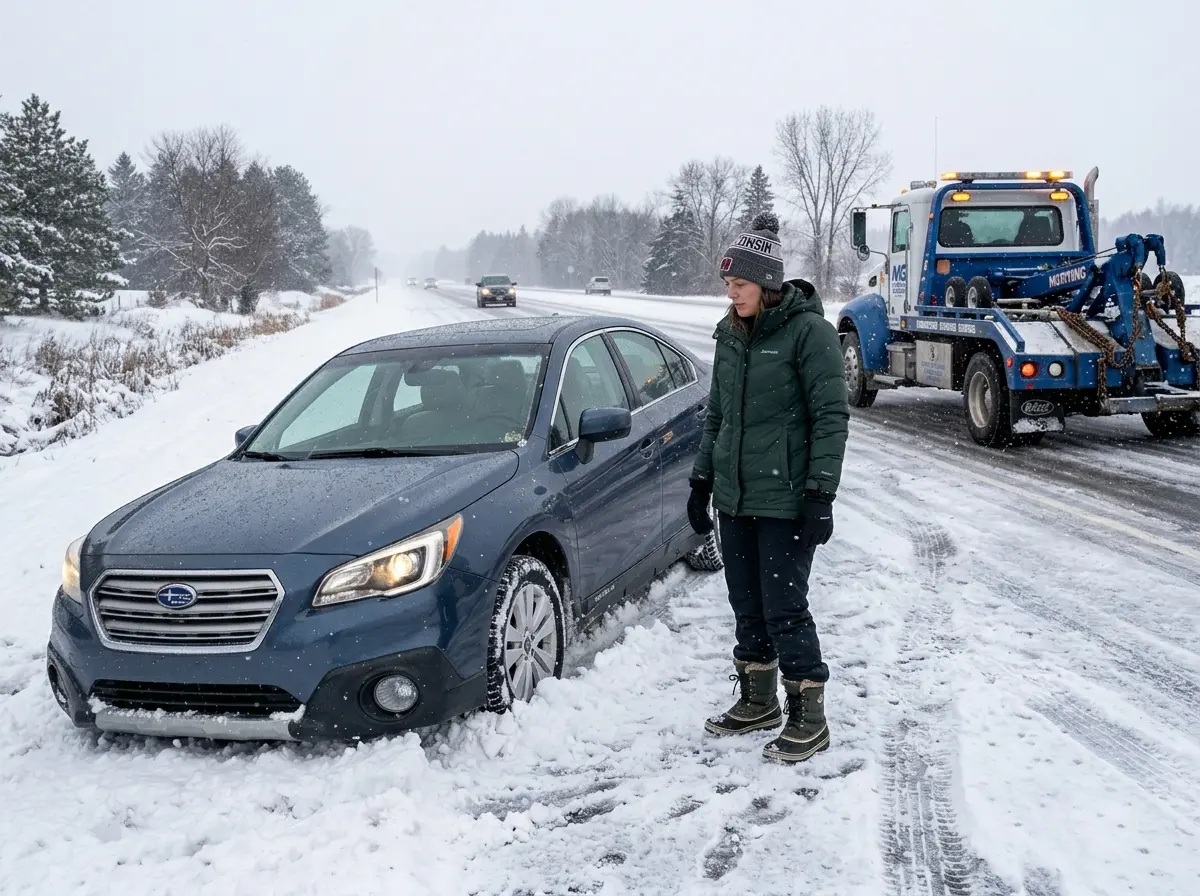
Every winter, thousands of Wisconsin drivers end up with a car stuck in snow, in a parking lot, on a residential side street that has not been plowed, in a ditch after losing traction on a curve, or simply buried at the curb overnight by a passing plow.
Getting stuck in snow is frustrating, and in the wrong circumstances it can become genuinely dangerous. Knowing exactly what to do in the first moments after your vehicle becomes stuck and knowing the difference between situations you can self-recover from versus those that require professional snow recovery services can save you from hours of cold, costly damage to your drivetrain, and dangerous roadside exposure in a Wisconsin winter storm.
This guide covers everything Wisconsin drivers need to know: the immediate steps when you find yourself stuck, self-recovery techniques that work and ones to avoid, when to call for professional vehicle recovery, winter driving prevention tips, and what professional emergency snow vehicle recovery costs in Milwaukee. Read it before winter. Keep it bookmarked for the season.
Related Articles:
Ran Out of Gas on a Milwaukee Highway? Here’s What to Do
What to Do If You Get a Flat Tire on the Road?
Why Getting Stuck in Snow Is a Serious Situation?
It Happens Faster Than You Expect
One moment you are driving down a side street or pulling into a parking space, and the next your wheels are spinning freely while the car goes nowhere. Snow getting stuck situations happen surprisingly quickly in Wisconsin. Fresh, heavy snow accumulates faster than roads and lots are plowed. Ice beneath a thin layer of snow is invisible until your tires are already on it. And even experienced drivers misjudge the depth of a snowdrift or the softness of a shoulder.
The city of Milwaukee receives an average of 47 inches of snow annually, with the heaviest totals typically falling between January and February. Lake-effect snow events off Lake Michigan can dump several inches in just a few hours, catching drivers off guard even when they checked the forecast that morning.
The Real Risks of Being Stuck in a Wisconsin Winter
Beyond the inconvenience, a car stuck in snow during a Wisconsin winter carries real risks that escalate the longer the situation goes unresolved:
- Hypothermia becomes a real risk if you leave your vehicle or if it runs out of fuel. In sub-zero Wisconsin wind chills, it can become dangerous within minutes.
- Carbon monoxide poisoning is another serious concern. If your car is running and the exhaust pipe is buried in snow, deadly CO gas can build up inside the vehicle.
- You can also damage your drivetrain if you spin the wheels too aggressively trying to get unstuck. This can affect parts like the differential, CV joints, and transmission.
- There is also the risk of getting hit. A vehicle stuck on or near the road, especially at night or in low visibility, can be struck by passing traffic.
- Finally, trying to rock the vehicle or spin the wheels too much can make things worse. It often pushes the car deeper into the snow, making recovery more difficult and more expensive.
| Carbon Monoxide Warning: If you are waiting in a running vehicle that is stuck in snow, check that your exhaust pipe is completely clear of snow before running the engine. A blocked exhaust pipe causes deadly CO to accumulate inside the cabin. Check the pipe every 15 minutes if snow is still falling. If you feel dizzy, lightheaded, or nauseous, get out of the vehicle immediately regardless of the cold. |
Step-by-Step: What to Do the Moment You Get Stuck
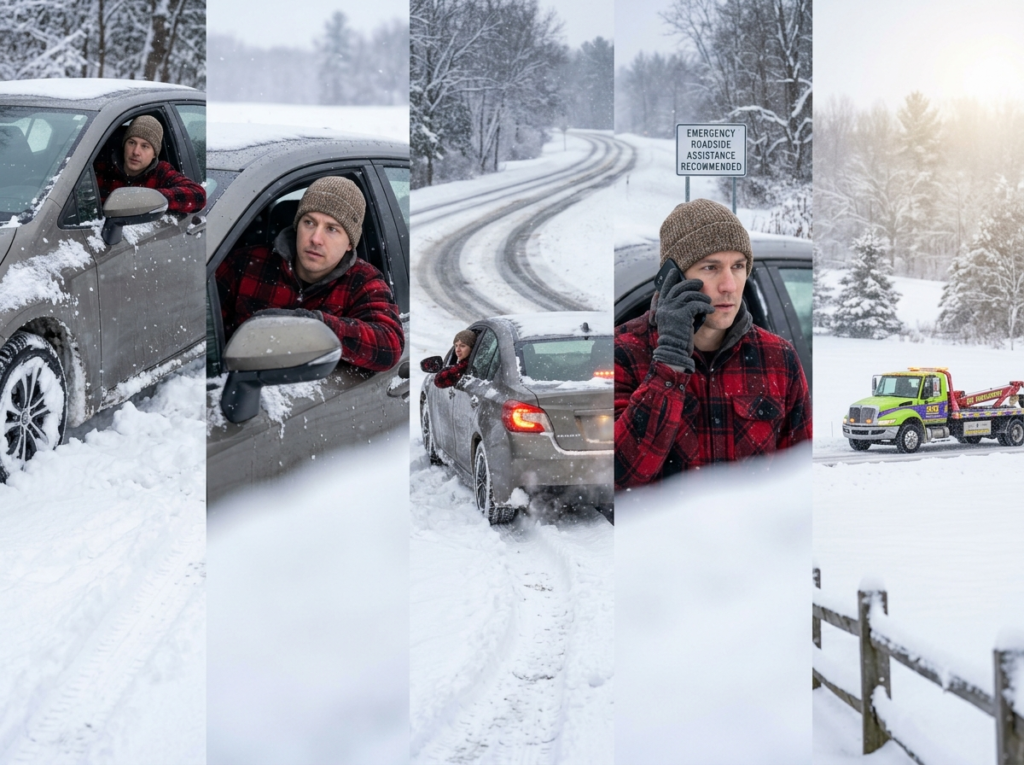
The first sixty seconds after your vehicle gets stuck in snow matter enormously. The actions you take or avoid in that window determine whether you dig yourself out quickly, wait for professional help efficiently, or make the situation significantly worse.
1. Stop Spinning Your Wheels Immediately
Stop spinning your wheels immediately. The instinct is to press the gas harder, but that only digs the tires deeper into the snow and can pack ice underneath, making it even harder to get traction. As soon as you feel the wheels spinning without moving forward, ease off the accelerator.
2. Assess the Situation Calmly
Take a moment to assess the situation calmly. Check how deep the snow is, whether all four wheels are stuck or just the drive wheels, and whether you are on flat ground or a slope. Also consider how close you are to traffic. Spending a few seconds understanding the situation will guide your next steps.
3. Turn On Hazard Lights for Safety
Turn on your hazard lights right away, especially if you are near a road or in an area where other vehicles could approach.
4. Check for a Clear Exhaust Pipe
Before letting the car idle for heat, step out and make sure the exhaust pipe is completely clear of snow and ice. A blocked exhaust can be dangerous.
5. Try Gentle Rocking if Conditions Allow
If the snow is shallow, you can try a gentle rocking motion. Slowly shift between Drive and Reverse while applying light throttle. This can sometimes help the vehicle break free if it is only lightly stuck.
6. Use Traction Aids if Available
If you have traction aids like sand, cat litter, or traction mats, place them in front of the drive wheels to improve grip.
7. Clear Snow Around the Tires
If it is safe, clear snow from around the tires and underneath the vehicle. A small shovel can make a big difference by giving the tires space to move and regain traction.
8. When to Stop and Call for Help?
If the vehicle does not come free after two or three attempts, stop trying. Continuing to spin the wheels will only make things worse. At that point, it is best to call for professional snow recovery assistance.
| The Two-Attempt Rule: Give yourself two to three careful attempts to self-recover using the techniques in this section. If the vehicle does not come free within those attempts, continuing will almost always make things worse deeper ruts, compacted ice under the tires, potential drivetrain damage. At that point, calling for professional snow recovery in Milwaukee is the right move. Time spent waiting for a professional is far less costly than an hour of wheel-spinning that buries you to the axles. |
Self-Recovery Techniques That Actually Work
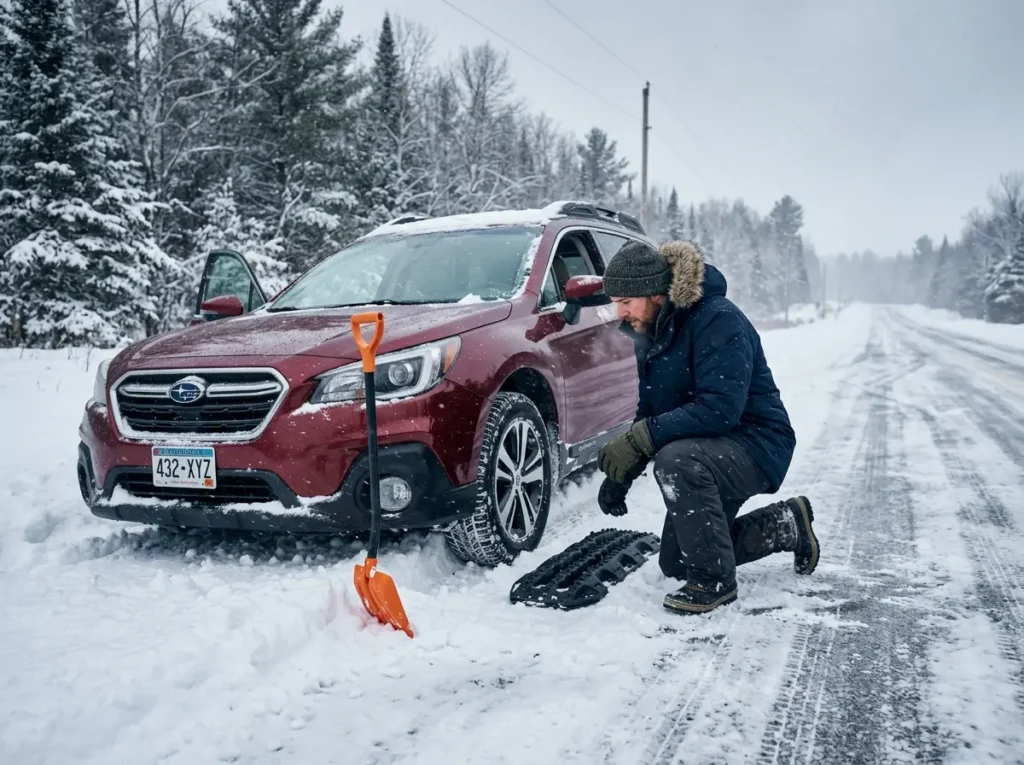
Not every stuck-in-snow situation requires a tow truck. For mild to moderate snow entrapment on flat ground, several self-recovery techniques genuinely work, as long as they are applied carefully and in the right order.
The Rock-and-Release Method
The rocking technique is the first thing most drivers try and, when done correctly, it does work for shallow stuck situations. The goal is to build momentum by alternating gently between Drive and Reverse, using the vehicle’s own weight to compact and push aside the snow.
The key word is gently. Use the lightest possible throttle, just enough to move the vehicle a few inches in each direction. Shift between gears only when the vehicle has stopped moving in the current direction.
The moment you feel traction, apply smooth, consistent throttle to carry the momentum out of the stuck position. Do not jerk the wheel or apply sudden acceleration.
This technique works well on loose, fluffy snow. It is much less effective on packed snow or ice, and it should be abandoned after three to four cycles if the vehicle is not making progress.
Traction Aids: Sand, Cat Litter, and Traction Mats
Placing traction-improving material in the path of your drive wheels is one of the most effective self-recovery techniques available. Sand and non-clumping cat litter both work by creating a grippable surface between the tire and the slippery snow or ice beneath it.
Place the material directly in front of and slightly under the drive wheels. For front-wheel-drive vehicles, this means the front tires. For rear-wheel-drive vehicles, the rear. For AWD and 4WD, placing material at all four wheels improves your chances. Apply enough material to fill the rut the tire has dug, then try the rocking method again with gentle throttle.
Dedicated traction mats, rubber or plastic devices that wedge under the tire and grip the road, are even more effective than sand or litter and reusable. Every Wisconsin driver should carry a set from November through March.
Shoveling: The Most Reliable Self-Recovery Tool
A small collapsible shovel is the single most useful tool you can carry in a Wisconsin winter. Clearing snow from in front of and behind the drive wheels and if necessary, clearing a path of several feet in the direction you want to travel, gives your vehicle the best possible chance of self-recovery without professional help.
When shoveling, focus on: the area immediately in front of and behind each drive tire, the snow packed against the undercarriage (which creates drag), and the snow bank blocking your intended direction of travel. Even on a very cold day, fifteen minutes of focused shoveling often frees a stuck vehicle without any need for recovery services.
Reducing Tire Pressure Slightly
In a genuine off-pavement stuck situation on deep snow, experienced winter drivers sometimes slightly deflate their tires to around 20 to 22 PSI from a normal 32 to 35 PSI to increase the tire’s contact patch and improve traction. This technique is borrowed from off-road driving and works best in deeper snow conditions.
Important caveat: if you do this, do not drive on roads at reduced pressure, and re-inflate as soon as you are free using a portable tire inflator. Driving at significantly reduced pressure on pavement damages tires and reduces handling dramatically.
What NOT to Do When Stuck in Snow?
- Do not spin your wheels aggressively because this will only dig your vehicle deeper into the snow and create heat that can melt the snow into ice under the tires, making traction even worse.
- Do not floor the accelerator repeatedly. It will not help you get unstuck and can lead to unnecessary strain or damage to your drivetrain.
- Do not attempt to push the vehicle by yourself on a slope. There is a serious risk that the vehicle could roll back and cause injury.
- Do not leave the vehicle running unattended for long periods without checking that the exhaust pipe is clear of snow, as a blocked exhaust can be dangerous.
- Do not stand directly behind the vehicle in a traffic lane while trying to recover it. In snowy conditions, approaching drivers may have reduced visibility and limited stopping distance.
When to Call for Professional Snow Recovery Services?
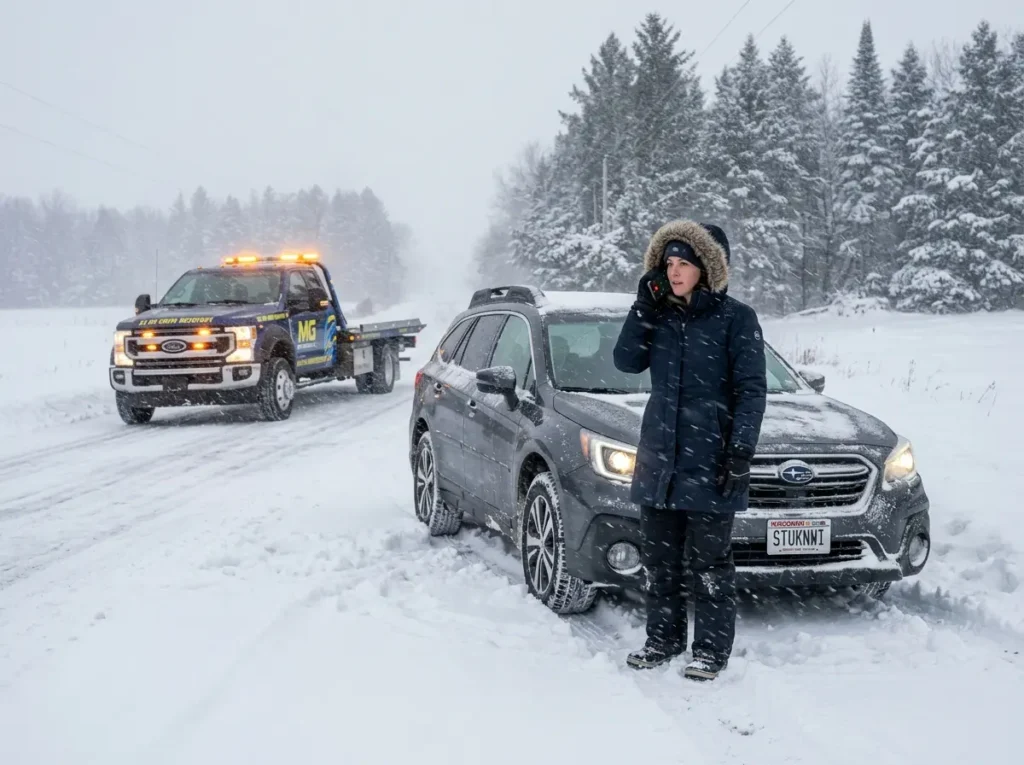
Self-recovery is appropriate for mild stuck situations on flat ground with adequate tools. But there are many snow entrapment scenarios common in Wisconsin winters where calling for professional vehicle recovery is the correct choice from the start. Recognizing these situations saves time, prevents vehicle damage, and keeps you safe.
Call for Professional Snow Recovery When:
- The vehicle is stuck in a ditch, embankment, or sloped area, and recovery in this situation typically requires winching equipment and trained operators rather than a simple push.
- The vehicle is buried deeply in snow above the wheel wells. At this level, self-recovery is rarely successful, and continued attempts can easily cause damage.
- All four wheels are completely unable to gain traction, even after using shovels or traction aids.
- The vehicle is in or near a travel lane and is creating a traffic hazard.
- You are in a remote location with no other vehicles or people available to assist.
- The weather is getting worse, and waiting to see if the situation improves is not safe.
- You do not have the right tools available, such as a shovel, traction mats, or other drivers to help push the vehicle.
- The vehicle has visible damage from the incident, such as a hard impact with a curb, a damaged bumper, or it is sitting at an unusual angle.
How Professional Snow Recovery Works?
Professional snow recovery in Milwaukee uses specialized equipment and trained operators to extract vehicles that cannot self-recover. The most common tool is a winch — a motorized cable system mounted on a tow truck or recovery vehicle that attaches to your vehicle’s frame at designated recovery points and pulls it free of the snow.
A winching service for stuck vehicles is carefully controlled — the operator chooses attachment points, controls the cable tension, and guides the vehicle’s direction of travel as it is extracted. For vehicles in ditches, on slopes, or buried at unusual angles, additional equipment such as a rotator crane or a second recovery vehicle may be used.
The extraction process typically takes fifteen to forty-five minutes depending on how deeply the vehicle is stuck and the terrain. A professional operator will also assess the vehicle for any damage caused by the stuck event before clearing the scene.
Snow Recovery vs. Towing: Which Do You Need?
Snow recovery and towing are related but different services. Snow recovery, also called vehicle extraction or winching, frees the vehicle in place so it can be driven away. Towing moves the vehicle from one location to another. In many stuck-in-snow scenarios, recovery is all that is needed: the vehicle is extracted, inspected, and driven home.
Towing becomes necessary when the vehicle sustains damage during the stuck event that makes it unsafe to drive, when the vehicle is stuck in a location that cannot be reached by a standard recovery vehicle, or when the driver needs the vehicle transported to a repair facility after extraction. MG Towing & Recovery provides both snow recovery services and emergency towing in Milwaukee, so one call handles whichever service or combination of services your situation requires.
| MG Towing & Recovery Snow Recovery: Our team operates winter recovery services across Milwaukee year-round, with 24/7 availability throughout Wisconsin’s snow season. Our tow trucks and recovery vehicles are equipped with winches rated for all vehicle sizes, and our operators are experienced in safe extraction from ditches, snow banks, parking lots, and ice-covered surfaces. One call is all it takes. |
Stuck in Snow in Milwaukee? Call Us Now. MG Towing & Recovery – 24/7 Snow Recovery & Emergency Towing, Milwaukee. Call Now: 414-973-1902
Staying Safe While Waiting for Help
Once you have called for professional snow recovery service or emergency towing in Milwaukee, you may have a wait of thirty minutes to an hour or more depending on demand during a storm event. How you manage that wait time is a genuine safety consideration in Wisconsin winter conditions.
Stay Inside the Vehicle When Possible
Your vehicle provides shelter from wind, snow, and cold. In most stuck-in-snow situations, staying inside the vehicle with the doors locked is the safest choice. The interior temperature of a running vehicle assuming the exhaust is clear, is far more comfortable and safer than standing outside in Wisconsin winter conditions.
Make yourself visible: keep hazard lights on, and if you have them, deploy reflective triangles or road flares around the vehicle. In heavy snowfall or at night, a roadside safety setup around your vehicle is essential for alerting approaching traffic.
If You Must Leave the Vehicle
If your vehicle is in an unsafe location, in a live traffic lane, on a bridge with no shoulder, or in a situation where remaining inside poses more risk than exiting, leave the vehicle from the side away from traffic.
Move to a safe distance from the roadway and find a location with some shelter from the wind: behind a guardrail, inside a nearby business, or at minimum on the far side of a solid barrier.
Never walk along a highway in a snowstorm. Visibility is poor, drivers cannot see you from distance, and the road surface is treacherous. Walk to the nearest exit, rest area, or business and wait inside.
Managing Cold While Waiting
Wisconsin wind chills can make exposed skin feel sub-zero even when the thermometer reads 20 degrees. If you are waiting for recovery service, conserve warmth proactively:
- Run the engine in short intervals to stay warm instead of keeping it running continuously, and always check that the exhaust pipe is clear of snow before each time you start it.
- If you have an emergency blanket in your winter kit, use it right away to help retain body heat.
- Put on every layer of clothing available in the vehicle to trap warmth and reduce heat loss.
- If you are outside, keep your body gently moving instead of standing still, since light movement helps maintain circulation and body temperature.
- Eat any non-perishable snacks you have on hand, because food gives your body calories that help generate heat.
- Conserve your phone battery by limiting usage and turning on airplane mode between necessary check-ins to make it last longer.
Roadside Safety During a Snowstorm
The roadside environment during a Wisconsin snowstorm is one of the most dangerous places for a stranded driver to be. Visibility is low, road surfaces are unpredictable, and other drivers may be struggling with their own traction and steering. Applying roadside safety during a snowstorm means treating every passing vehicle as a potential hazard and positioning yourself accordingly.
- Stay behind guardrails whenever possible when outside the vehicle.
- Wear bright or reflective clothing if you have it, a bright jacket or reflective vest dramatically increases your visibility to other drivers.
- Do not stand in or near the path of your vehicle, if another vehicle hits yours, it could push your car into you.
- Keep your phone charged and the recovery service’s contact number easily accessible.
Snow Recovery and Emergency Towing Costs in Milwaukee
Understanding what professional snow recovery and emergency towing costs in Milwaukee helps you make informed decisions and avoid being overcharged during a stressful situation.
| Service | Typical Cost Range | Notes |
| Vehicle extraction / winching (basic) | $75 – $150 | Straightforward parking lot or driveway recovery |
| Ditch recovery (shallow) | $100 – $250 | Requires winch, some equipment setup |
| Deep ditch or embankment recovery | $200 – $500+ | Complex angle, multiple equipment required |
| Rotator or crane-assisted recovery | $350 – $800+ | Rollover or severe off-road situations |
| Local tow after extraction (under 10 miles) | $100 – $200 | If vehicle cannot be driven post-recovery |
| After-hours winter emergency surcharge | $25 – $75 extra | Nights, weekends, peak storm periods |
| Heavy-duty snow recovery (trucks/SUVs) | $150 – $400+ | Larger vehicles require more equipment |
Is Snow Recovery Covered by Insurance?
Many Milwaukee drivers do not realize that snow recovery may be covered by their existing auto insurance or membership programs. Here is a quick guide:
- Roadside assistance endorsement on your auto policy typically includes vehicle extraction from snow as part of its towing and recovery coverage, usually up to a set dollar amount or mileage limit.
- AAA membership also provides vehicle extraction through its roadside assistance benefits, and higher-tier plans often cover more complicated recovery situations.
- Comprehensive auto insurance generally does not specifically include snow recovery, but it may cover towing if your vehicle is damaged.
- Some premium credit cards also offer roadside assistance benefits that can include vehicle extraction, but it’s important to review your card’s benefit guide to confirm the exact coverage.
Even if coverage exists, response times through national programs can lag during peak storm periods. Many Milwaukee drivers call MG Towing & Recovery directly for the fastest local response and submit receipts for reimbursement afterward.
Winter Driving Safety Tips: Avoiding Getting Stuck in the First Place
The most effective snow recovery strategy is the one you never need. Experienced Wisconsin winter drivers develop habits and practices that dramatically reduce their chances of getting stuck in the first place. Here is what works.
Before You Drive in Winter Conditions
- Check the forecast before every trip. Lake-effect snow events and ground blizzard conditions can develop quickly in Milwaukee, so knowing what’s coming gives you the option to delay your trip or choose a safer route.
- Clear your entire vehicle of snow before driving, not just the windshield but also the roof, hood, trunk, and all lights. Snow blowing off your vehicle can create serious hazards for other drivers and is also a ticketable offense in Wisconsin.
- Check your tire pressure regularly. Cold weather typically reduces tire pressure by about 1 PSI for every 10-degree drop in temperature. Underinflated tires reduce traction and increase the risk of damage.
- Know your vehicle’s drive system. Front-wheel drive, rear-wheel drive, all-wheel drive, and four-wheel drive all behave differently in snowy conditions, and understanding your setup helps you react better in low-traction situations.
- Make sure your winter emergency kit is fully stocked and easily accessible in your vehicle.
How to Drive on Snowy Roads in Wisconsin?
Driving safely on snowy roads in Wisconsin is a skill that develops over time, but it rests on a set of principles that every driver can apply from day one:
- Slow down. Posted speed limits are designed for ideal driving conditions. In snow or icy weather, you should drive significantly slower even on roads that have been plowed.
- Increase your following distance dramatically. A safe gap in snowy conditions is typically three to four times greater than normal, and on icy roads it may need to be even more.
- Accelerate and brake gently. Smooth, gradual inputs help prevent wheel spin and skidding much more effectively than sudden or aggressive movements.
- Look farther ahead than you normally would. This helps you anticipate stops, turns, and intersections early so you can slow down in a controlled way instead of braking hard at the last moment.
- Avoid using cruise control in winter conditions. You need full manual control of the throttle to quickly adjust to changing traction on slippery roads.
- Do not stop unnecessarily on hills. Keeping steady momentum is important when driving uphill in snow because stopping on a slope can make it very difficult to start moving again.
How to Drive in Heavy Snow: Special Considerations
Heavy snow, falling at rates that reduce visibility and accumulate faster than plows can clear, requires an even more conservative approach than ordinary winter driving. During a heavy snowstorm in Milwaukee or on Wisconsin highways:
- If conditions become severe enough that you cannot see clearly or maintain control, pull off the road completely at a safe location and wait for conditions to improve, arriving late is far better than not arriving.
- Avoid side streets and residential roads during or immediately after heavy snowfall, these are the last to be plowed and are where most vehicles get stuck.
- Stick to main roads and highways that are plowed and salted regularly.
- Reduce speed even further in unplowed lanes, the snow depth and hidden road conditions under fresh snow are unpredictable.
- Give plow trucks maximum space, they are doing critical work, they move slowly, and the snow they throw can reduce your visibility to zero instantly.
Your Wisconsin Winter Emergency Kit
Every Wisconsin driver should keep a winter emergency kit in their vehicle from late October through April. The following items have proven their value in real-world stuck-in-snow and winter roadside emergency situations:
- Compact collapsible shovel, the single most important self-recovery tool for stuck vehicles
- Traction mats or a bag of sand or non-clumping cat litter
- Jumper cables or a portable jump starter battery pack
- Warm blanket and extra gloves, hat, and socks
- Ice scraper and snow brush
- Portable 12-volt tire inflator
- Flashlight or LED headlamp with spare batteries
- Reflective warning triangles or road flares
- Non-perishable snacks and water
- First aid kit
- Phone charging cable and portable power bank
- Windshield washer fluid rated for sub-zero temperatures
- MG Towing & Recovery’s contact number saved in your phone for 24/7 Milwaukee snow recovery
Frequently Asked Questions: Stuck in Snow in Wisconsin
How long should I try to self-recover before calling for help?
Apply the two-attempt rule: two to three careful tries using gentle rocking, shoveling, and traction aids. If the vehicle does not come free within those attempts, stop and call for professional snow recovery service. Continuing beyond that almost always digs you deeper, wastes time, and risks drivetrain damage.
What is the fastest way to get snow recovery help in Milwaukee?
Call a local Milwaukee snow recovery provider directly. Local companies dispatch from within the city and know Milwaukee’s streets and winter conditions intimately. MG Towing & Recovery provides 24/7 winter roadside assistance and snow recovery across Milwaukee with local dispatch, faster response times than national programs routing through out-of-area call centers, especially during high-demand storm events.
Can I damage my car by trying to free it from snow myself?
Yes. Aggressive wheel spinning can damage differentials, CV joints, and transmission components. Rocking the vehicle too forcefully can strain drivetrain mounts. And attempting to push or tow the vehicle improperly can damage the bumper, tow points, and frame. Stick to gentle, controlled self-recovery attempts and call a professional if they do not work quickly.
Is AWD better than FWD or RWD in snow?
AWD and 4WD systems provide better traction for getting moving in snow than FWD or RWD alone. However, AWD does not improve braking or cornering on ice, and AWD vehicles get stuck in deep snow just like any other vehicle. AWD is an advantage in typical Wisconsin snow conditions but is not a substitute for appropriate tires, controlled speed, and good winter driving habits.
What if my car gets stuck on a Milwaukee highway during a snowstorm?
If you get stuck on I-43, I-94, I-894, or another Milwaukee-area highway during a snowstorm, turn on your hazard lights immediately and, if possible, move the vehicle as far toward the right shoulder as you can. Stay inside the vehicle with your seatbelt on.
Call 911 if you are in a dangerous position blocking traffic, and call MG Towing & Recovery for emergency snow recovery. Wisconsin DOT Highway Helpers also patrol major Milwaukee highways and can assist with snow recovery situations.
Prepared Is Better Than Stuck
Getting stuck in snow in Wisconsin is not a matter of if, but when, and how prepared you are when it happens. Every winter, Milwaukee and surrounding areas see thousands of stuck vehicles, from quick parking lot recoveries to long ditch extractions during heavy storms.
Prepared drivers keep a shovel and traction aids in their trunk, maintain proper tire pressure, understand basic self-recovery limits, and have a trusted towing number saved in advance.
MG Towing & Recovery provides 24/7 snow recovery and emergency towing across Milwaukee and nearby Wisconsin areas. Our equipment handles everything from simple pullouts to full winch recoveries, helping you get back on the road quickly and safely all winter long.